


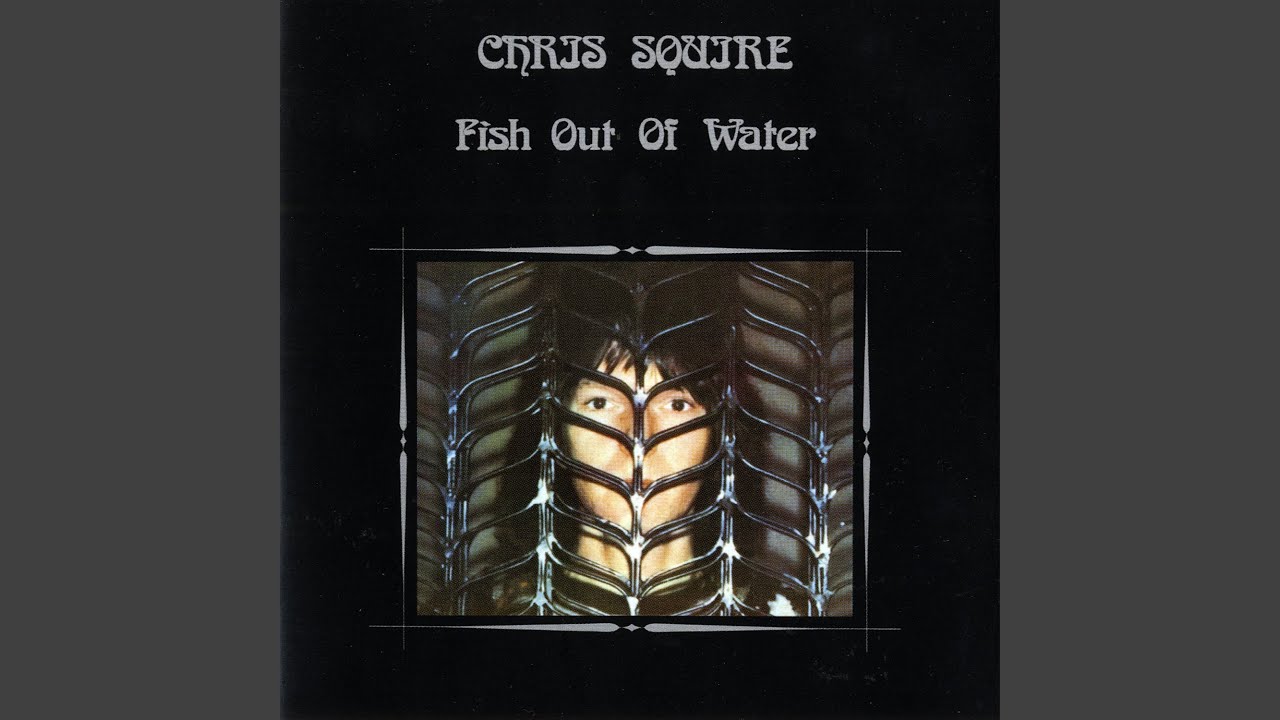
Between 1975 and 1976 the five members of Yes took time out to focus on solo endeavours. One of the results was the late Chris Squire’s remarkable Fish Out Of Water. In 2018 Prog spoke to the people who were there as the album took shape.
Chris Squire is checking the time and he’s smiling. It’s long gone midnight, deep within St Paul’s Cathedral, where he’s watching recording engineer Gregg Jackman and a couple of assistants placing microphones and checking levels. Advising them as to the best spots within the vast, resonant building is Barry Rose, the newly appointed sub‑organist who’s about to play the third-largest pipe organ in Europe. Joining Rose at the keyboard, Andrew Pryce Jackman, Gregg’s brother, goes over the details of the score he’s written.
The scene leads Squire to recall when he and the Jackman brothers were choristers at St Andrew’s Church in Kingsbury. Under the direction of choirmaster Rose they’d even performed in this very building. Now, in the early hours of a summer morning in 1975, here they all are once again, old friends reunited in the making of Squire’s first solo album. The moment feels special.
There’s a count in, the backing track of Hold Out Your Hand fills the headphones, and Rose begins to play. Squire suppresses a deep chuckle of delight as the jubilant ascending chords fill the air of this cavernous, sacred space. In his head he finds the lyrics especially apt: ‘You can feel it coming/With the morning light/And you know the feeling’s/Gonna make you feel all right.’ As the rhapsodic arpeggios and lines ripple and reverberate out from the pipes around the building, the boy who grew up in Salmon Street – known to his bandmates and millions of fans around the world as The Fish – is in his element.
It’s sometimes easy to forget the velocity at which Yes travelled in the early 1970s, when A dizzying schedule of increasingly larger tours and more prestigious venues followed each new album. Despite being locked into an apparently eternal treadmill, the creative bar was incrementally raised from 1971’s The Yes Album through to 1974’s Relayer. Even allowing for the critical backlash and controversy surrounding 1973’s Tales From Topographic Oceans, they maintained their reputation as the most innovative and ambitious band of their generation.
In this context, the novel idea that all five members of the group should record separate solo albums, to be released over the course of a year, could be viewed as either audacious – or the hubris of over-inflated ego. Executives at Atlantic Records were underwhelmed, worrying (perhaps understandably given the volatile nature of the line-up) that Yes were in danger of diluting a highly successful formula.
For Squire, the trappings of that success provided him with New Pipers in 1972, a sprawling mansion at Virginia Water in Surrey; and later, like any self-respecting member of rock’s aristocracy, the installation of a bespoke recording studio in the basement. It was here, between tours, that Fish Out Of Water slowly took shape.
It might have been assumed that any Squire solo album would be an elaborate showcase for his bass playing, using The Fish (Schindleria Praematurus) from Fragile as a template. Yet the core of the album was composed at the piano, in the company of his old friend and former bandmate in The Syn, Andrew Pryce Jackman. His skill as an orchestral arranger meant he who could make a reality of whatever vision Squire conceived.
Andrew’s brother Gregg remembers being called to work on the album after Eddy Offord became unavailable. “I was 21 years old, and really not experienced enough to be doing this record,” he says, “but the young have a brave heart, so I gave it my best shot. Andrew and Chris always seemed to have faith in me.”
The young engineer also recalls that the sessions weren’t held at regular hours. “Chris was the only bloke I ever knew who could be late in his own house. I would turn up with Andrew at maybe midday and we’d find things to do until Chris decided to get into the studio – which might be as late as seven in the evening.”

Bill Bruford, who’d quit Yes for King Crimson in 1972, was playing drums for the album. Following Robert Fripp’s unilateral decision to disband the group in 1974, he’d been enjoying life as a peripatetic drummer, and he was delighted to be hired by his old bandmate. “Chris was really my first bass player, as it were,” he says. “So I didn’t really know what bass players did or what they might want to do. I didn’t think it weird at all that he seemed to be adopting a rather plectrumy, trebly sound on his bass, and that he wanted it to be as predominant as a guitar part.
“He became very good at counterpoint, so the bass parts had a life of their own. They were something you could sing or hum along to in their own right. You’re supposed to have this empathetic relationship with the bass player – but that’s a very old fashioned idea that comes along with words like ‘gig’, ‘pad’, ‘charts’ and ‘rhythm section’. I’m not sure I ever thought I was in a rhythm section much, and I don’t think Chris did either.”
Chris created momentum – he set the bar for each of us to come up with a solo album that was as good as his
Patrick Moraz
Bruford’s part in the recording began at the end of February 1975, extended over 13 sessions in March and then a final four in early April. He recalls the material was very malleable. “It was just like a Yes record; there weren’t any bits of paper. Chris played me a bit of a song and I said, ‘Well, I could do this’ – the usual kind of thing. We only knew one way of working together. Andrew was effectively the musical director and he would have been noting bits down because he knew he was going to have to orchestrate it all later. So we did have a real musician present, thank God!”
Another visitor to New Pipers was Yes keyboardist Patrick Moraz, who drove in from the rat-plagued basement flat that he rented in Earl’s Court, just as he’d done during the making of Relayer. Squire had a certain presence, says Moraz: “He had a kind of ‘halo’ around him, if I can put it like that. As quiet as he could be compared to Jon or Steve, he was extremely forthright in telling you what he wanted from you. His instructions could bes meticulous in terms of the arrangement, the sound, the balance and so on.”
Moraz’s incendiary Hammond solo on Silently Falling – judged by Squire to be “one of the best I’ve heard” – was, like his idea to play Minimoog bass, ample proof of his inspired contributions to the process. As proud as he is about his work on the record, he has one regret: that the album didn’t lead on to a further collaboration. “There was an inspirational empathy between Bill, Chris and myself, you know?”
Although Moraz and Bruford would later work together, touring and producing two albums together in the 80s, Moraz sees a follow-up to Fish as the project that got away. “If only we’d been able to do a trio album, just the three of us. Man, it could have been absolutely unbelievable. Unbelievable!”
Back on the road, the members of Yes played their individual works-in-progress to each other. Moraz, who also worked on Howe's Beginnings, says it had a galvanising effect. “What Chris did was create a kind of momentum – he set the bar for each of us to come up with a solo album that was as good as his.”
I know the sessions were tortuously slow sometimes, but that’s because they were striving for perfection. It was worth it
Steve Nardelli
From the exuberant St Paul’s organ lines of Hold Out Your Hand, the pastoral interludes within You By My Side, the driving rock that merges into a Beatlesesque coda on Silently Falling, Lucky Seven’s jazzy undertow and the surging romanticism of Safe (Canon Song), with its orchestral splendour and spectral phase-shifted comedown, the range and reach of Fish Out Of Water is impressive. Arriving at a time when extended musicality was an integral part of the progressive rock landscape, it’s an album that not only holds its own next to any albums by Yes’ contemporaries – but also towers above the other solo releases of his bandmates.
Released a month after Howe’s Beginnings in November 1975, Fish Out Of Water found its way into the charts on both sides of the Atlantic. While Squire’s virtuosic playing is evident, it’s always serving the needs of the music rather than dominating centre stage. “Those were really pioneering days – none of us knew exactly what we were doing,” Squire remarked in 2007.

Hearing the notes leap from the pages of Pryce Jackman’s notation was a revelation as the bassist watched his friend conducting the orchestra at Morgan Studios. “Being able to write it down on the manuscript and just know what it sounded like by looking at it was amazing,” He said. “Although later I met people who could do it, Trevor Rabin being one of them, Andrew was the guy I grew up with and I thought, ‘God, it’s amazing he can actually do this!’”
Perhaps not surprisingly given their close working relationship, Squire offered Pryce Jackman co-writing credits for the record – but he politely declined. “Andrew never promoted himself and you’d never see articles in the press about him,” says Steve Nardelli, vocalist with The Syn. “He wouldn’t have cared about getting credit. He was really pleased with the outcome. I know the sessions were tortuously slow sometimes, but that’s because they were striving for perfection. It was worth it; I think it’s one of the greatest albums ever made.”
Brimming with a confidence that comes from being at the very top of his game, the blending of pop, classical and rock music into one coherent, thematic statement remains a considerable achievement with which Squire was immensely proud. There was talk of a follow-up, though the endless touring cycle and increasingly internecine politics within Yes meant his priorities lay elsewhere.
The death of Pryce Jackman in 2003 robbed Squire of a dear friend, and the opportunity to create something with similar aspirations. Perhaps the fact that Fish Out Of Water is a one-off is the very quality that gives the album its remarkable presence and power.

