


Author's note: Author’s note: In the mid-80s Aerosmith went through rehab. All of them. Steven Tyler was the first to go, dragged in kicking and screaming. Joe Perry, the other half of the Toxic Twins, followed, then the rest of them one by one. This was a time when a wave of musicians, from Ringo to Stevie Ray Vaughan, were holed up in clinics. There was a joke doing the rounds that all the groupies were at the Betty Ford Centre because it was the only place to find a rock star.
As you might imagine, Tyler - who in his own words “snorted up half of Peru”- was not the least bit keen to go. But the drink and drugs were killing Aerosmith, and there were plenty of other bands out there, Guns N’ Roses for one, ready to take their place.
It was that last thing that did the trick. Aerosmith’s manager, Tim Collins, told them if they cleaned up he’d make them the biggest rock band in America. He brought in a professional interventionist to help. The band did as they were told and the manager kept his word. The first album they made sober, Permanent Vacation, sold five million copies in the US alone. Their next album, Pump, was bigger still: seven million copies sold. Two monster hits in a row.
I’d wondered what life without coke had done to their frontman. Nothing too damaging, it seemed. He was still loud and enthusiastic, if not quite as hyper. Then again, before our interview, he and Joe had been working out at the gym for two hours. Not bad for a 42 -year-old.

The cover of Aerosmith’s Pump album says it all: two trucks, great greasy hunks of metal, the same International Harvesters that the band used to haul their gear around the States in the 70s, reared up and fucking!
Twenty years after they first got together, Aerosmith are still the kings of slippery, sliding grungey rock, spiritual fathers and grandfathers of countless strutting, scarf-wearing rock bands. Permanent adolescents. It’s been a wild and bumpy ride – break-ups, shake-ups, shooting up – and in between some of the mega classic rock albums of the past two decades. Here’s their story…
Steven Victor Tallerico always looked like a whoopee cushion impaled on a pencil. The kids at school called him ‘‘n’ lips’. “My mom used to say my lips would be good for kissing the girls with.” Whatever. “Ever since I was a small dude I guess I always had this urge to show off… I wanted to prove myself.”
He was born in March 1948 and grew up in Yonkers, New York. But his summers were spent in Sunapee, New Hampshire, approximately 500 yards from the Middle Of Nowhere, but not too far from Boston, where his classical-pianist father owned a small holiday resort. In Sunapee, Steven weeded the lawns; in New York he ran with the Green Mountain Boys gang. At 16 he decided to compromise and turned to rock’n’roll. There was the band Chain Reaction, then The Strangeurs, who put a record out. When he met Joe Perry and Tom Hamilton, Steven was in a slick Beatles covers band.
Joe Perry, two years younger, came from Boston. His uncle played an acoustic guitar and Joe picked up on it, playing along with The Beatles, Roy Orbison, then R&B and garage rock. He got together with Tom Hamilton – a smalltown boy a year younger than him and a self-confessed “fanatical music fan; even the equipment trucks outside concerts would give me a big rush!” – in a group called The Jam Band.

In the summer of 1970, Steven Tallerico went to see them play. When they did Fleetwood Mac’s Rattlesnake Shake, “my dick went soooo hard!”
“I always liked to create mayhem,” said Perry, “and have unlimited energy and smash guitars and play fast loud rock’n’roll. That was the thing Steven liked about me when he first saw me. And Steven was into arrangements and getting things just right, they had to be perfect. That was the combination that made Aerosmith Aerosmith.”
Aerosmith were almost The Hookers at one point – Steven looked like one, dressed like one, wiggled his arse like one – and that was going to be their name, until Joey Kramer remembered the name he’d once doodled on his maths notebook in high school. Aerosmith. No one knew what it meant, but it sounded good, so that’s what they became: lead guitarist Perry, vocalist Tallerico, now Tyler, bassist Hamilton, drummer Kramer – from Yonkers, like Tyler, brought in because original drummer Tyler wanted to concentrate on singing – and second guitarist Ray Tabano, quickly replaced by Massachusetts-born Brad Whitford.
They moved into a cheap apartment in Boston, Perry and Tyler sharing bunk beds in one small room. “We ate a lot of brown rice in those days and Campbell’s Soup,” Tyler recalled. “Joe was a great cook,” Hamilton added. “He used to make these really good Japanese vegetables.”

Always “very ambitious”, they decided early on against playing the Boston club circuit and getting lost in endless sets of cover material, and lived on what they earned from day jobs – Tyler worked in a bakery, Perry was a janitor in a synagogue – and the money they made playing their own songs at college fraternity parties and dances.
“We used to play at Navy Officers clubs for all these straights,” Hamilton remembered. “We’d go in and play our stuff and rock out. And though they’d never heard the songs before, they knew damn well they could dance to them.”
“It was all the songs off our first album, One Way Street, Walking The Dog,” said Tyler, “if those aren’t dance songs I don’t know what are!”
There were no other bands around Boston doing what Aerosmith were doing back at the start of the 70s, playing original rock material. There were some blues bands, purist stuff, and that was it. It was “real tough”, said Perry. “We were playing our own stuff in high schools around the suburbs, because to play the city you had to play Top 40, and we didn’t.”

By the time their first, self-titled album came out in ’73 they were selling out every place they played. Their manager – who’d spotted their show at New York rock club Max’s Kansas City – got them the record deal in ’72. He turned up before one of their high school dates with a fist full of dollars and a contract from CBS that demanded two albums a year. (They managed half that many for the first four years.)
Aerosmith was recorded in a local Boston studio and included the now-classics Dream On (the ballad that came from Tyler tinkling on his dad’s grand piano in Sunapee) and Mama Kin. Guns N’ Roses liked the latter song so much they put it on their debut EP. Tyler liked it so much he had the title tattooed on his arm.
“We couldn’t get our stuff played on the radio,” Perry recalled. And MTV hadn’t even begun. So “we just had to get out and play”.
Their first tour for Aerosmith was opening for the highly inappropriate and cosmic jazz-fusion band Mahavishnu Orchestra. Guitarist-leader John McLaughlin used to demand a minute’s silence from the audience after their set to get his ‘vibes’ on the right astral plane. Aerosmith got there by taking any alcohol or chemical around.
The press wrote them off as second-rate Stones clones, pissing Stones fan Tyler right off. He told RAW magazine: “The Stones were a huge influence, I grew up on them. I smoked so many joints listening to their albums, fucked so many girls in high school. That was my whole youth, man! I spent it with the Stones.”
But as Tom Hamilton told Rolling Stone: “I think what we wanted to do, without really saying, was be the American equivalent of the great British bands. They were all so classy and powerful-sounding. We couldn’t think of an American band like that. We wanted to be the first one.”
Plus the Stones and Zeppelin and the rest weren’t touring all over America at the time. Aerosmith were. “We were America’s band,” said Perry, “the garage band that made it real big. The ultimate party band.”

By their second album (and first with Jack Douglas producing), Get Your Wings, they were beginning to make their name. But the big breakthrough came in the summer of ’75.
Next album Toys In The Attic, featuring Sweet Emotion, Uncle Salty and Walk This Way, spent two solid years in the US chart. Its follow-up Rocks – the album Slash credits with getting him to pick up a guitar – went double platinum. Back then no one went double platinum. They were packing out arenas and stadiums across the States, but visited Britain and Europe just once, in 1976, scared of getting mauled by sniffer dogs at Customs, what with their bodies being 99 per cent alcohol, heroin, hash and coke (Tyler made a quick visit to Germany in the mid-70s; customs officers found his stash of cannabis and arrested him).
The endless touring – meaning lots of money to buy lots of drugs and have lots of reasons and excuses for taking the lot of them – was taking its toll. Aerosmith, brought up in the 60s on the idea that “if you didn’t do all the drugs that you had you weren’t cool, and then there were all your rock’n’roll idols who were always out of their minds and you wanted to be like them”, did the rock’n’roll lifestyle thing to excess.
They had it all: rock-star mansions they didn’t live in because they were always on the road, sports cars they couldn’t drive because they were always banned, groupies they couldn’t fuck because the road crew always nicked them while Perry and Tyler were out chasing stuff to shoot up. Look at the photo of the band on the back of Toys In The Attic. Examine the complexion. Road scars!

“We never knew enough to stop touring,” said Tyler. “We just stayed on the road, and our vacation was in a little gram bottle…
“We spent the whole of the seventies on a treadmill. It was never like there was a tour. We’d stay on the road for a year and a half. The only time we’d come off was to record an album.”
Perry started taking heroin in ’76. At the time it was “a cool thing to do – it was okay to walk on stage and fall down. It was all part of the image”.
They did fall over onstage – Steven did anyway. In the video Live Texxas Jam ’78, during Same Old Song And Dance, when Tyler lets go of his mic stand he almost falls on his face. And this is that year’s biggest rock event. Another night Tyler fell off the stage and broke his ankle and didn’t even notice.
They often played the same song twice in the same set without realising. One night they went to the other extreme, decided to open with a song that they usually did at the end, figured the show must be over and walked off stage!
Back in the hotel room, Perry ran up the legendary $80,000 room-service bill.
“I once had three Porsches, and I sold them all so I could snort up half of Peru,” Tyler told RAW’s Mark Putterford. “I would have traded my nuts for a good ounce of heroin in those days!
“Drugs are fun. Once you’ve tried them you love them so much it turns bad on you.” What was once a laugh turned Aerosmith into a joke.
“I actually got offended by Spinal Tap,” Tyler told Phil Alexander, “cos I was so fucked up I was doing all the shit that was on there.”
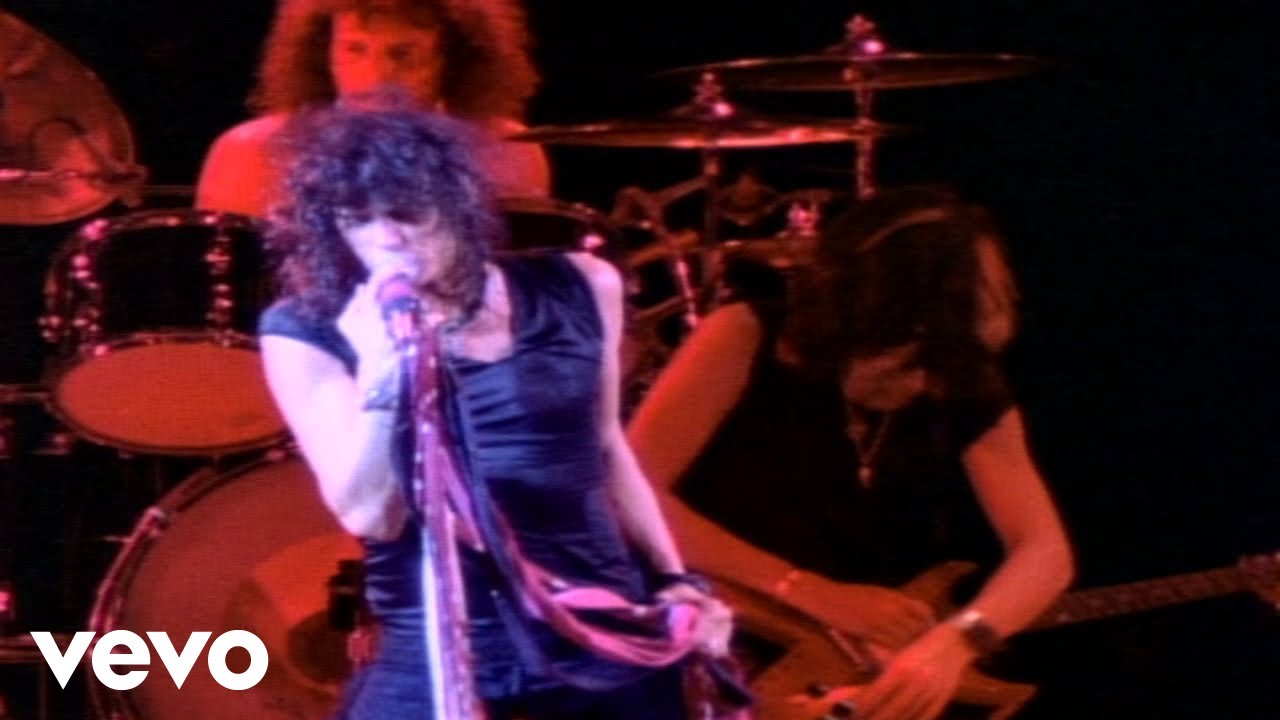
Their next album, 1978’s Draw The Line, took a year and a half and a million dollars to make. The band block-booked a studio in a converted monastery in the hope that their frontman would sober up enough to sing or write lyrics.
Tyler had demoed some songs on a tape, lost the tape on the way to the studio, and was too out of his head to remember how they went. Most of his time, apparently, he spent locked away in the monastery’s tower, shooting at targets with handguns, almost shooting himself when, in a stupor, he fell on his gun.
Things weren’t any better by the following year. Their record company released ‘Live Bootleg’; the band just about managed to make a cameo appearance in the execrable Sgt. Pepper’s Lonely Hearts Club Band movie and record a Beatles cover.
“We’d already done a couple of Beatles songs in our repertoire somewhere along the line,” said Tyler, “so it was really easy for us to get up there and do a song like Come Together. We just sat down and got drunk and did it in five takes.”
The film, its primary producer Robert Stigwood’s answer to The Who's Tommy, starred The Bee Gees and Peter Frampton. The screenplay required Tyler to be beaten in a fight by Frampton. “We went through that part of the movie carefully,” Hamilton told me at the time “and had them change it so it didn’t come off too much like Frampton directly overcoming Steven physically. He just lost his balance and fell.” As we know, a pretty frequent occurrence for Tyler.
“It was nothing to do with Peter Frampton that I lost,” Tyler exclaimed. “Nobody ever beats Aerosmith!”

But something was beating it. The Perry/Tyler relationship – which had always a volatile one (they’d had a fight the very first time they played together; Steven accused Joe of playing too loud) – was positively volcanic that year. Tyler pushed Perry during a guitar solo; Perry hit him in the mouth with his guitar neck. Money was running out, all of it having gone up their noses or their veins and liver.
The California Jam in 1978 was the biggest show of the year – 350,000 people bought tickets, a whole lot more got in for free, including me. I interviewed Tyler and Hamilton (Perry wouldn’t be in the same room as the singer) before the show. Tyler was piling cocaine up on the nostrils of a full-page photo of his own face in a Japanese magazine; the record company representative had all but given up!
Tyler recalls the Jam as “a blackout. I was kind of drifting in and out...”
Backstage, Tyler was moaning to his wife about Joe, Joe was moaning to his wife about Steven. The whole thing culminated in a huge punch-up at Cleveland Stadium, with the wives joining in.
“The drugs won,” said Tyler. “It made me say: ‘Fuck you, Joe!’ over a glass of spilt milk. Can you believe it? It was over a glass of spilt milk we broke up. His ex-wife threw some milk at Tommy Hamilton after a gig in the Midwest somewhere. It was the straw that breaks the camel’s back. It was a row about bullshit. We were so smacked out and drunk. All the pressures of the last ten years exploded.”
During the recording of Night In The Ruts, Joe Perry quit. He called Tom Hamilton and said: “It’s off. I’m going to stick to my solo thing. I can’t put up with it any more.”
“That was the last official word I said to the group. I never got a phone call from any of them. I got a telegram from Steven congratulating me on my ‘new vinyl’, quote. That’s it.”

I spoke to Perry on the release of that album, Let The Music Do The Talking. The Joe Perry Project included the unknowns Ralph Morman on vocals, David Hull on bass and drummer Ronnie Stewart. They were on a club tour of the States.
“It was like, I’ve been through it all,” Perry said. “I’ve played in front of 350,000 people, I’ve been in a rock movie, I’ve been to Europe, been to Japan, I’ve been through millions of dollars, I’ve wrecked expensive cars. I’ve done it all! It got to be so boring. Musically I was a fucking shell.
“I don’t feel any link with the band [Aerosmith] at all,” he said in 1980. “I’m proud of what I did with Aerosmith, and it’s a drag because it could have gone on to be fucking great. But it started getting dragged down and we lost our edge.”
He said later: “Basically, we had it all and then we pissed it all away.”
Perry’s first solo album sold a respectable quarter of a million.
Tyler, meanwhile, was in New York, living in a hotel room, doing street-bags of junk and eating doughnuts, “getting more fucked up”.
The following year, guitarist Brad Whitford left and put together Whitford St Holmes with ex-Ted Nugent singer Derek St Holmes. Their one album together didn’t set the world on fire. Neither, as it happens, did Perry’s two other Joe Perry Project albums: I’ve Got The Rock ‘n’ Rolls Again in ’81 and Once A Rocker Always A Rocker in ’83.
Tyler “just wanted to keep Aerosmith together”, so he brought in replacements for Perry and Whitford: Jimmy Crespo and Rick Dufay. “I pretended that Jimmy Crespo was Joe Perry,” said Tyler, “but the reality was he wasn’t.”
The one album the new lineup recorded, Rock In A Hard Place, had its moments, but it didn’t sell. “People didn’t buy it, because Joe Perry wasn’t there,” said Tyler.
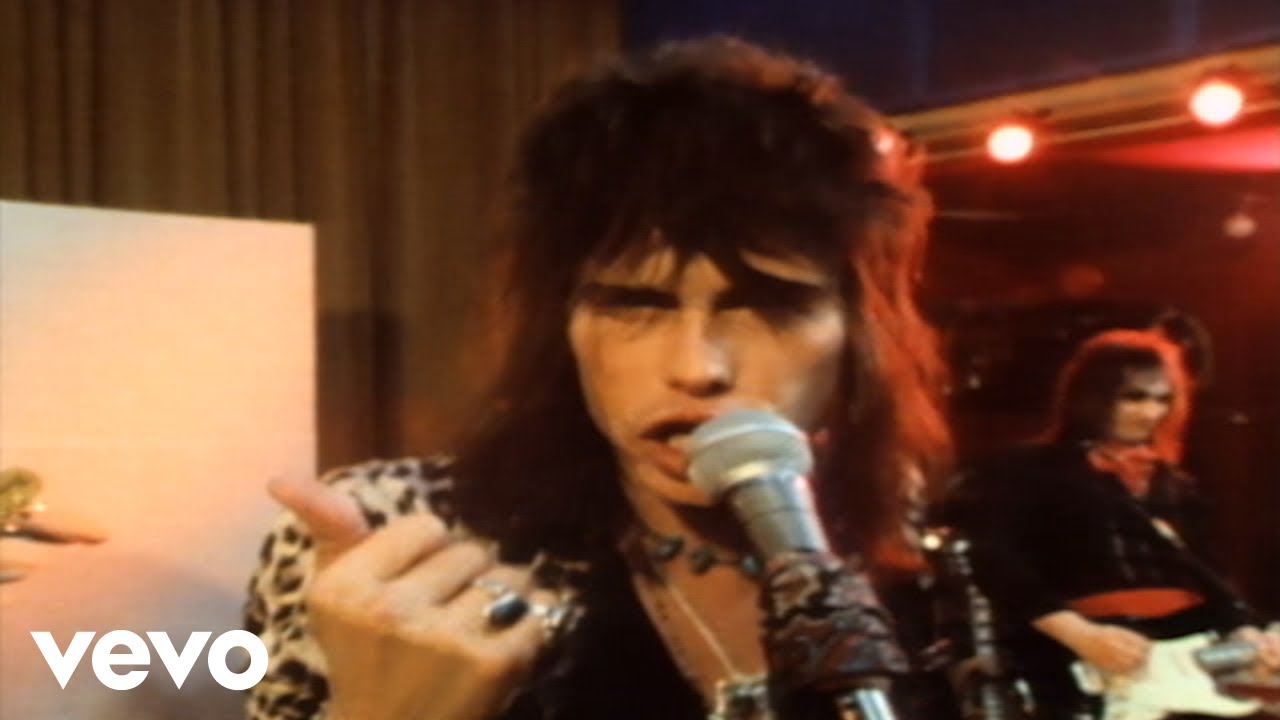
At this point Joe Perry was living on his manager’s sofa. His marriage was over, his money was gone, and he was about to take up Alice Cooper’s offer of a job in his touring band. Someone told Tyler. Tyler phoned Perry. Four years had gone by, and Aerosmith was going to start again.
They almost literally did that – Perry suggested they change their name, what with the legal hassles attached to the old one. He was suing their management, and the band wanted out of their record deal. Perry brought in the Project’s manager, Tim Collins, to take over the headaches. Brad Whitford re-emerged.
But it was harder to do anything about the band’s reputations, especially when they were still busy drinking and doping. Whitford was an alcoholic, Hamilton was doing lots of blow, Toxic Twins Tyler and Perry were doing everything. Promoters didn’t want to touch them. New bands inspired by Aerosmith were taking over the stadiums and the charts.
Their reunion album (and their first for Geffen Records), Done With Mirrors, was a relative flop, and Tyler almost got arrested when he collapsed from drugs during the Back In The Saddle tour.
Then something happened.
In 1986, Walk This Way, a song on Aerosmith’s 10-year-old album Toys In The Attic, was dusted off by a rap trio and released as a single. It shot to the top of the charts. Run DMC – who had been using the song in their live sets – had called and said they wanted to record a cover of the song, taking Tyler’s vocals off the verses and leaving it on for the choruses. The result was the first of the now commonplace rap-metal combinations.
“If you took the guitars off an old Aerosmith album you would say that’s rapping,” said Tyler. He made up the song’s lyrics as he went along, writing them on the Record Plant studio wall, and sang them like he would have drummed them, “because I’m a drummer too”.

The priceless video for Walk This Way put Aerosmith back in the public eye and helped flog lots of the ‘Greatest Hits’ album their old label put out. Old stuff.
It was time to choose between being a drugged band with a past, or a straight band with a future. And so Perry and Tyler became the De-Tox Twins. Or rather: “We’ll always be the Toxic Twins, it’s just that we’re not using drugs right now.”
While their old label released Classics Live!, without their consent and reportedly using Jimmy Crespo and Adam Bomb on overdubs, Aerosmith were starting the long and agonising process (four years and innumerable clinics) of drying out. They ran into an odd collection of people in the rehab centres - a priest who used to shoot up in the confession box, cops, airline pilots, Dave Mustaine of Megadeth…
“It would have been real cool for Aerosmith to go out in great rock’n’roll style,” said Perry “but I’ve got too many songs left to play, do you know what I mean?”
You would if you listened to 1987’s Permanent Vacation, the first substance-free Aerosmith album. Recorded in Vancouver, with producer Bruce Fairbairn and using songs co-written with megahit outsiders such as Desmond Child and Holly Knight (Bon Jovi) and Jim Vallance (Bryan Adams), it featured the brilliant Dude (Looks Like A Lady), Rag Doll, St John and the hit ballad since ‘disowned’ by the band, Angel. It went triple platinum. The tour, with up-and-coming megastars Guns N’ Roses opening, was enormous. Their manager kept the two bands apart backstage to avoid substance temptation, and cleaned out their hotel mini-bars before they checked into their rooms.
“It’s a bitch to stay straight,” said Tyler, “because all the kids are getting drunk, smoking pot and getting high at our shows. I just take it from day to day… If I had a drink I’d become an instant asshole and I might be dead tomorrow because I love it so much, I just go for it.”
The wives had T-shirts made up with dates of their ‘tour’ of the clean-out clinics on the back. Perry, aptly enough, gave his to Slash.
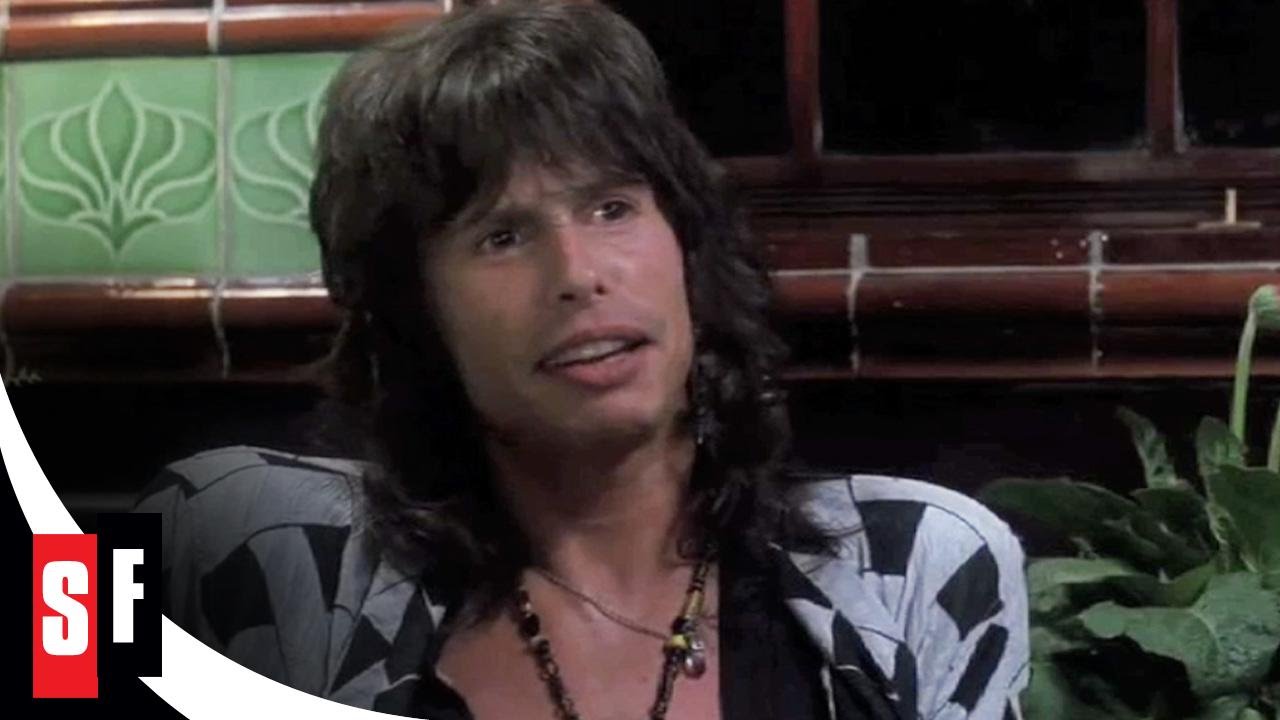
Aerosmith appeared in the 1988 film The Decline of Western Civilisation II: The Metal Years as ridiculously young-looking Wise Elder Statesmen. A couple of years earlier they would have been doing Chris Holmes of WASP’s bit with the vodka. A cover of Rocking Pneumonia appeared on the soundtrack to ultratrendy film Less Than Zero. Classics Live! II was released against their wishes, but at least this time with their co-operation.
The band went back to Vancouver to record Pump, which resulted in one of the crucial rock albums of the 80s.
Love In An Elevator, its first hit single, was based on “a true Joe Perry story”, according to Tyler. (“Well over the years,” said Perry, “you spend a lot of time in Holiday Inns with elevators, you know?”) The two still have their differences, hardly surprising what with Perry being the taciturn quintessential cool rock star type and Tyler a hyperactive motormouthed terrier-puppy, “but nowadays we talk things out”.
They finally came to Britain, their first trip since four shows 13 years earlier. They made an impromptu appearance with Bon Jovi at Milton Keynes, did a Hammersmith show at which Robert Plant and David Coverdale felt morally obliged to join in, played the best show that Wembley Arena’s ever seen, and had the press as well as women falling at their feet. Like Sounds said: “I don’t care how good the Rolling Stones are again or how many millions of units Guns N’ Roses can shift. Aerosmith have rewritten the book.”
And they’ll probably continue to do so, if some rival band doesn’t sneak into their dressing rooms in the night and shovel something addictive up their noses. As Steven Tyler told RAW: “As long as our plane doesn’t go down we’ll be around for ever!”

