




There’s never been a better time to get into vinyl. Except for maybe 2008, when all the good prog records from the ‘70s were still absurdly cheap in charity shops and vintage stores. Still – now, with a renewed general interest in the world of wax, there’s a glut of potential between countless new physical releases and countless new hi-fi options to enjoy them with.
All this might seem a little foreboding from the outside, of course, particularly when there’s so many options for record players on the market (a decent handful of which cross the rubicon into four-figure price territory). As a stone-cold newbie, where are you meant to start? Everyone’s got to start somewhere with vinyl – and for you, or someone you know, that somewhere is somewhere in this guide.
That’s because I’ve gathered up the best record players for beginners on the market at the moment, taking in a variety of coveted features and use cases. Whether you want an easy-going portable turntable, a wireless wonder or the first stepping-stone to an audiophile hi-fi system, you’ll find the right record player in the ensuing entries.
But to get you off to the perfect start, my no.1 pick goes to the Audio-Technica LP70XBT. Why? It's simply a great all-round turntable that delivers when it comes to the audio department. It features a VM95C stylus which can be switched out easily, has Bluetooth functionality and looks amazing.
And if you’re still not quite sure what you’re looking for, or indeed at, you’ll find answers in my FAQ guide further down the page and I've also included a glossary highlighting key terms.
Best overall

✅ Buy if you want a solid deck: The Audio-Technica LP70XBT is a dependable, great-sounding turntable which is a great choice for a first turntable.
❌ Avoid if you want something cheaper: This is a great record player, but the price is at the top of the scale in this category.
Audio-Technica’s LP70XBT is truly a graduation of sorts, being a marked improvement on its hugely-popular predecessor unit the LP60XBT. A new look, some new parts and a highly impressive new quality of sound make this the platonic ideal record player for beginners – and how!
The LP70XBT’s biggest selling-point is arguably its stylus. Though still using integrated cartridge, Audio Technica have bumped this entry-level unit up to AT-VM95 compatibility. The turntable comes with a VM95C stylus pre-attached, but if you have designs on upgrading your turntable in the not-too-distant future, you can simply slide it off and replace it with another from the same series – and without the same jiggery-pokery that replacing a whole cartridge can involve.
As a result, this automatic turntable is not only a smooth player and a smooth looker, but also one of the best-sounding beginner record players you’ll find on the market. And it has all the connectivity you could hope for in a modern machine, too. Don’t sleep on this!
Best portable

✅ Buy if you want a unique turntable that's perfectly portable: TheSound Burger is an excellent first-time turntable and its design and affordability make it stand out from the crowd.
❌ Avoid if you want a player for your home: A more stable turntable is a better option if using in your living room.
Portable turntables have always had a place in the pantheon – but haven’t always been good. Today’s menagerie of generally suitcase-shaped portable record players are compelling prospects for the beginner, but also often run the risk of damaging your vinyl and sounding bad while doing so. Audio-Technica has put paid to the era of the dodgy suitcase turntable, by bringing back a much smaller, much cooler and much better alternative – the Sound Burger.
The AT-SB727 Sound Burger is a revived ‘80s design, with an iconic clamshell mechanism that clamps records in. The new version iterates on the old by adding a built-in rechargeable battery and a Bluetooth output, as well as the requisite line out, for connectivity to practically any party speaker.
Being the size and form it is, you’d be forgiven for thinking the Sound Burger a gimmick. But it’s actually a real, competent record player for beginners, that treats vinyls fairly decently, and with a surprisingly stable playback too. It looks rad; it sounds rad; it is rad.

"This is a gimmicky retro-styled rework of a classic ‘80s product, but it’s future-friendly, immensely charming and just as good – if not better – than record players that ask for similar prices. Sure, it has some foibles, and might be a little pricey for some; still, for what it is and how it handles itself, I find this particular burger incredibly moreish."
Read our full Audio-Technica AT-SB727 review
Best Bluetooth

✅ Buy if you want a fully automatic turntable from a household name: Sony continue to impress with their range of record players, and new vinyl enthusiasts hooked on the Sony name will find a lot to love here.
❌ Avoid if you're on a tight budget: This isn't a super-expensive unit, but I'd like a little more from a turntable at this price.
Sony’s not had as much of a look-in with the turntable market as it once did – but it’s fixing to change that with its new PS-LX range of turntables. This is the PS-LX3BT, the entry-level turntable that offers some extremely beginner-friendly features.
For one, it’s a fully automatic turntable, which means you can control the playing and stopping of records with buttons instead of by manhandling the tonearm (which, if you’re a beginner, comes with an outsized risk of scratching your precious new records). Simply select the size and speed of your record using the knobs, then press ‘Start’; it’ll play to the end, and return the tonearm to its cradle at the end of the side.
But perhaps the best aspect to the Sony PS-LX3BT is its Bluetooth transmissivity. It’s one-touch connectible to any Bluetooth audio receiver, and capable of aptX Adaptive transmission; this is functionally lossless audio, delivered at low-ish latency to your speaker of choice. In a word, that also aptly describes the LX3BT’s looks: neat.
Best with speakers

✅ Buy if you want a turntable with versatility: An internal amp, speakers and Bluetooth functionality make this a neat option.
❌ Avoid if you want a top tonearm: The Eastwood II is a great turntable for the price, but there are definitely better units out there with more robust tonearms.
The Victrola brand is no stranger to the beginner turntable bracket, with a frankly impressive roster of products that run the gamut from portable players to baby’s-first-hi-fis. This, the Eastwood II, is a second iteration of their popular, chic Eastwood all-in-one turntable system – and an easy contender for the ‘best record player for beginners’ title.
Why? Well, it’s a highly versatile little unit, for one. Not only does it have its own internal amp and speakers for immediate plug-and-play vinyl-listening fun, but it’s also Bluetooth-connectible – and bi-directional, to boot. You can stream audio to the Eastwood II’s capable speakers, or you can stream your vinyl audio to a Bluetooth receiver of your choice.
This box of tricks is well dressed, too, with a nifty cloth-covered front and wood-effect panelled sides. There are a couple of aesthetic options too – my favourite is the Walnut one.
For this price, the Victrola Eastwood II is an unbeatable integrated vinyl-and-speakers, even if its cheap (and common) tonearm construction leaves a little to be desired.
Best sound

✅ Buy if you want an excellent turntable by a solid manufacturer: Pro-Ject have been making a name for themselves for a while now, and the E1.2 is a brilliant place to start.
❌ Avoid if you need a pre-amp: If you don't have a pre-amp, you might want to shop around for another record player.
Pro-Ject is the last word in affordable record-playing, being that Pro-Ject’s entry level and mid-range turntables are some of the best-constructed – and best sounding – that money can buy. This is the company's newest record player for beginners, the E1.2.
It’s a manual record player with little else in the way of flashy bells or whistles; it plays records, and that’s that. It comes with one of Pro-Ject’s own Pick-It MM-E cartridges installed, which brings a moreish, warm character to things. It’s a smooth operator, too, with decent stability and a sleek look besides. Being simple, it’s a highly affordable starting point for developing your own upgradeable hi-fi system; the downside to starting down this road is that you’ll need to spend a little more on peripherals – something that other record players for beginners might have helped you avoid a little longer.
The E1.2 does not have its own built-in phono preamp like other entry-level turntables, meaning you need a separate phono stage to put between your turntable and your hi-fi device of choice. If this is getting to dealbreaker territory, there are two other versions of the E1.2 with a phono preamp built-in (and with a correspondingly higher asking price). No excuses, then, if you’re serious about good sound from the very start of your new vinyl journey.
"The E1.2 is an extremely tasteful entry-level turntable, using its manual operation to its benefit in creating a minimal record player with maximal sound quality. The Pick It MM E cartridge has a fantastic sound profile for its price, and the E1.2’s playback was buttery-smooth besides. As starting-points go for a brand-new turntable to kickstart a brand-new hi-fi journey, this is tough to beat."
Read our full Pro-Ject E1.2 review
Best for sampling

✅ Buy if you're a budding DJ on a budget: The ability to start and stop in a flash makes this a neat option for DJs.
❌ Avoid if you're after a lightweight turntable: This is a heavy unit, so might not be ideal if you're planning a little bit of portability.
While the majority of record players on this list are here solely for music listeners, I really wanted to include an option for those looking for a record player that could potentially double up as part of a DJ or sampling setup.
The Audio-Technica AT-LP120XUSB might have a long-winded name, but it's an ideal beginner’s record deck for music-making pursuits. This is largely due to the fact it operates using direct drive, which means it can start and stop in an instant rather than winding down as belt-driven decks do.
It’s also one of the most robust turntables on the list, with a pleasing amount of heft to it which gives me confidence that it’ll last for a long time if it’s well looked after.
"This is a remarkable piece of inexpensive direct-drive technology. It’s a supremely solid player, with unflappable stability in the face of bumps and bangs; it sounds pretty great too, even through its own built-in phono preamp. Unfortunately, it falls just shy of full marks for its price and capabilities, though, as a result of its disappointing USB-recording performance; a digital whine interfered with what could have been a slam-dunk."
Read our full Audio-Technica AT-LP120XUSB review
Also tested
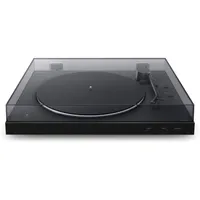
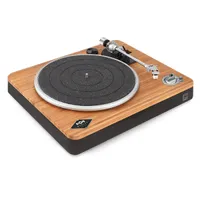
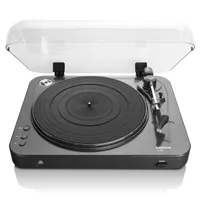
The record players above are what we think you should be spending your money on as a beginner. That said we've tested loads of record players so here are a few more beginner friendly options if you didn't find what you were looking for.
Glossary
Anti-skate: A calibration feature on turntables, that uses springs to apply a force to the tonearm, opposing the centripetal force acting on it when a record plays. Without it, a stylus can be forced against the wall of the groove, causing noise, an uneven stereo spread and uneven record wear.
Automatic: A turntable with a mechanism that starts the platter, lifts, moves and places the tonearm on the user’s behalf, and retrieves the tonearm from the end of the record, all at the press of a button.
Belt drive: Wherein a turntable’s platter is linked to a motor by a rubber belt; this is the most common form of turntable design, and benefits from a reduced propensity to mechanical noise, wow and flutter.
Cartridge: The apparatus at the end of a turntable’s tonearm, including the stylus and the electromagnetic pickups that convert its vibrations into sound. Generally, cartridges are replaceable or upgradeable items; some turntables for beginners have built-in cartridges with replaceable styli.
Conical: A type of stylus shape; conical styli have rounded ends, that read reliably but often with a softening of high-end information. These are the most common kinds of styli found on cheaper turntables.
Counterweight: The weight on the opposite end of the tonearm to the stylus, which ensures the correct tracking force is applied to the record. Most record players for beginners are pre-calibrated, with built-in counterweights designed for the cartridges they come with.
Direct drive: Wherein a turntable’s platter is directly connected to a motor; direct drive turntables are preferred by DJs for their higher torque, and more immediate responsiveness.
Manual: A turntable which requires you to lift and place the tonearm yourself, without the help of an automated mechanism.
Moving coil (MC): A type of cartridge, wherein the cantilever holding the stylus has an electromagnetic coil on the other side; the movement of that coil against static magnets is what generates the turntables electrical audio output signal. Moving coil cartridges are quieter but more detailed than their moving-magnet counterparts, and generally found on more expensive turntables accordingly.
Moving magnet (MM): A type of cartridge, wherein the cantilever holding the stylus has a magnet on the other side; the movement of that magnet against static electromagnetic coils is what generates the turntables electrical audio output signal.
Skips/skipping: When turntable’s stylus bounces out of the groove and across the record.
Tracking force: The weight a tonearm applies to a record through the stylus. This is set using the counterweight at the other end of the tonearm. If it's set too heavy, the stylus can gouge and damage the record; too light, and it is more prone to skipping and scratching the record’s surface.
Phono preamp: An amplification stage designed to boost the tiny signal from a turntable’s cartridge, to prepare it for amplification by a hi-fi or active speaker. Most record players for beginners have a built-in phono preamp, to make it easy for their owners to connect them to whatever devices they already have.
Platter: The rotating plate on a turntable, on which a vinyl record sits to be played.
RCA: A standardised coaxial connector, otherwise known as a ‘phono’ cable; stereo RCA outputs are found on most record players for beginners.
Stylus: The needle that reads the grooves of vinyl records; its vibrations are converted into electrical signals by the cartridge.
FAQ

What type of turntable do I need?
While the turntable is, fundamentally, a simple piece of technology – and one which, basically, operates the same way the first ones did more than 100 years ago – there are a few complicating factors that can make choosing one a bit more difficult for the new vinyl convert.
There are lots of ways in which record players can differ, but they’re typically differentiated by how ‘automatic’ they are. A fully automatic turntable has a mechanical action, which means the tonearm can lift, place and return itself to its cradle on your behalf; play your records with the press of a button, and without the risk of scratching them by dropping the stylus.
Manual turntables, meanwhile, require you to lift and place the tonearm by hand – though some will have a built-in switch that detects the tonearm’s movement, and starts the platter for you automatically. These might be considered semi-automatic.
This isn’t the only defining factor in a turntable, though. There’s also the matter of complexity. While their purpose may be simple, turntables can still require a lot from you in the way of preparation, calibration and hi-fi knowledge.
High-end turntables expect you to know your VTF from your VTA, and your moving-magnets from your moving-coils, in service of getting the best possible sound for your needs. There’s a time for learning all this, and it doesn’t have to be now. Particularly for the fact that many record players for beginners aim to remove the busywork from getting started with vinyl.
This guide is proof positive, with plug-and-play pre-calibrated record players that don’t ask too much of you in getting them ensconced in your hi-fi. Otherwise, in looking for a record player for beginners, your choice of turntable will come down to your preferences, and then again to the matching-up of budget to expectation.
Do I need to spend a lot of money on a turntable?
Essentially, the more you spend on a record player, the better you can realistically expect it to perform both in terms of audio quality and build quality. Expensive turntables aimed at audiophiles with cash to burn can be fairly high maintenance and require a lot of precise calibration and alignment – tasks that are easy to learn (after all, we have our own guide on how to calibrate your turntable here), but not necessarily fun or beginner-friendly.
Basic, entry-level models, on the other hand, tend to be simple to operate without much in the way of tinkering required. There are often trade-offs in terms of stability and sound quality, but with the right beginner turntable, these trade-offs won’t make much (if any) difference to your listening experience – not because you don’t have the ears to hear them, but because your listening environment is going to be very different from those same audiophiles with cash to burn.
Do I need external speakers for a turntable?
Most turntables are there to do one thing: turn the physical information in your record’s grooves into electrical information. Given this, you’ll need an amplifier and speakers to hear those signals. Some turntables, like the Victrola Eastwood II, have their own amplifier and speakers built in – but unless you don’t have or can’t afford a separate hi-fi or speaker system, or you want a bedroom hi-fi for a younger member of the household, I would generally warn against such all-in-one solutions.
With a separate speaker or hi-fi, you have more control over the sound of your records – and you save yourself from paying a premium for built-in hi-fi electronics in a starter turntable, allowing you to get more bang for your buck on the record player front.
The platonic ideal vinyl-equipped hi-fi system would comprise a turntable, phono preamp, amplifier and a set of speakers. The vast majority of entry- and even mid-level turntables now have a phono preamp built-in for convenience; make sure to check whether or not the one you choose has one, though.
Nowadays, it’s also common to find turntables which offer Bluetooth connectivity, meaning they can stream directly to a set of Bluetooth speakers (or indeed any Bluetooth receiver, whether a device that plugs into a hi-fi or a set of wireless headphones). This gives you a neat, simple and clean way to get the audio from the turntable and means you don’t have to worry about long wiring runs.
What’s the best record player for Bluetooth?
There are a few contenders for the best Bluetooth-equipped record-player, but one of the best Bluetooth record players for beginners is the Audio-Technica AT-ALP70XBT. It, like some of its competitors (including the Sony PS-LX3BT) can transmit using the aptX Adaptive codec – which is capable of transmitting at up to 24-bit/96kHz.
Bluetooth connectivity in a turntable is something of a controversial technology amongst older vinyl heads and audiophiles – in my opinion, largely because the butting of ‘analog’ against ‘digital’ seems… unseemly.
With Bluetooth technology as it is today, this is most certainly not the case from a results perspective. High-fidelity Bluetooth transmission like with the AT-LP70XBT’s aptX Adaptive codec, is functionally lossless, and the only real detracting factor is the latency between source and destination. Besides which, when you’re listening to records through a portable speaker in your kitchen, fidelity is not your primary focus.
Can I upgrade my record player?
If you’re looking to the longer-term and want a record player that can grow with you, then you want a turntable with more extensive features than those entry-level plug-and-play devices. Features like anti-skate and counterweighting are giveaways for a better long-term candidate. As for upgradeability, there’s only one thing you can really upgrade on a given record player: the cartridge.
Your turntable’s cartridge is the mechanism by which sound is translated to electrical signals – and some are far better at it than others, by virtue of the shape of the needle and the responsiveness of their electromechanical design.
Most turntables follow the same ½-inch “standard mount” connection standards, and enable you to remove and replace your cartridge for a different one entirely just by unplugging four wires and unscrewing two screws. If you want an upgradeable record player, make sure to look for two screws atop the headshell at the end of the tonearm, or a knurled nut connecting the headshell to the tonearm.
Setting up your new cartridge is fiddly, but the results can breathe decades of new life into your hi-fi (if your hi-fi is good enough to hear the differences on – but that’s a huge topic of its own, for another time).
If you'd like more information about how to properly set up a record player, we have you covered here at Louder – and we also have some handy tips to make your vinyl records sound their best.
How we test
When we put our pick of the best record players for beginners through their paces we first look at the build quality, how stable the turntables are and how easy they are to set up.
Audio quality is a huge factor in deciding what record players to include in our list so we check to see if the products come with in-built speakers and if not, how easy it is to connect them to either external Bluetooth speakers or headphones - and the reliability of the connection. If that drops unexpectedly or if we have any issues, we'll let you know.
We also hook the record players up to a variety of speakers and turntables to ensure there are no issues - and we play a variety of musical genres to see how they perform.
Buying your first record player can be daunting with the sheer variety available, so if you need extras such as a phono pre-amp, we'll let you know. We'll also inform you whether the turntables are belt-driven or direct drive - and if you're looking for more info in this department, we have a guide explaining the differences between the two.
Why you can trust us
⚡ Louder was established in 2017 and founded on long-running brands including Metal Hammer, Classic Rock and Prog (launched in 1986, 1998 and 2009 respectively)
⚡ Over 80,000 products reviewed on site, from music listening tech to albums and box sets
⚡ Our reviewers are all passionate music fans who draw on decades of testing experience
Louder’s reviewing team consists of music fans, musicians and professional product testers, who between them have accumulated decades of product reviewing experience, writing thousands of words on music listening gear across thousands of reviews on Louder. Our tests also inform our buyer's guide - just like this one.
As lifelong music fans, we're serious about the tech we listen to our favourite artists on. We want them to sound incredible, giving us all the detail those bands intended us to hear, and deliver the perfect balance of bass, mids and highs. We're looking for pure immersion in our chosen sounds, whether it's a classic '70s rock album, or a cutting-edge noise band.
And we test turntables with albums we know inside and out, and that we've listened to on a variety of systems already, so we know exactly what we should be hearing and when we're being short-changed by lackluster audio.
Meet the experts

James Grimshaw is a freelance writer and music obsessive with over a decade of experience in music and audio writing. He's lent his audio-tech opinions (amongst others) to the likes of Guitar World, MusicRadar and the London Evening Standard – before which, he covered everything music and Leeds through his section-editorship of national e-magazine The State Of The Arts. When he isn't blasting esoteric noise-rock around the house, he's playing out with esoteric noise-rock bands in DIY venues across the country.

Chris Corfield is a journalist with over 12 years of experience writing for some of the music world's biggest brands including Orange Amplification, MusicRadar, Guitar World, Total Guitar and Dawsons Music. Chris loves getting nerdy about everything from guitar and bass gear, to synths, microphones, DJ gear and music production hardware.

Matt is a Junior Deals Writer here at MusicRadar. He regularly tests and reviews music gear with a focus on audio interfaces, studio headphones, studio monitors, and pretty much anything else home recording-related. Responsible for over 60 buying guides, a large part of his role is helping musicians find the best deals on gear. Matt worked in music retail for 5 years at Dawsons Music and Northwest Guitars and has written for various music sites, including Guitar World, Guitar Player, Guitar.com, Ultimate Guitar, and Thomann’s t.blog.
Latest updates
27/08/26: The guide has had a complete audit and features a brand new introduction, while the following product entries have been added to the guide: Audio-Technica SB-727, Sony PS-LX3BT and the Pro-Ject E1.2. All products now include "At A Glance" panels explaining the pros and cons of each. The FAQ section has been completely re-written to better reflect commonly-asked questions – and a new glossary section highlighting the key terms you may come across while shopping for a new record player has also been included. Finally, we've added a "Meet The Experts" section so you can learn a bit more about the authors of this guide.
Read more
You can trust Louder Our experienced team has worked for some of the biggest brands in music. From testing headphones to reviewing albums, our experts aim to create reviews you can trust. Find out more about how we review.
- Best budget turntables: Our pick of the best cheap record players
- Best vinyl records to test your turntable: The albums you need to own
- Best vinyl record cleaners: Keep your vinyl collection in prime condition

