

On the surface, Tears For Fears represented the closing era of the British synthpop movement that included The Human League, Heaven 17, Depeche Mode and OMD. But the duo’s prog influences bubbled close to the surface, as second album Songs From The Big Chair proved without doubt. In 2015 lead songwriter Roland Orzabal reflected on the record that made them massive, and explained why they didn’t take part in the era’s most memorable musical moment, Live Aid.
Roland Orzabal recalls that, “ridiculous as it may sound,” he and Tears For Fears partner Curt Smith hooked up after he heard the latter singing Blue Öyster Cult’s Then Came The Last Days Of May. After a brief period in ska band Graduate and another as metalheads History Of Headaches, Orzabal and Smith joined forces, and used their music to exorcise their bad feelings about their unhappy childhoods. They took the name from John Lennon’s favourite primal scream theorist, US psychologist Arthur Janov.
Debut album The Hurting, released in 1983, was a concept work involving copious quantities of post-punk angst and alienation, recorded in a penthouse studio in Abbey Road with producer Chris Hughes and his right-hand man, Ross Cullum, who had worked with Roxy Music, Kate Bush and Karlheinz Stockhausen, and was erstwhile assistant to George Martin.
“It was myself, Curt, Ross and Chris in a very tight four,” recalls Orzabal. “Chris was a Zappa freak and Ross would be listening to Coltrane. We would argue about virtually everything on the record, all the way down to the hi-hats.”
They recorded under the influence of David Byrne and Brian Eno’s My Life In The Bush Of Ghosts, David Bowie’s Scary Monsters (And Super Creeps), Talking Heads’ Remain In Light and Peter Gabriel’s III. “But we weren’t old enough to truly emulate those albums so it ended up as a kind of adolescent, fragile, distilled version of them,” reflects Orzabal, who was 21 at the time.
He acknowledges that one of the differences between Tears For Fears and their British synthpop peers was their reliance on external musicians. “One can argue that the economy and homogeny of a band like The Human League is what made them so attractive and appealing,” he says.
“Whereas dormant within us were the seeds of something much more musicianly – whether you like it or not. As time went on we started using those session guys, like Pino Palladino and Manu Katché, who were among the best in the world.”
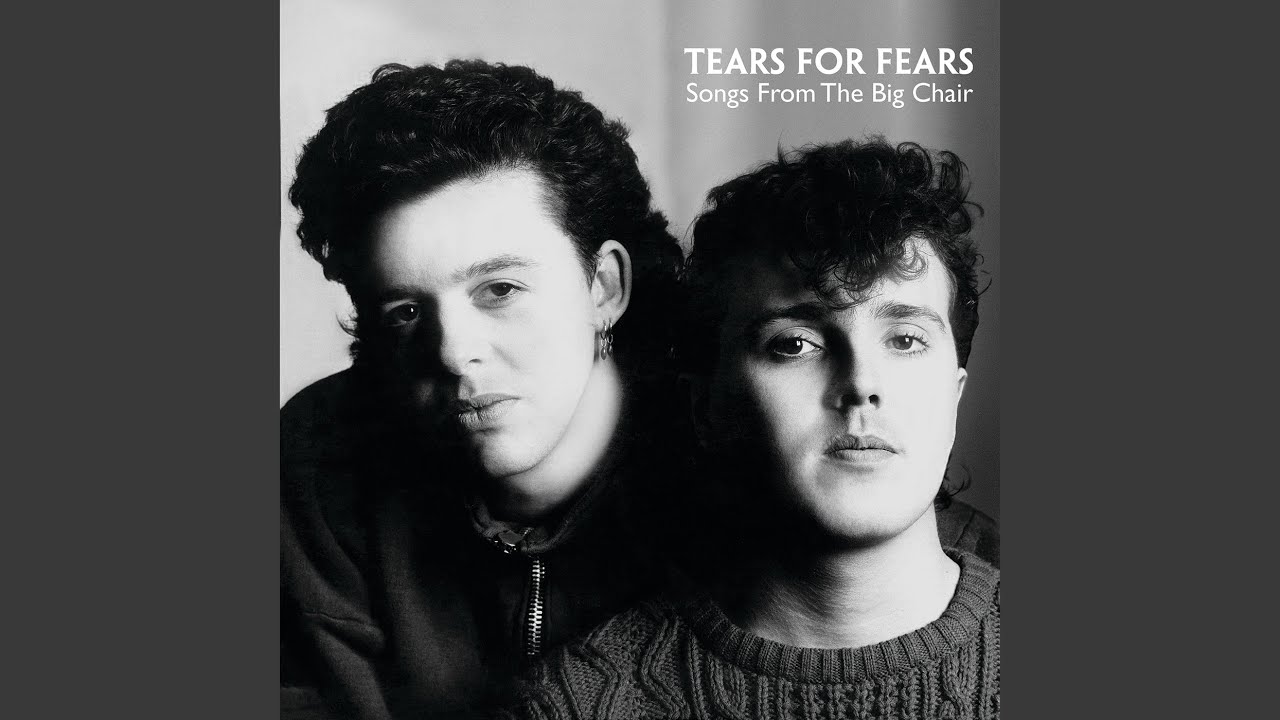
Released in 1985, second album Songs From The Big Chair may only have featured eight songs, but they were all big – world-class triumphalist anthems, with titles that demanded attention such as Shout, Listen and Everybody Wants To Rule The World. They required a lot of performing too, hence the appearance of Mel Collins (Alan Parsons Project, Camel, Crimson) and Will Gregory, later of Goldfrapp, both on sax.
Had there been any doubt in the past, Big Chair made no bones about its prog roots. “I suppose the obvious track is Listen [the seven-minute closing track],” says Orzabal. “You hear it and you think of the two words that one always associates with long, trippy music: Pink Floyd.
“Mothers Talk was a bit of a steal from Weather Report’s Teen Town, especially the bass part at the end, which was a sort of tribute to Jaco Pastorius. Hey, you know, we grew up with Genesis and Yes and that kind of stuff.”
With Chris Hughes once more at the controls, Big Chair was a nonpareil burst of pop bombast. Well, almost nonpareil. “Were we trying to out-Horn Trevor? Yeah, of course!” laughs Orzabal. “It was very difficult to do. But were we bothered – disturbed – by Trevor Horn? Yes!”
The success of the album and its attendant singles, which brought them No.1 hits in Europe and the States, made Tears For Fears one of the biggest acts on the planet. And yet they were conspicuous by their absence from both Band Aid’s Do They Know It’s Christmas? and the following summer’s Live Aid extravaganza. Did they never get the call from Sir Bob Geldof?
“When we heard about Band Aid we were mixing Big Chair in Munich, because Chris Hughes had fancied a skiing holiday – the things we had to work around!” Orzabal laughs. “That’s when we got a call from our manager. I remember it vaguely as, ‘Bob Geldof’s getting together with a bunch of musicians to record a song. Do you fancy it?’ And we were like, ‘Not really, no.’ We had no idea what it was. The next thing we knew it was No.1.
“By Live Aid we’d taken off and become huge,” he continues. “But by then we were on our first tour of America, due to go to Hawaii and on to Japan. So the question was, ‘Do we fly back from Hawaii to do the show in Philly?’ We took a vote and Hawaii won.”
Was Geldof cross? “Nah,” Orzabal says. “There were already too many people doing it for him to worry. Anyway, think about it – bands who played later in the day like Queen and U2 were used to playing stadium rock. It was easy for them and they sounded great.
“But some of the other artists, our peers, that came on early in the morning… no one remembers their performances, and some have tried to erase it from their history. I think we would have fallen into that category.”

