


The 1970s were nuts, just completely bonkers; a decade where love and hate mashed into one big ball of war, peace, drugs, full-frontal nudity and acid-spitting guitars. A time and space that was loony.
Sifting through the detritus of those strange and often alarming times, you begin to see shining moments when everything came together perfectly. Climax Blues Band are responsible for one of those moments.
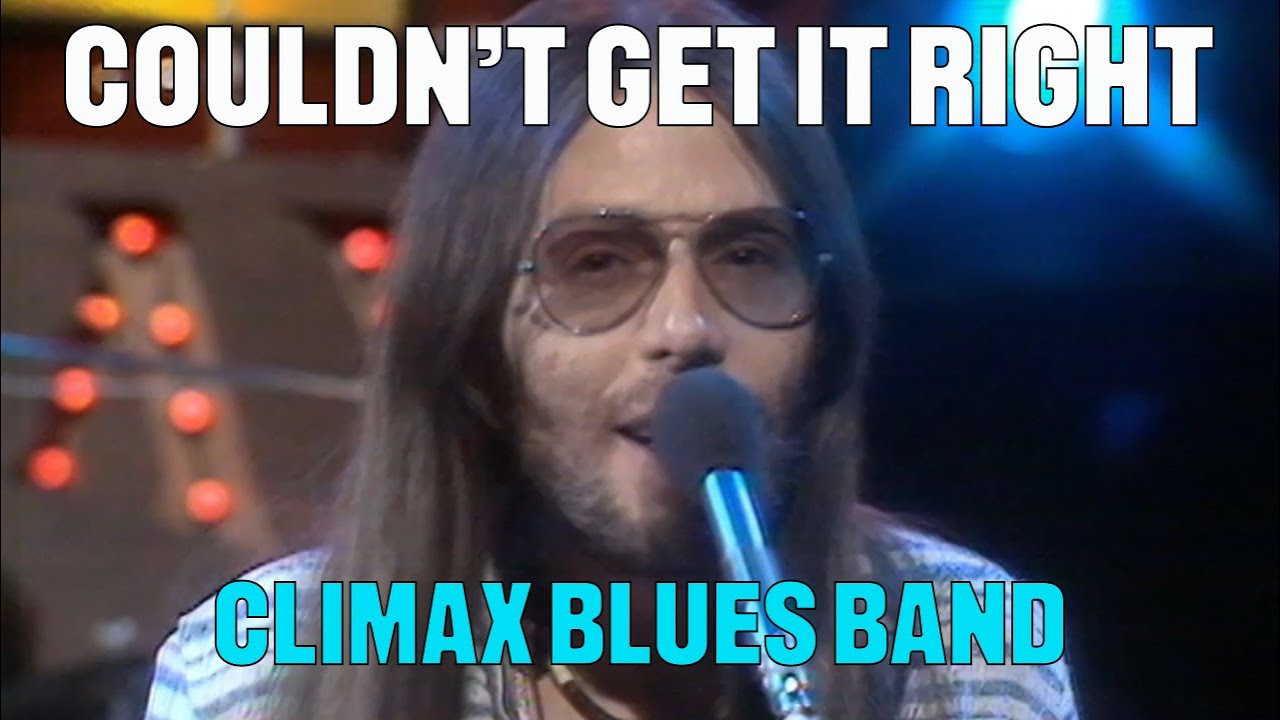
The band’s hit Couldn’t Get It Right, a song from their aptly-titled 1976 album Gold Plated, simply and elegantly summed up life in the mid-70s. The band had already been together nearly 10 years by then, had progressed from a scruffy, straight blues outfit from the streets of Stafford to a globe-trotting, multi-faceted modern rock band. With Gold Plated, they had hit their stride, and the album fairly throbbed with downtown cool.
While Gold Plated contained many rewards, it was Couldn’t Get It Right that truly rose to the occasion. It was a warm, evergreen slice of pure pop genius full of funky bass, cowbell, and lyrics that dripped with wide-collared cool: ‘Time was drifting, this rock had got to roll/So I hit the road and made my getaway…’ The song reached No.10 in the UK in October ’76 and later No.3 in the US.
It all started in the West Midlands town of Stafford, circa 1967. Singer/songwriter Colin Cooper had just finished his tenure with The Hipster Image, a sax-driven garage-pop band. Looking to get back to his first love, the blues, Cooper got together with some fresh-faced local talent and named his new outfit the Climax Chicago Blues Band. At their inception, they were a straight-ahead blues band, but by the time of their second album, Plays On, their signature sound – an R&B-tinged, blues-rock hybrid – began to emerge.
Things picked up quickly for the band from there. After a minor squabble with US band The Chicago Transit Authority (later just plain old Chicago), they shortened their name to the Climax Blues Band and released a slew of seminal albums, including A Lot of Bottle (1970) and Tightly Knit (1971).
Despite their headway, the early 1970s were still a struggle for Climax. They got by the hard way: gigging endlessly. And then came Couldn’t Get It Right.
“The original draft composition was mine,” guitarist/vocalist Peter Haycock said of their breakthrough song. “The band then worked on the arrangement for an afternoon at [drummer] John Cuffley’s place in Milwich, Staffs. Later, Colin honed and added to my lyrics to suit his own deep vocal style during the recording period, including evenings in the hotel in London after the sessions, when we would sit together and work on the lyrics.
"A good example would be the transition from my original ‘We all went looking for a sign in the middle of the night’ to ‘I kept on looking…’ My original chorus lyric idea was simply about driving around some city in the USA trying to find the Holiday Inn, which, despite its brightly illuminated sign, became increasingly hard to reach due to one-way systems, etcetera.
“Couldn’t Get it Right was a hit in England, we were on Top Of The Pops, all that. About a year later it went to number three in the States. From 1975 to ’76 was our best year. But a long one.”
The gigs got bigger, and so did their earnings. And with them a slew of new challenges, opportunities and inevitable dysfunctions. “It was a long year with many rewards,” Haycock recalled. “A couple of us had developed expensive hobbies involving white powder and noses. As for myself, I was pretty busy writing songs.”
Climax kept things rolling, but that all-important follow-up hit eluded them until 1980, when one of guitarist Derek Holt’s songs, I Love You, took them back into the spotlight. A syrupy, AOR ballad, it became both a blessing and a curse for Climax. While it boosted their status, especially in the US, it would ultimately break them apart.
“It was purely the producer’s idea,” Haycock said. “I hated most of it. Unfortunately, the producer was nominated mainly by the record company and turned out to be an idiot. I ended up writing bland pop crap, too, thanks to him.”
Disillusioned, Haycock left the band soon after. Climax carried on, operating first as a modern rock band, and then returning to Colin Cooper’s first love, the blues. Peter Haycock’s post-Climax career included a successful run with ELO Part Two. While he stayed in touch with most of the original Climax band members, it was strictly business.
Climax Blues Band settled into a comfortable groove, playing blues festivals. But things took a turn for the tragic in 2006, when founder Colin Cooper was diagnosed with cancer. He continued to play with the band until his death in July 2008. Haycock, who collaborated with Hans Zimmer on several Hollywood film scores after leaving ELO Part Two, died in October 2013 of a heart attack.
After Cooper's death, the band rallied and continued to tour without any remaining original members. Their most recent album, 2019's Hands Of Time, included a bonus track featuring vocals from the late singer.
This feature originally appeared in Classic Rock 140, published in January 2010. The story was updated in 2026.

