


In 2021, marking the 50th anniversay of Jethro Tull’s landmark album Aqualung, Prog asked artists from across the genre’s spectrum to explain what it meant to them.
Neal Morse: “It's still one of my favourites”
When I was 11 or 12 someone brought the Aqualung album to our house in suburban Southern California. My friends and I were always bringing our favourite albums over and listening to them together. We listened to the second side first.
I remember my friend saying, “Wait for it... Check this out!” setting up the moment when the guitars and the band kick in for My God after Ian Anderson sings: ‘With his plastic crucifix.’ What a killer moment! I was hooked from there on out. I learned to play Hymn 43 on the piano, and played it a lot in my early teens. When Mike Portnoy suggested that we record a cover version recently, I jumped at the chance.
Side One is great, of course, but I always preferred Side Two – having not been raised with any sort of religion or spiritual direction I’d hardly thought about God at the time. So I found the lyrics really interesting and compelling.
It’s still one of my favourites. I found a used vinyl copy in good shape at a thrift store in Southern Oregon while I was on vacation last summer, and I bought it once again. A classic!
Derek Shulman, Gentle Giant: “Tull reached their zenith with Aqualung”
In my opinion Jethro Tull reached their zenith in both creativity and entertainment with Aqualung. Together with Thick As A Brick, Ian and band were unique in their flawless ability to fuse blues, folk, rock and quasi-classical music wrapped up in a magical period in their career.
Gentle Giant toured both Europe and North America in 1972 with Tull, and the cheer that went up when Martin Barre played the opening riff to Aqualung was always deafening!
The band’s stagecraft was also at its peak during this period – rather than appearing like pompous over-practised classical musicians, they had fun onstage. It was reflected back from an audience who smiled, laughed and cheered together with, and for, the band.
Sonja Kristina, Curved Air: “Forward-thinking songs”
In 1971 Curved Air toured extensively with Jethro Tull as they promoted Aqualung in the US. I got to appreciate how impressive the band were. In recent years I’ve made guest appearances with the excellent Italian band OAK – a popular Tull-influenced band. Through them I’ve listened to Aqualung again, and it’s reinforced for me just how forward-thinking the songs were. The album underlined that Ian Anderson, a Dickensian hobo/pied piper, was a weaver of intricate, evocative wordy tales.

Arthur Brown: “A tantalising and relevant album”
Aqualung is still a tantalising album. Still ‘in’ with cutting-edge views as far as conservative people in the church go; still relevant to social justice today.
Musically, it has its place in the development of various genres of music – yet it’s also a thing unto itself, which can be appreciated from different stylistic viewpoints. It includes classic rock, folk, jazz, heavy metal, blues and classical, to name but a few.
It has enough delicacy for pure folk aficionados, enough oomph to keep the metal fans interested and just a touch of classical. It’s lyrically intelligent with an incisive mind, asking valid questions and taking a wide spectrum of humanity into account.
Andy Glass, Solstice: “Ian was at the top of his game. The material was stellar”
I first came to the Tull party with Minstrel In The Gallery and caught them live at their 1978 Hammersmith Odeon show. Christ, they were good! Ian was at the top of his game and the material was stellar – including, of course, Aqualung… twice!
About 15 years later I became friends with Mick Abrahams, and through him the wonderful Clive Bunker, who later joined Solstice for an album and supporting shows. I was producing a solo album for Mick when I met Ian, who came in for the day to record harmonica and flute parts. Next thing I knew, I was Jethro Tull’s front-of-house sound engineer and spent the next couple of years touring Europe and the States with them.
They played Aqualung, My God and Locomotive Breath at every one of those 120-plus shows. Cross-Eyed Mary made regular appearances too. That speaks volumes for the significance of the album – and the ecstatic audience reaction confirmed it every time.
I never tired of hearing that incredible band, especially Martin’s playing, but My God was the track that floored me every single time.
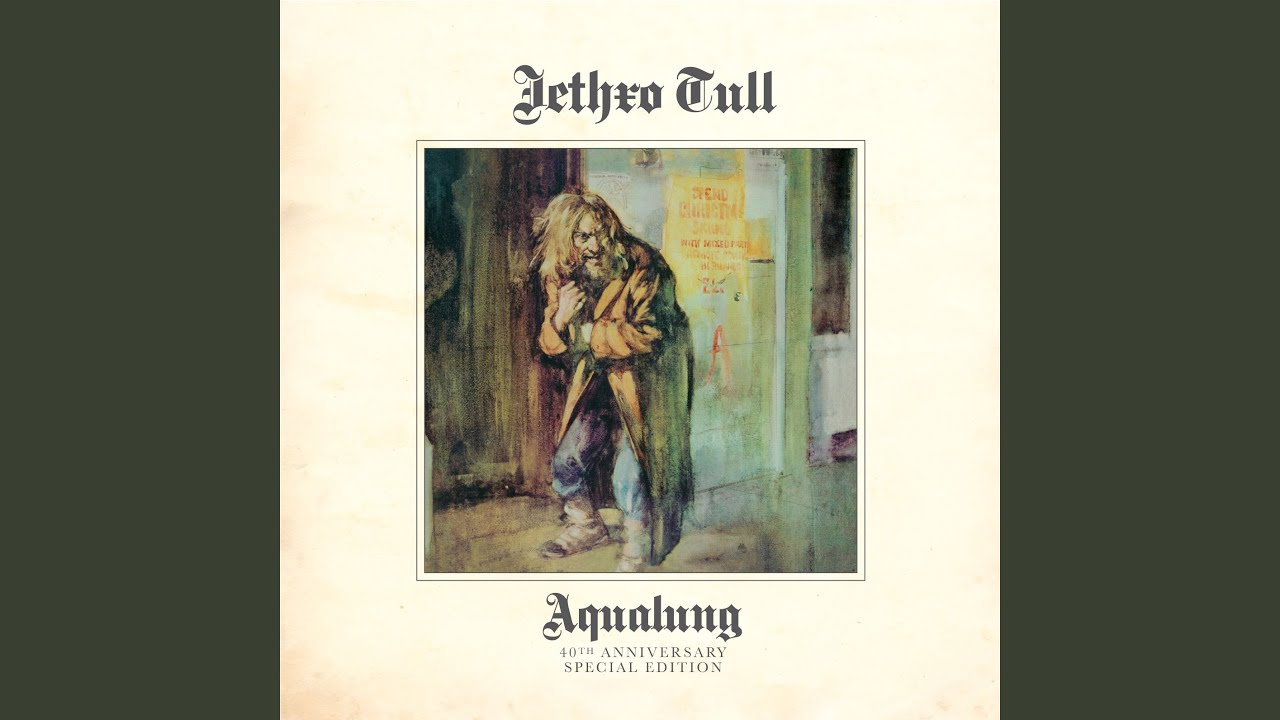
Dave Oberlé, Gryphon: “It’s still one of my favourite albums from the 70s”
I didn’t hear Aqualung until 1972 after a friend’s recommendation. I’d been a fan of Jethro Tull before that; I loved the sound of Ian Anderson’s voice and his virtuoso flute playing. Aqualung had the perfect mix of acoustic and electric sounds – and the occasional sound of recorders. I had always been a fan of Clive Bunker’s drumming and Martin Barre’s guitar playing. Favourite tracks for me are Aqualung, Mother Goose and My God. It’s still one of my favourite albums from that period of the 70s.
David Longdon, Big Big Train: “It is, without doubt, a masterpiece”
I’ve bought Aqualung four times. It is, without doubt, a masterpiece. It captures Tull at their most powerful and cohesive best – it creates a rich environment and offers an intense listening experience, with highly-articulate lyrics.
It was one of the first albums to be recorded at Island Studios, and was done at the same time as Led Zeppelin were recording their fourth album. There were technical teething troubles, which resulted in the 1971 mix having an unusual timbre to the instruments. The 2011 Steven Wilson remix of the album greatly improves upon the listening experience.
Troy Donockley, Nightwish: “It hit me like a bus”
Aqualung, with its easy, heavy, natural sophistication, hit me like a bus. It felt like it came from my environment – the sound of the local steelworks to the open-air drama of the Lake District. Wond’ring Aloud and Slipstream in particular shone for me; acoustic music rooted in something wonderfully British and romantic. It’s also a signpost to the mighty Songs From The Wood and Heavy Horses.
Lynsey Ward, Exploding Birdsong: “An amazing example of individuality”
For me, Aqualung is an amazing example of individuality within progressive rock. It’s impossible to listen and not be transported, thanks to Ian Anderson’s observational and vivid style of songwriting.
I feel that writing a song based on a whimsical or fantastical concept is well within the comfort zone of most prog writers. But Aqualung forces you to remember you’re in the real world –and that sometimes the real world can be pretty disgusting.
It seems to be up to the listener to decide if it’s a concept album that explores the idea of religion versus God. Anderson’s ability to create a musical arguments, based on what someone would see and hear in everyday life, sets his writing apart.
The killer combination of witty lyrics and expertly-crafted melodies solidifies Aqualung as a triumph in prog, and a masterclass in storytelling.
Jordan Rudess, Dream Theater: “It changed the world as we know it”
There are only a handful of prog albums which, in my opinion, changed the world as we know it. Aqualung is one of them. Jethro Tull introduced an original sound which highlighted Ian Anderson’s unique voice and his cutting-edge approach to the flute.
Not to mention the fact that radio stations picked up on a few of the songs, and exposed their sound to the masses. It was a different time in the music industry, and this album sparked so much creativity and joy in all of us!
Ross Jennings, Haken: “It was love at first listen”
I was 14 when comic actor Owen Wilson, in a scene from 1998 blockbuster movie Armageddon, joked, “One thing that really drives me nuts is people that think Jethro Tull is just a person in the band,” only to be given the reply, “Who’s Jethro Tull?”
My knowledge and interest in rock music beyond Aerosmith had long matured by then, but Tull were not a band I was familiar with yet. From what I could tell, Aqualung was an entry point for anyone who dared explore the world of Tull. Most never looked back, and that was also to be my fate.

Aqualung was love at first listen; it came to me at a very influential period of my life when I was discovering many legendary prog rock bands and albums. It’s rich in variety, which makes it progressive, yet still strong in its blues influences, which I absolutely adore. It’s probably why it’s so widely accessible. The album contains some of Tull’s most memorable tunes, and it proved quite boldly that the flute can rock too.
Fast-forward 20 years from that ill-fated asteroid movie experience, and I happened to catch both Locomotive Breath and the title track performed by Martin Barre and his band on Cruise To The Edge. It was a reminder just how special that record is to me. The icing on the cake was meeting Martin briefly, and discovering what an absolute gentleman he is. Whoever said never meet your heroes was wrong in his case.
Roine Stolt: “Tull definitely had their own sound here”
Aqualung came at a time when rock music was expanding. Having followed the band from the very first jazzy/bluesy album, This Was, their fourth offered more of everything – definitely riffing from the first bar.
For me title track wasn’t the best. It may be the most well known, but what followed was far more interesting, as it saw the band exploring both heavy riffs and folky scaled-down tunes, plenty of flute, odd time structures, more acoustic guitar and even some Mellotron.
I tend to love the acoustic stuff more than the overblown orchestrations. The ones I prefer have very dynamic arrangements; all the musicians shine and Ian’s vocals sound great. It’s promise that was leading up to A Passion Play – in my opinion their best and most solid album.
Tull definitely had their own sound here – the blend of power trio riffing, some piano and the jazzy flute.
Sam Vallen, Caligula's Horse: “Vigour and attitude that was unique”
Although not as ambitious as its follow-up, there’s a vigour and attitude to Aqualung that was unique in then-nascent progressive rock. The songs are structurally tight and punchy, and Anderson’s socially, religiously minded and often gruesome lyrics lend a sophistication to the riff-heavy record. Whether it’s a concept album or not, it never feels bloated or pompous – clearly a factor in its significant commercial impact in addition to its lasting stylistic influence.

