


Even before Stranger Things introduced her to a whole new generation via Running Up That Hill, Kate Bush was one of the most unique and beloved musicians in the history of music. In 2018, Classic Rock looked back over the career of a true one-off.

It’s three months after the release of the Sex Pistols’ Never Mind The Bollocks, and a 19-year-old Catholic girl from a south-east London suburb who shares a birthday with author Emily Brontë is singing about Heathcliff and Cathy as she wafts about on Top Of The Pops, the embodiment of gothic romance, generally giving it plenty of interpretive dance and jazz hands.
Wuthering Heights, her debut single in January 1978, had its release date pushed back because the singer was unhappy with the photograph on the sleeve. Fortunately this means it avoids being smothered by Wings’ all-conquering Christmas singalong Mull Of Kintyre.
Kate Bush’s Wuthering Heights also sees off competition from another female singer’s UK chart debut – Denis by Blondie – to reach No.1, displacing ABBA, in March. It stays there for a month. We have let her in at our window. Kate Bush has defied the laws of logic, gravity and punk. And she would continue to do so.

A huge chunk of time later it’s March 2014, and Kate Bush announces an epic 22-night, August-October residency at Hammersmith Apollo in London, the venue of her last gig, 35 years previously. Tickets sell out in 15 minutes, and that autumn she becomes the first female ever to have eight albums in the UK Top 40 simultaneously. Only The Beatles and Elvis have ever topped that tally; Bowie’s death later adds him to the list.
The shows are the buzz event of the year, even before they’ve taken place. When they do, she owns every front page, even though she barely plays any of her hits. All this despite a reclusive, off-camera relationship with publicity that could best be described as ‘sparing’.
Kate Bush is now established as both a national treasure and an enduring enigma. In a career in which she has usually done the opposite of the rational thing, she has maintained stellar status as a much-loved musical pioneer, transcending her initial pigeonhole as a kooky hippie girl with a high-pitched voice. An imperishable influence on subsequent female artists, sure, and then some, yet Bush has primarily been significant beyond gender, her art and attitude a nudge to all idiosyncratic creative types who don’t follow formulae.
She remains her own entity, and we grant her the awe – and occasionally forgiveness – afforded to the truly unique. She has even survived describing then-Conservative Prime Minister Theresa May as “wonderful”. The rules, and common sense, go out of the window in Kate Bush World. How did she pull this off?

Kate Bush was always something of a prodigy. Forty years ago this January, Wuthering Heights, the first ever British No.1 self-written by a female singer, brought a fresh and candid voice to music. Her debut album The Kick Inside followed a few weeks later. She had written most of the songs on it in her mid-teens. They were rich with pretentious references (in this case a good thing), mentioning Brontë and Gurdjieff with that manner of unselfconscious earnestness exhibited by young people who haven’t read many books but have therefore reacted really intensely to the ones that they have. Which is how most of us reacted to Bush’s music.
Most male music really lays it on you. It really puts you against the wall. And that’s what I like to do.
Kate Bush
There was, at the time, a striking novelty to her upfront expressions of lust and eroticism through the female gaze. You can sweat the details, cite Bessie Smith and Joni Mitchell, but it wasn’t yet the norm. And in an era when punk was on the rise, she was – at least technically – its very antithesis. Her moods, chords and theatricality (mentored by Pink Floyd’s David Gilmour) had more in common with prog. Her songs swooned and sighed with romance and yearning – not a current hot ticket. What she did share with punk was a free spirit, a doing-her-own-thing drive – the same young generation who queued to get gobbed on at Damned gigs embraced her.
Gilmour was thrilled by his young protégé’s success. “Kate is a complete one-off,” he said. “I can’t think of anyone like her. Joni Mitchell was also a one-off, an original, but Kate is nothing like that.”
That debut was averse to self-editing; it was both unfettered and rhapsodic. Urges, fevers, visions, unfiltered. She somehow transcended the mundane categories of the here and now. She was atypical, not topical. Pansexual. We all know what an impressive musical career she’s gone on to have, keeping that differentness, that individualism. Along the way she’s evolved from TV light-entertainment regular and accidental sex symbol to arguably the most enigmatic recluse in the business, one who marches to her own eccentric drum beat.
“Every female you see at a piano is either Lynsey de Paul or Carole King,” Bush told Melody Maker in 1977. “And most male music – not all of it, but the good stuff – really lays it on you. It really puts you against the wall. And that’s what I like to do. I’d like my music to intrude. Not many females succeed with that.”
Her ‘intrusions’ are often Trojan horses, dark themes hosted by sweet melodies, a charm of charisma. She has become one of the most invaluable figures in British music, and has done so chiefly by being herself. Or, in earlier years, by being herself while inhabiting various characters. Then hiding herself away and letting us project on to the indelible impression she had made already. Bowie, to name the most blatant example, used a similar sleight of image, but it’s a tightrope act, this blend of striking personae and blank canvas.

As motherhood induced a 12-year gap between Bush albums, maybe this happened, in part, without a plan. Even after revealing her hand at those 2014 Hammersmith concerts after being for so long a myth, a fable, she remains a mystery, an evergreen enchantment. We raise our hats to the strange phenomenon.
Artists have this god-like quality about them, just because their craft makes a lot of money. It’s a forced importance.
Kate Bush
Back in April 1979, her six-week first-ever tour drew reviews remarking upon her “unabashed obsession with sex” and complaints that “you’re distracted by Katy [sic] being wheeled around in a giant, satin-lined chocolate box”. Others praised “the best welding of rock and theatrical presentation that we’re ever likely to see”. Bush’s opinion was: “It was lovely.”
Tour programmes cost £1.50; there was “magic, mime and illusion”. Incorporating dancers, props, magic and 17 costume changes, the show, while radical for its era, was perhaps primitive compared to her 21st-century comeback. Yet even on a purely technical level, it broke new ground. As Bush was often being lifted up and carried around by her dancers, she didn’t always have hands free to hold a microphone.
“So my sound guy basically invented the radio mics you see nowadays,” she said. “He made it out of an old coat‑hanger, which he bent out of shape.”
At the 2014 shows the calm reserve of most critics was bent out of shape, the most hardened observers gasping as progress in the world of tech meant we got a stage resembling a sea bed on which strange creatures roamed, and a spooky living room with a sofa, lampshade and telly which materialised in the ocean. Tour programmes may have cost a lot more than £1.50, but we saw a blindingly bright lighting rig swoop in and out of the audience, making rotator-blade noises, which was half terrifying and half thrilling. Later, there was a pastoral scene with painters, wild birds, mannequins, a moon and, as a grand finale, Kate sprouting wings and flying. It was a magical mash-up of The Glass Spider and The Wall, except that it was like nothing else on earth.
There were reasons why Kate didn’t tour for so long in her youth, why it took so long for her to retake the live stage. Part of her motivation now was wanting to involve her son Bertie, to launch his musical career (she hoped) and, being a proud mum, showcase his vocal talent. (In truth, most of the audience found him an irritation.) But she’d stepped away for more than three decades for other causes than parenthood.

The Tour Of Life had been marred by tragedy. Her lighting engineer, Bill Duffield, fell through a cavity and died of his injuries days later. This had a big impact on Bush. She mentions him in two later songs: 1980’s Blow Away and 1993’s unbearably poignant Moments Of Pleasure. Also, she had become increasingly uncomfortable with the emphasis on her sexuality and the necessary promotional rigmarole. So she and her close-knit family took greater control of her management and business affairs and she stepped back to move forward, evolving into more of a studio animal. The more she retreated and played hard to get outside her luxuriant videos, the further her legend stretched.
“Artists shouldn’t be made famous,” she mused in 1980. “Y’know, they’re just as important as, um, doctors, priests… or maybe not as important. And yet they have this huge aura of almost a god-like quality about them, just because their craft makes a lot of money. And… it’s a forced importance, like football stars or theatre stars. It’s man-made so the press can feed off it.”
The irony is that as this Garbo talked less, the aura grew.
Each of her albums offered up a filmic fantasy world, a riddle, a conjuration. Lionheart, recorded as a rushed follow-up to The Kick Inside, may wallow in fairy-story camp at times, and even suggest a peculiarly dated patriotism (hmm, her politics), but it still captures the sound of afternoon sunlight streaming through your window. It’s a world of wide-eyed wow with just a streak of Hammer horror.
If I was living the life of a pop star, it’s too distracting. It’s too much to do with other people’s perceptions of who you are.
Kate Bush
Never For Ever released swans, cats and whales from beneath her skirt (at least on the cover art) and dropped references to François Truffaut and Henry James, brewing left-field hits in Army Dreamers and Babooshka and, in the eerie womb-like microcosm of Breathing, indicating how much deeper and heavier into the psyche she was prepared to probe.
After self-producing 1982’s experimental The Dreaming, which visited topics such as Vietnam, Houdini and indigenous Australians (Peter Gabriel was by now a friend and collaborator), she built a studio in her farmhouse barn. We owe this barn some of the period’s most elevated musical moments. 1985’s million-selling Hounds Of Love yields her best-loved yet most innovative uphill run of cloudbusting singles, and still finds time for an unabashed full-on conceptual prog suite.

As the video age peaked, her releases became events. 1989’s The Sensual World – erotic, delirious and gauging its level of Joycean abandon perfectly – included a ‘Yes’ as physical and tactile as anything Marvin Gaye, Millie Jackson or the young Robert Plant had emitted. The Red Shoes, which brought her into the 90s, is one of her artistic peaks, from the bouncing-like-a-trampoline white funk of Rubberband Girl to Bush’s loftiest tearjerkers: Top Of The City and Moments Of Pleasure. This pair are as brittle and fluid as you can get without actually collapsing, hence their huge emotional heft.
Whenever Bush misfires – which happens – it’s worth remembering she can pull off miracles like these. Rather an erratic genius who might belly flop but might also leap over tall buildings in a single bound than a competent, uninspired jobsmith. We indulge all our favourites similarly, because we want the out-of-the-ordinary, the inimitable. Oh to be in love.
Guest stars ranging from Prince, Elton John and Eric Clapton to Stephen Fry, Lenny Henry and (oh dear) Rolf Harris have made cameos on her records, yet still she’s cool. There was that dozen-year motherhood gap, then in 2005 the surprise comebacks began.
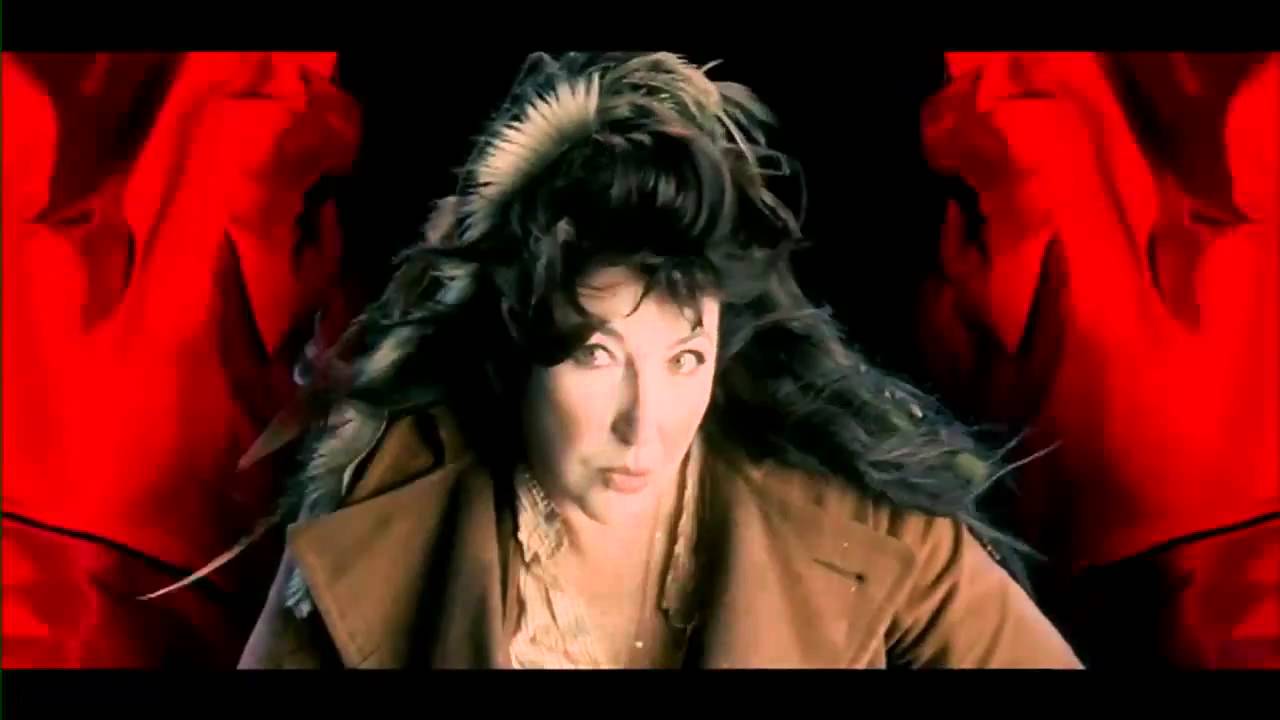
“For the last twelve years I’ve felt really privileged to be living such a normal life,” she said at the time. “It’s so important to me to do the washing, the hoovering. Friends of mine in the business don’t know how dishwashers work. For me that’s frightening. I want to be in a position where I can function as a human being.”
Friends of mine in the business don’t know how dishwashers work. I want to be in a position where I can function as a human being.
Kate Bush
She is commendably grounded, the opposite of our image of her, but we still willed Bush to take flight. This she did in spells on Aerial. It presented effectively two albums – A Sea Of Honey and A Sky Of Honey – which were rich with birdsong, a lyric about a washing machine and, in the stunning Nocturn/Aerial, an addictive neo-techno-rave construction which suggested she had a radio in that barn of hers.
She seemed to have the feel for recording again, rushing out 2011’s Director’s Cut (a muddled reworking of earlier songs, inferring the versions we’d loved for years were wonky and we were daft to adore them) and 50 Words For Snow. These later albums had barren patches and longueurs, but the universe was so pleased to have her back that reviewers said they were brilliant anyway. The myth was maintained. So when the live return was announced… well, you recall the furore.
“For me to get into the creative process, I have to have a sort of quiet place that I work from,” she told Mark Radcliffe in 2005. “And if I was living the life of… a pop star or whatever, it’s too distracting. It’s too much to do with other people’s perceptions of who you are. What’s important to me is a human being who has a soul, and has a sense of who they are, not who everybody else thinks you are. And I think that’s something that’s very difficult for people who become extremely famous.”

She added that she found the contemporary obsession with celebrities “ridiculous. It’s absolute crap… so shallow”.
Perhaps in 2014 it felt to faithful fans like the return of a wizard, a true star. To non-converts it didn’t make sense that everyone was going nuts to get a ticket to see a 70s/80s icon in her mid-50s who had barely appeared in public for decades. And those spectacular Before The Dawn shows focused on her most intricate, lengthy album tracks, in the main ignoring crowd‑pleasing hits.
But almost everything about Kate Bush defies conventional reason. Those who routinely ridicule artiness and pretension make an exception for her. She’s very British, yet the British tick of sneering at the ‘different’ and their hifalutin ideas is set aside for her. People who profess to hate prog clasp their hands to their ears in denial if you point out how closely related her music and ideas, even her imagery, are to significant phases of Genesis and Floyd.
Her influence on other singers, musicians and performers who have surfed her slipstream during four decades is immense. Again, it’s not just the overt – Tori Amos, PJ Harvey, avowed fan St Vincent. It’s foolishly reductive to list just female artists as her legacy, her debtors, when there are as many men who, emboldened by her footprints, desire and require autonomy to function best. Kate Bush’s genre is, essentially, Kate Bush.
Among those who owe her are all those who like to stride or hide at their own pace, to make shapes that might seem awkward at first but will outlast cookie-cutter convention; those who are, you know, a bit ‘out there’. She spoke once of sometimes feeling like she was trying to open a door with the wrong key. “So I changed the key and the door began to open.”
It has stayed ajar since, and those smart enough and bold enough will always push on through and go running up that hill.
Originally published in Classic Rock issue 246 (February 2018)

