




When Peter Gabriel quit Genesis in 1975, his bandmates weren’t sure how to respond. They kept writing music but without a clear idea of how to use it. But it all came right when they delivered seventh album A Trick Of The Tail the following year. In 2016 Prog marked its 40th anniversary by exploring the turmoil behind the scenes – and the triumphant results.
Whatever happened to Mick Strickland? He was one of hundreds of vocalists who applied for the job of lead singer in Genesis after Peter Gabriel left the band. Strickland even made it as far as Trident Studios for an audition – that didn’t work out.
Others who sent tapes and waited for the call included Brinsley Schwarz’s guitarist/vocalist-turned-punk producer Nick Lowe, Manfred Mann’s Earth Band vocalist Mick Rogers and Jahn Teigen of Norwegian prog rockers Popol Ace, last seen receiving ‘nul points’ as a contestant in the 1978 Eurovision Song Contest.
Showing the same indomitable spirit that helped them survive an English public school education, Mike Rutherford and Tony Banks’ response to Gabriel’s departure was to put their heads down and simply carry on without him – until they couldn’t carry on any more. “For a time, I thought we’d carry on as a four-piece without any singing,” revealed Phil Collins.
“We kept writing songs,” Mike Rutherford told Prog, “but after a while we realised they’d get a bit boring without any vocals.” Soon enough, Genesis began looking around for a new lead singer. What nobody realised yet was that they’d already found him.
Gabriel had announced his departure at a band meeting in Cleveland, Ohio, in January 1975, while Genesis were touring The Lamb Lies Down On Broadway. The singer had already left during the album’s recording sessions, but had been persuaded to return. This time he wouldn’t change his mind. His wife had recently given birth to their daughter, he was torn between family and band commitments, and also uneasy with what he called “the rock’n’roll culture” and being “part of the machinery.”
Today, Rutherford is less surprised by Gabriel’s departure than he was back then: “He was moving forwards a bit braver and faster than we were.” But at the time he was shocked and disappointed. After seven years together, Genesis were starting to make real headway, and some proper money.
Publicly, the band tried to put a brave face on it all. “But there was a lot of fear about whether we could carry on without him,” admitted Tony Banks.
Oddly, the one person who was convinced they could carry on was Gabriel: “I had much more confidence in the band’s ability to transcend my departure than they did.”
In a premonition of a future line-up, Steve Hackett was absent when Genesis started work on what would become A Trick Of The Tail in July ’75. The guitarist was busy finishing his first solo album, Voyage Of The Acolyte. In the meantime, Rutherford, Collins and Banks began jamming in a rehearsal studio in Acton, West London. By the time Hackett turned up three days later, they’d written most of Dance On A Volcano and Squonk.
Dance On A Volcano was a doomy fanfare with echoes of Collins’ beloved Santana and Weather Report in its busy rhythms. “It embodied all that Genesis did well,” said Rutherford. Squonk paired a thunderous drum figure with lyrics about a fictional beast taken from the Argentinian writer Jorge Luis Borges’ Book Of Imaginary Beings. Led Zeppelin’s Physical Graffiti had come out earlier that year. Genesis had heard its signature song, Kashmir, on the radio in Germany, and loved the huge drum sound. Squonk was “my John Bonham moment,” said Collins, who still considers it one of his favourite songs on the album.
Genesis had kept the news of Gabriel’s departure secret from the press. But after they placed an anonymous advert in Melody Maker seeking a singer “for a Genesis-style group,” the news leaked out. “Gabriel Out Of Genesis!” announced the paper on August 16. A week later, MM writer Chris Welch interviewed the group at their rehearsal studio and presented his subsequent article as an obituary. “No longer will Peter startle his fans with apparitions, kinetic structures and theatrical trickery of every description…” he wrote.
Everybody was a little sceptica. But we started recording and we just knocked one song off after another
Phil Collins
The premature announcement of the band’s death made them even more determined to carry on. Before long, between 100 and 400 tapes – nobody can agree on a total – had arrived at the Charisma Records office. Among them were demos from some “very well-known singers,” recalled Banks, though he’s never revealed who.
Reports also vary as to how many vocalists made it to the audition stage. Banks says it was two or three a day for a time. Rutherford recalled the mysterious Mick Strickland having “the right bluesy voice” but struggling to master Squonk. “It was in completely the wrong key,” the guitarist said. “The poor guy battled through it, but it was never going to work.”
Ironically, it was Collins who’d been teaching the songs to applicants beforehand. He’d sung lead vocals on Nursery Cryme’s For Absent Friends and More Fool Me from Selling England By The Pound. His voice had worked particularly well with Gabriel’s on The Lamb. But at this point, nobody regarded the drummer as a potential lead singer.

Drummer Bill Bruford was rehearsing with Brand X and recalled Collins dropping by the studio and moaning about the auditions. “He said something like, ‘They’re all bloody useless – I can sing better than they can,’” said the Yes and King Crimson alumnus, who suggested Collins put himself forward for the job. Collins’ wife Andrea, who’d known him since drama school and had seen him singing and playing drums, suggested the same.
Banks remembers Collins singing Squonk directly after Strickland’s audition. It worked. He sang another song. And then another. “Everybody was a little sceptical,” Collins recalled. “But we started recording and we just knocked one song off after another.”
Sessions for A Trick Of The Tail began at Trident Studios in October ’75, with new producer David Hentschel. “David had engineered Goodbye Yellow Brick Road for Elton,” says Collins. “I got to know him through my dallying around and playing with other people, and suggested him to Genesis.”
Collins returned to his childhood theatre role as the Artful Dodger. It’s the only misstep on the whole album
Recording The Lamb Lies Down On Broadway had been a tortuous affair. In contrast, A Trick Of The Tail took a little over a month. In some ways it was easier without Gabriel – He, Rutherford and Banks had always been the principal writers, with Hackett chipping away on the sidelines. With Gabriel gone, there was one less potentially dissenting voice. The band now relished the opportunity to prove that Genesis had always been a songwriting collective, and not just a vehicle for their frontman.
That said, A Trick Of The Tail’s unsung hero is Hackett, the co-writer of one of its finest moments, Entangled. “It was based on this really beautiful piece Steve had written,” said Banks, who wrote the chorus and contributed an eerie synthesizer solo that suggested mythical sirens luring unsuspecting sailors onto the rocks. But when Hackett showed Collins his lyrics – ‘Over the rooftops and houses… sentenced to drift far away now’ – he thought the song had “a Mary Poppins feel to it.”

Even now, Entangled and parts of Mad Man Moon do evoke images of Disney’s Poppins gliding, umbrella in hand, over an autumnal landscape. In fact, most of A Trick Of The Tail has a dreamy, childlike atmosphere. Heard again now, Banks and Rutherford’s ballad Ripples – a song about old age and fading beauty – also pre-empts the uncomplicated love songs Genesis wrote in the 80s and 90s.
What the album did share with the Gabriel era, though, were what Banks called “story songs.” He and Collins composed Robbery, Assault And Battery, on which Collins returned to his childhood theatre role as the cockney Artful Dodger, to sing about a bungled burglary: ‘You got it wrong sir/I’m only the clean-ah!’ But it now feels like a clunky companion piece to The Battle Of Epping Forest from Selling England. It’s the only misstep on the whole album.
It was something I’d written many years before. With Peter’s departure, I liked the idea of slipping in something lighter and more quirky
Tony Banks
Far better was the title track – another story song. “It was something I’d written many years before,” said Banks, “but with Peter’s departure, I liked the idea of slipping in something lighter and more quirky.” Lyrically, A Trick Of The Tail partnered Squonk. This was Genesis back in the netherworld of elves and sprites, but with a cautionary message. Banks had been reading William Golding’s 1955 novel The Inheritors, which used the story of a Neanderthal tribe to comment on modern social mores.
The tale of a ‘beast that can talk’ put on display in a public ‘freakshow’ had a cultural message – but it also had the album’s most immediate melody and chorus. Banks later revealed that the song was partly inspired by The Beatles’ Getting Better.
In contrast, the grand finale, Los Endos, picked up where Dance On A Volcano left off. It was the singing drummer’s baby; an instrumental showdown full of whirling dervish drum patterns and tinkling Chinese cymbals. He admits Santana’s Promise Of A Fisherman inspired the whole piece: “I wanted to get all of that energy and melody in there.”

By November, A Trick Of The Tail was complete. “I think we knew we’d made a good album,” Rutherford told Prog. “It already felt like a new chapter.” In keeping with that notion, the finished work also looked different, arriving in February 1976 in a sleeve that suggested the cover of a Victorian fairy tale book. There was a masked felon, a hook-nosed judge, a withered old crone and a sobbing Squonk, all drawn by artist Colin Elgie.
Banks’ assessment that “some of the public found Genesis with Peter a bit too strange” was borne out by the new album’s sales. A Trick Of The Tail reached No.3 in the UK, tying with Selling England as their highest-charting LP yet. “We had to prove we could do it without Peter,” Banks told Melody Maker, before adding boldly, “We think it’s the best album we’ve ever done.”
People didn’t want to give up on Genesis. They wanted us to stay together, so they backed me up
Phil Collins
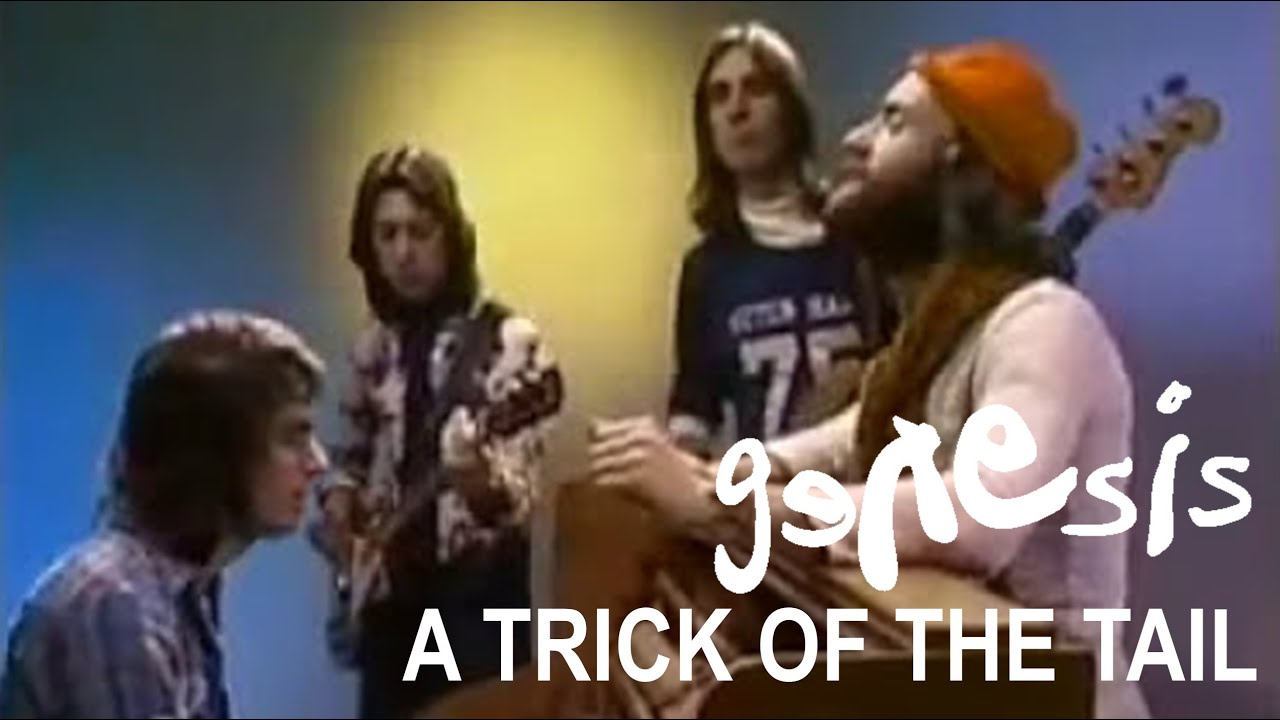
But Genesis now faced the challenge of how to perform the album live. Unlike part-time singing drummers such as 10cc’s Kevin Godley, Collins was Genesis’ only lead singer. Gabriel had sold the band from the stage, dressed as a fox, a flower and, on The Lamb tour, a giant rubber penis. When the quartet filmed a video for the Trick Of The Tail single it only highlighted how different – how ordinary – their new lead vocalist was. In his winter scarf and quirky orange hat, he looked like a hippie window cleaner moonlighting from his day job. “We knew from the start costumes wouldn’t be part of it,” Rutherford admitted. “You only had to look at Phil to realise he wouldn’t have been good in a flower mask.”
The solution was to let Collins just be himself, and to find a second drummer for the tour. He recruited Bruford, his Brand X sparring partner, who damned his new employers with faint praise in an interview before the shows. “I’d never seen Genesis or heard their albums before,” he told Sounds. “But I respected Phil and knew he wouldn’t be involved in any rubbish.” Thanks, Bill.
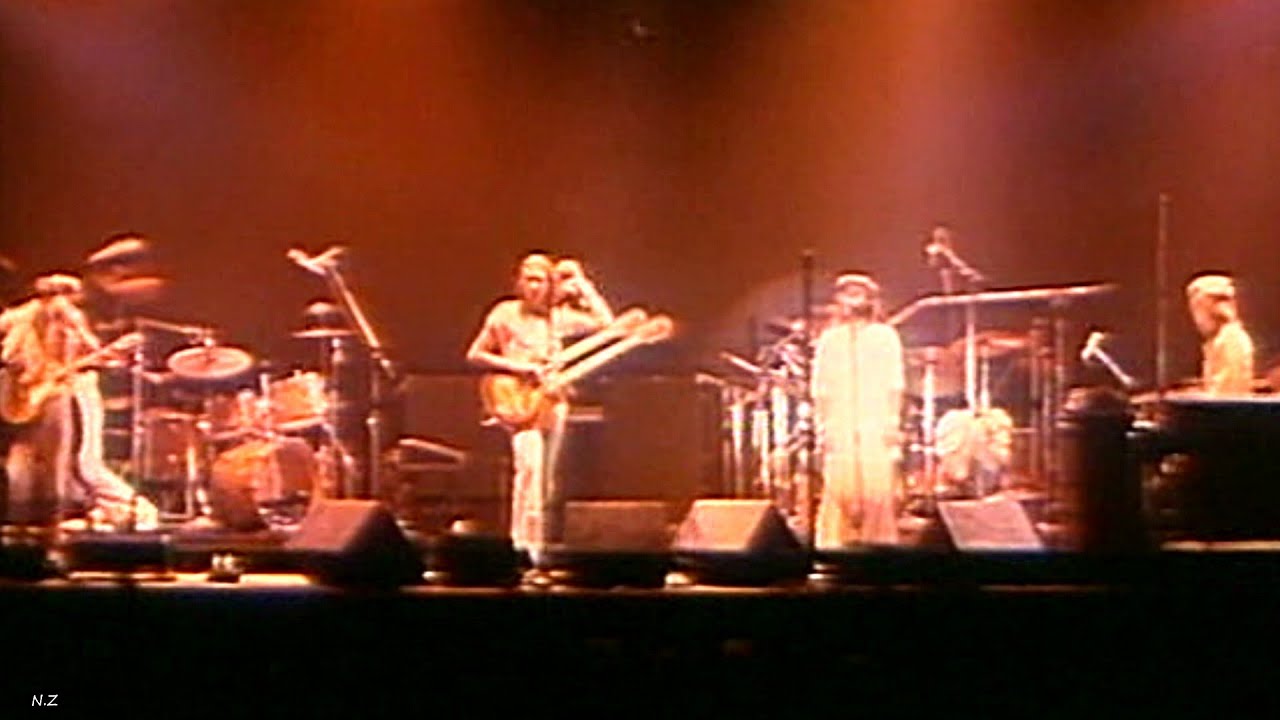
“The day I started singing with Genesis changed my life,” Collins admits. On March 27, 1976, at the Kitchener Auditorium, Ontario, Canada, he first walked on stage as a lead singer. His hands were shaking and he was clutching a piece of paper with notes of comments for the audience. But without any lavish props or costumes to hide behind, he engaged the crowd with his directness, his down-to-earth humour and his unerring ability to sound like Gabriel when he sang the ‘old stuff.’
“People didn’t want to give up on Genesis,” he said. “They wanted us to stay together, so they backed me up.”
As the tour progressed, he grew into his role. In June 76, Gabriel slipped quietly into the Hammersmith Odeon to watch the new band. “It was a very strange experience and I had mixed emotions,” he admitted.
Rutherford’s once said of Collins: “When Phil had an idea, you listened.” That would become even more significant in the years ahead. When Genesis went back into the studio to record Wind & Wuthering, and after Steve Hackett’s departure, …And Then There Were Three…, the band had a different dynamic. Neither the band, nor Collins, would ever be quite the same again.

