


All Hope Is Gone (2008)
The final album cycle with the original nine line-up of the band, All Hope Is Gone featured some of the most drastic updates to Slipknot's masks to date. While the elements of horror were still there, the masks looked sleeker, shinier and decidedly less grotesque than they had over the previous decade.

Corey Taylor

In some ways Taylor’s scariest mask is the scariest of all in this period. It featured no hair at all, and had an almost entirely featureless face that appeared stitched to his skull. Eerily blank.
Mick Thomson

An angrier, more menacing update on the same theme: Thomson’s mask broadly remains as the same metallic-looking, futuristic visor throughout the band’s history.
Jim Root

Again, not much has changed: Root’s mask is still the same jester’s face as before. The black diamond still features around the eyes, and the zip is still drawn shut between black lips.
Craig Jones
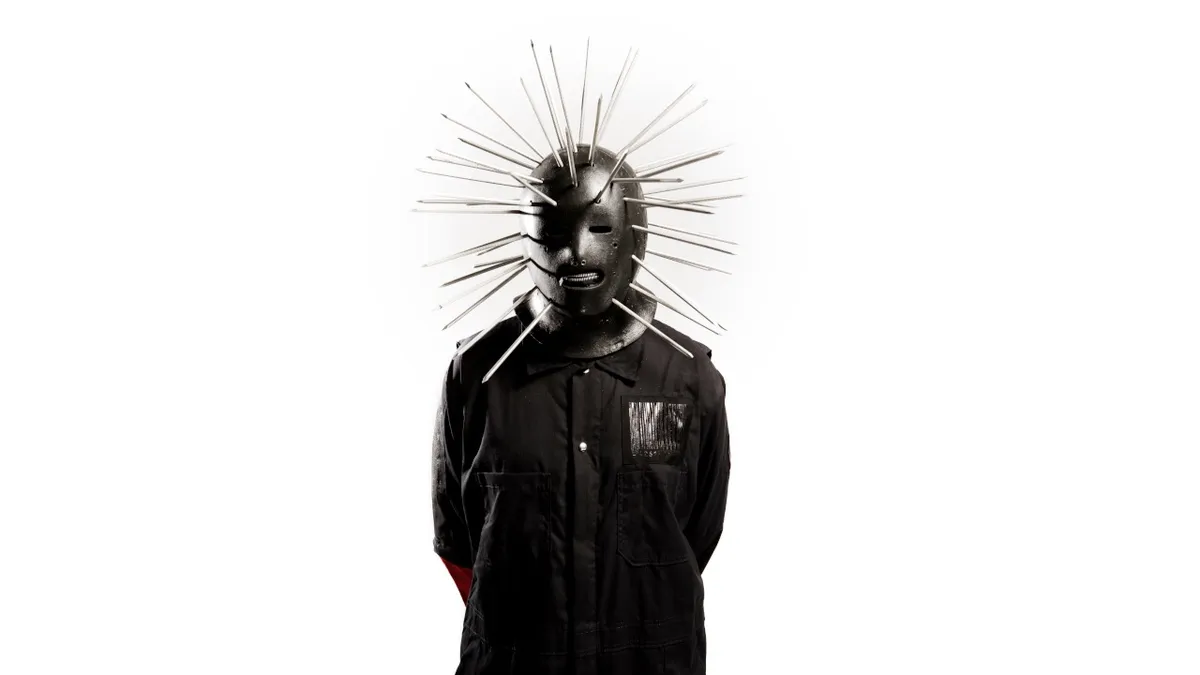
The mask becomes more metallic and the nails are a little longer, but Jones’s look does not really change from Vol. 3.
Sid Wilson

By All Hope Is Gone, Wilson’s mask had undergone another radical change: now his face resembled a Transformer – he is a fan of the TV show – and featured controllable eyebrows to allow him to change his expression.
Shawn Crahan

Clown’s All Hope Is Gone mask was probably the most technical: a patchwork of black leather, thick red and white stitching and zips that was both sinister and brooding. “I don’t want any of it to look human – there are no human elements to it,” he said. “The mask is actually made of steel, so I can rip it off my head and use it as a weapon. It’s not some plastic bullshit.” He had an alternate one too: a more human face but one with a such disturbing lack of features that it looked like the plastic dollface of your nightmares.
Chris Fehn

Still featuring its long nose and zipper mouth, Fehn’s All Hope Is Gone mask no longer included the hood that covered the back of his head.
Paul Gray

Gray had two masks for his last years in the band, both of which were very similar to his Vol.3 Hannibal Lecter mask, but with the slight additions of small cracks in one and a paint smear on the other.
Joey Jordison

Anyone for a crucifixion? Joey’s facial stitches and crown of thorns lent him the air of a demonic christ. The dials were most definitely set to ‘creepier than ever’ – though the drummer would probably say the air of martyrdom appropriate given what happened a few years later….

