





Getting into vinyl isn’t so much a single event as it is the start of a long, sometimes-expensive, and often-obsessive journey. This journey is punctuated by graduations. You might start with a budget hi-fi speaker, and move up to a fuller-sounding hi-fi stack; you might start with charity-shop bookshelf speakers, and graduate to richer-sounding floorstanders; you might start with a budget turntable cartridge, and graduate to something altogether better.
Each kind of upgrade you bring to your home listening setup provides a different kind of benefit, all of which work together to pull the very best out of your physical media. I would argue, though, that the single biggest material impact you can make to the sound of your records (at least, outside of jumping from a portable party speaker to a serious hi-fi setup) is right at the end of your record player’s tonearm.
So what difference could a new stylus really make to the quality of your listening experience – and is it worth it? Read on!
What’s in a cartridge?

The turntable cartridge is a treasure trove of clever engineering moves, which collectively make it possible for you to extract highly-detailed audio information from the bumps and notches in your hard-won Record Store Day purchases. These can be boiled down to three key components: the stylus, the cantilever, and the pickup.
The stylus is the bit that actually touches your record; it follows the bumps and notches in the groove closely, using a gem tip (typically diamond), communicating the information held within as motion. This motion is passed through the cantilever, to which it is attached.
On the other end of the cantilever, in the body of the cartridge, that motion is communicated to an electromagnetic pickup, which turns it into electrical information – the very same information that leaves the turntable for your phono preamp or integrated amplifier.
Most cartridges you’ll come across are moving-magnet (MM), which means the cantilever is outfitted with magnets that move relative to static coils, thus disturbing the electromagnetic fields they create. At the top end of the cartridge spectrum, you’ll find moving-coil (MC) cartridges, which work the opposite way. These are far more delicate, and often attributed to much more detailed results.
Should I replace a cartridge or replace the stylus?
Cheaper cartridges make small compromises in various areas of this essential assembly – whether it’s an easy-to-manufacture stylus shape that doesn’t catch as much groove information, or a pickup that’s not as responsive as you’d like it to sound. This is why the cartridge is so crucial to good sound, and often the first thing that vinyl listeners choose to upgrade.
While, historically, you’d have to buy a whole new replacement cartridge to upgrade your system, it can be even easier for newcomers to upgrade their own system. This is with thanks to a decent handful of cartridge manufacturers, who have created modular cartridge systems which enable you to upgrade the stylus part of the system without needing a new cartridge body.
Chief amongst these is, arguably, Audio-Technica’s VM95 series of carts, which have the same body and pickup system, but which have removable (and upgradeable) styli. With these, there’s practically no re-calibration needed at all; they’re straight-swap, plug-and-play styli that give you better sound for less money and effort than replacing the whole cart – an exciting glimpse at a better, less-gatekept future for newcomers to vinyl audio.
Indeed, Audio-Technica’s new flagship for the entry level is the Audio-Technica AT-LP70XBT, a full-featured automatic turntable that combines convenience with quality – most notably, through a fully built-in cartridge body which accepts VMN95-series stylus replacements. With this, you can upgrade your listening experience without having to spend more on new carts or even new turntables altogether.
Do I have to upgrade a stylus?
But I've still not answered why you should do this at all. Why spend even a small amount of money swapping out something already designed to work quite well?
Well… the stylus is a perishable object. It can wear and break, so if you’re hammering your Record Store Day finds hard enough, you’ll need to replace your stylus semi-regularly (that is, every 300-500 hours of playtime) anyway. But this speaks to replacement, not upgrades. The real reason to upgrade is sound quality.
The stylus has a huge impact on what you’re hearing when you play records – being the part that actually interprets the information in the groove. The shape of the tip and the assembly of the stylus itself each have demonstrable impacts on fidelity and sound character, owing to how the stylus interacts with the groove walls where audio information is held, and how that information is translated through to the cartridge body.
Is upgrading your stylus worth it?
Generally speaking, upgrading your stylus is very much worth it, and especially so if you’re currently working with an entry-level stylus like the conical, blue-tipped AT-VM95C that comes stock on the AT-LP70XBT. The leap in sound quality from here up is one of the biggest, and one you’ll hear immediately – even on a middling hi-fi setup. The returns may start to diminish from here, particularly when you’ve other parts of your hi-fi to upgrade as well.
To demonstrate these positive impacts of upgrading your stylus in real, experimental terms, I got my hands on two different types of stylus upgrade from the good ship Audio-Technica: the VMN95EN, and the VMN95SH.

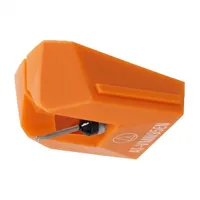
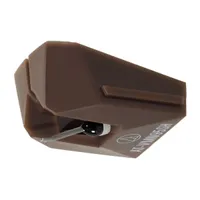
My experience with both styli was, to say the very least, remarkable. For the AT-VMN95EN, the jump from bonded to nude is a lot more impactful than you might expect; it gives a whole new feel to your record collection by virtue of quicker transient response and an altogether more robust, structured low end.
If you like listening to the heavy stuff, you’ll find guitars and drums are treated far more favourably here than with the less-detailed VMN95C or -E. Transient sounds are so much quicker off the mark, and there’s so much more rewarding weight to strums, plucks or whacks.
As for the VMN95SH, that fine, edged tip does an incredible job of extracting high-end information. Instruments sound glossier, glassier and much more three-dimensional. Cymbals and percussion shine brighter than ever, while transient information is given the presence and texture it truly deserves. The soundstage is so much easier to parse, with well-separated instruments and crystal-clear articulation.
Another advantage of line-contact styli like this one is that the deep-penetrating tip often eliminates a great deal of surface noise; it gets past the dust that would otherwise interrupt blunter implements, making for an altogether cleaner listen. My Queens Of The Stone Age records have never sounded so pristine!
Generally, my suggestion would be that it isn’t worth jumping to a line-contact style of stylus if you’re still using entry-level hi-fi equipment. The AT-VMN95SH commands a relatively high cost, for fidelity benefits your budget speakers might not have the capability to properly realise. Still, the reduced surface noise is a hard benefit to overlook – and sonically, for my better-than-budget hodge-podge hi-fi system, the AT-VMN95SH was an unmitigated joy.
As a first upgrade, though, the AT-VMN95EN is a no-brainer improvement well worth your time and money. It unlocks so much more of your records than you might expect; a great leap in quality for a not-too-unreasonable price.
How do I replace my stylus?

Upgrading an Audio-Technica VMN95 stylus is incredibly simple. All you do is slide the stylus cover back on, under the cartridge body, then gently pull down with a rocking motion. If your turntable, like mine, has a removable ½” headshell, you’ll find it easier to do this with the headshell off and in your other hand.
If you have Audio-Technica’s AT-LP70XBT, with its built-in cartridge body, you won’t be able to do this, but that’s fine; just secure the tonearm to its rest, and carefully wiggle the old stylus down and out.
Installing the new stylus is even easier. With it safely nestled in its cover, line up the tab with the opening on the cartridge body and press in. It’ll click in, and you’re done! A painless process, and one which requires much less fiddling than replacing your cartridge completely.
What stylus types are there?
Stylus shapes
There are several types of stylus shape for you to choose from; these have differently-shaped tips, which interact with the groove differently and extract audio information differently too. Broadly speaking, the three key types are conical, elliptical and line-contact – with some different shapes and designs hiding under each option.
Most budget turntables today come with an Audio-Technica AT3600L cartridge attached – a remarkably decent-sounding budget cartridge, in possession of something called a conical stylus. The end of the stylus is like the end of a ballpoint pen, meaning it doesn’t extend too far down the groove. The result is often a slight lack of treble response, and a proneness for light distortion.
If your turntable comes with a green-tipped VM95E cartridge, you are in possession of an elliptical stylus. These are narrower than conical styli, allowing deeper penetration into the groove and more contact with the groove walls – with correlating benefits for high-end representation and distortion.
Line-contact styli are the next step-up, so named for the relatively sharp edges they use to interpret the groove walls (inspired by the sharp edges that cut those same initial grooves into the master disc in the first place). These are the logical conclusion when it comes to tracking accuracy, fidelity and soundstage, but are a little more finicky to set up.
Bonded or nude?
Most less-expensive styli are ‘bonded’, meaning the diamond tip that receives the information from the groove is glued to a metal needle, which itself attaches to the cantilever. ‘Nude’ styli eschew the metal shank entirely, instead being fashioned completely from diamond, all the way up to the cantilever.
Bonded styli can get in the way of detail, as there’s two different materials between that diamond tip and the cantilever – both of which alter the response of the needle as a whole, and add mass too; nude styli are lower-mass, more immediately responsive and often better-shaped, too.
Also consider

The VMN95 series of stylus upgrades is comprehensive and, in my mind, brilliant. It isn’t the only option on the block, though. Upgradeable styli are catching on elsewhere, too.
Rega’s entry level Planar 1 and Planar 2 turntables, for instance, ship with the Rega Carbon cartridge as standard; once you’ve gotten comfortable with your Rega turntable, you can upgrade the sound without replacing the cart by buying a Rega Carbon Pro stylus replacement.
Ortofon’s OM-series cartridges enable you to upgrade their styli, too, with a big roster of their own: the OM 3E, 5E, 10, 20, 30 and 40 respectively, which range from basic bonded elliptical styli to nude fine-line styli and beyond.
For the real newcomers amongst us, using an Audio-Technica AT-LP60X, an AT-SB727 Sound Burger or a basic suitcase player, you’ll be listening to your records through the ubiquitous entry-level AT-3600L and its conical stylus. Now, you actually stand to experience one of the bigger quality jumps of all of us, with the AT-3600LE elliptical upgrade.
Read more
- How to clean your record player and vinyl collection
- Best vinyl record cleaners: Keep your vinyl in prime condition
- How to calibrate your turntable: A step-by-step guide
- Cool vinyl record storage ideas
- How to store vinyl: Tips on keeping your collection in great condition

