




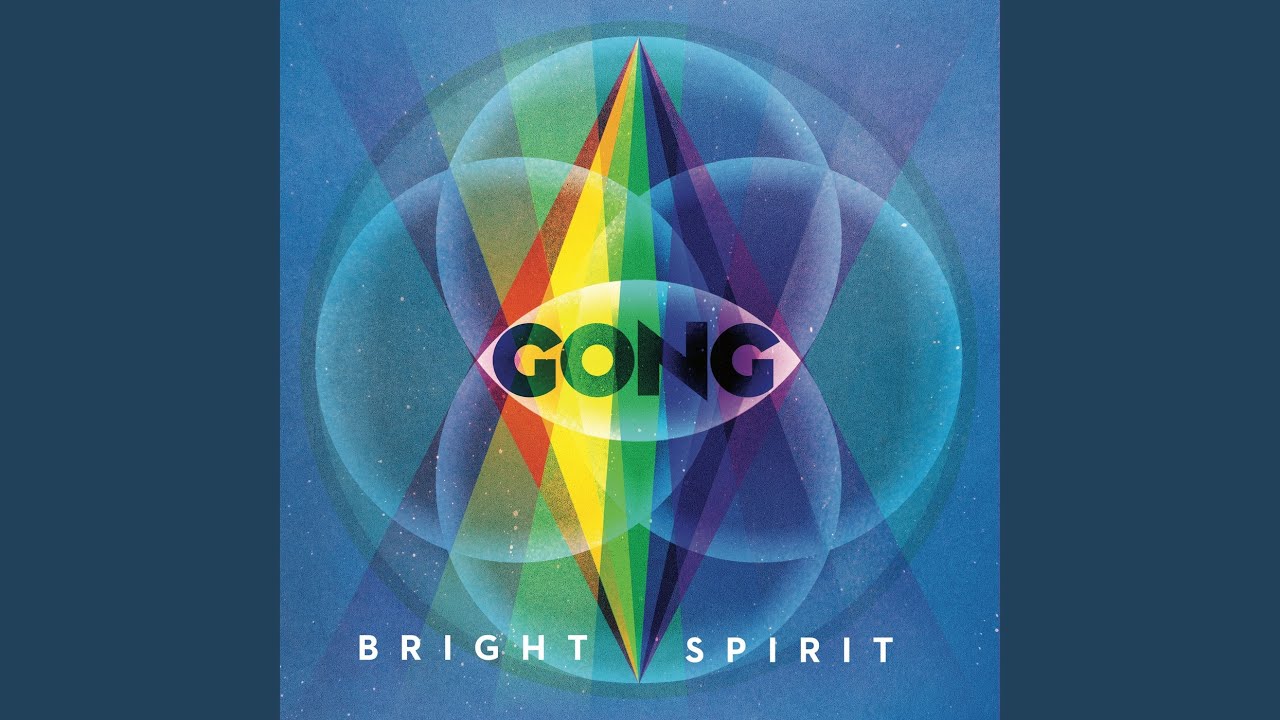
Gong’s music has always been out of this world. But on their latest offering, Bright Spirit, they transcend darkness with a hefty dose of glissando and a pinch of System 7. Frontman Kavus Torabi, bassist Dave Sturt and guitarist Fabio Golfetti tell Prog how the third part of their latest trilogy has re-energised them.
Charged with continuing Gong during Daevid Allen’s final months in 2015, the current line-up is arguably the most stable the band have had. Bassist Dave Sturt joined in 2009 and was followed by Ian East (saxes, flute) and Fabio Golfetti (guitar, vocals), with Kavus Torabi (guitar, lead vocals) and Cheb Nettles (drums, vocals) both jumping aboard in 2014.
This band’s first album, Rejoice! I’m Dead!, was a gloriously progressive transition from the Allen era; its follow-up, The Universe Also Collapses, was a collection of epics; and 2023’s Unending Ascending was an accessible mish-mash of 60s-drenched tunes and punchy bites. Compared to its predecessors, fourth release Bright Spirit seems somehow more comfortable in its own skin – a dreamscape of sorts. Golfetti labels it “a kind of resume of the creative process of this incarnation of Gong.”
The album kicks off with Dream Of Mine, a statement so startling it provided the obvious set-opener for the recent joint tour with madcap stablemates Henge. Representing Gong’s most eastern-looking manifestation since Didier Malherbe’s snakish saxophone on 1973’s Radio Gnome Invisible or perhaps the ‘om riff’ of 1974’s Master Builder, Prog wonders if its unfathomable time signature and, in Torabi’s words, “a funny-ass riff,” were a nod to his Persian heritage?
“I wrote the whole tune over Christmas 2024 at my girlfriend’s house in Newquay,” he replies. “It would probably be a little bit of a reach to say that there’s a Persian influence there – but why not?” There’s also some influence from a song he first heard as a child: Rainbow’s Stargazer. “It was just the best thing I’d ever heard,” he explains. “I always love that harmonic minor sort of stuff.”
Dream Of Mine gains additional authenticity through East’s reeds. He explains: “It immediately reminded me of the flavour of the music I play at Arabic and Balkan weddings – a beautiful joyous celebratory dance music that accompanies the arrival of the married couple, exhilarating to experience both as listener and performer. The air is electric. I play zurna [a double reed wind instrument] at weddings sometimes; that’s what you hear me play at the beginning of this track.”
The album’s other outlier is Mantivule: a spiky and uncompromising piece based around a guitar motif reminiscent of System 7. “It came from Kavus playing around with rhythmic delays,” Golfetti says, “a classic style echoed in artists like Manuel Göttsching, Steffe Sharpstrings [Here & Now], Ed Wynne [Ozric Tentacles] and myself.”
Torabi adds: “Mantivule is two things we’ve not done before: firstly it’s an instrumental, and secondly it uses the dotting technique, where you play guitar with a delay, but you play against it. You sort of bounce; you’re playing in triplets against it. I remember reading an interview with Ed Wynne from the 90s, talking about dotting – he said, ‘It turns you from a guitar player into a human sequencer.’
“Hats off to everyone, especially Ian, who started composing these hooks and these melodies on top of it. There’s no way any one of us individually could have composed the track. You can hear all five members’ different takes. Everybody’s bringing their own flavour, with harmonic and melodic decisions I’d never have come up with. I love it. It’s really exciting and extremely psychedelic!”
Elsewhere, the more reflective feel of the album is embodied by the stately Stars In Heaven. Sturt jokes: “I think Kavus has got an aversion to 4/4 – it’s not good for his health. He has to take a semiquaver out somewhere and stick it in somewhere else!”
Lead track The Wonderment recalls Steve Hillage’s Rainbow Dome Music in its tranquillity. The piece is notable for Torabi’s flirtation with the Arturia
MiniBrute monophonic synth, recalling the bubbling oscillation of Tim Blake-era Gong, as well as the soaring sounds of glissando guitar, an indelible link to the band’s classic era.
The atmospheric glissando technique pioneered by Allen in the late 60s after apparent inspiration from Syd Barrett. “‘Glissando’ means to go from one note to another without a gap, passing through all frequencies,” Golfetti explains. “It’s similar to a slide guitar, but played with the right hand. I started using a screwdriver – but you can use any metal bar.”
Death has been a big obsession for me. I felt it was my responsibility to write about this for my pre-35-year-old self
Kavus Torabi
“It’s the sound of angels singing,” adds Torabi. “It gives us a sound that no one else has; it’s instantly recognisable as Gong. It gives us a great way to work because it takes up sonically quite a lot of bandwidth. Both Steve Hillage and Daevid Allen have said – and I quite agree – that Fabio is the best glissando player they’ve ever heard. He’s really gone deep into it and has this extraordinary understanding.”
The gliss is a constant backdrop throughout Bright Spirit, not least on the achingly beautiful closer Eternal Hand, adding to a sense of reverie. Lyrically, Torabi admits to an open fascination with dream worlds, as well as a wider connection to themes of existence and mortality. “I suppose over all three albums I’m trying, in a poetic and hopefully non-specific way, to talk about my understanding of existence.
“Everything is happening in an instant, a single moment. From a young age death had been a big obsession for me; making peace with mortality. I felt it was my responsibility to write about this for my pre-35-year-old self, terrified of the inevitability of losing this fleshy avatar. You’ll hear me go on about this every single gig! I’ve always had a thing about this kind of charge that’s in dreams – it’s more than just playing out a little film, because you can feel sadness or anger or happiness or laughter in a dream. And that’s very real.
“I’m starting to see more of a connection between these dreams. Music, art, death, time, consciousness, they’re all part of the same thing. I can’t articulate this in a scientific or great philosophical way; I’m just some stoned goofball musician with a guitar!
“But around Unending Ascending, I think we started to see that we should make our trilogy. We saw the The Universe Also Collapses as the stars, Unending Ascending as the moon with its lunar invocation; and we see this one as the water.”
Bright Spirit is on sale now.
