




For a working-class kid growing up in an ailing North Wales seaside town during the 70s, opportunities were limited. But Mike Peters resolved to make something of himself. Discovering A Glasgow Gang Observed, James Patrick’s frank study of inner-city poverty and violence, had a profound effect on the teenage Peters.
“It’s about how a group of people were driven to the bottom of life’s ladder,” he explained to Classic Rock in 2014. “The only things that keep them together are clothes, music, street culture and their friendship. And when they realise they haven’t got anything else, that’s when they become their most creative. I sort of related to that story.”
Peters was inspired to write a piece (“almost a screenplay, really”) titled Sixty Eight Guns. “It was all about this gang mentality and how creative you can be when you’ve only got a white sheet of paper and no other materials to build with. I wrote a line for it that said: ‘If they take our chances, we’ll create our own’.”
In many ways, Peters’ gangland discourse set the template for his entire career, both as The Alarm’s charismatic leader and as a solo artist. He wrote socio-political songs about liberty, togetherness and self-determination. Those detractors who accused The Alarm of cheap sloganeering missed the point entirely. For all the band’s anthemic rallying cries, Peters wasn’t interested in some spurious call to revolution; his primary objective was to inspire others.

Punk provided the spark. In September 1976, the 17-year-old Peters saw the Sex Pistols play at Quaintways in Chester. Returning home to Rhyl, he wasted no time in starting his own band, The Toilets. They were imbued with plenty of raw punk spirit, but lasted barely a year. By 1978 he was fronting Seventeen, a mod-inclined power-pop alternative. Their legacy was slightly more susbtantial: an indie single (1980’s Don’t Let Go) and a tour supporting Stray Cats.
But there was something else. Peters’s final songwriting contribution to Seventeen was Streets Of Fear. Informed by his almost-screenplay from earlier, it soon morphed into Sixty Eight Guns. As the band transitioned into The Alarm in 1981, they made sure to take it with them.
The Alarm were built very much in Peters’ image. Their tenacious energy drew from punk, but the era’s pervasive sense of cynicism was shelved in favour of lyrics that spoke of hope, defiance and positivity, however unfashionable that may have been in music biz circles. At their first gig, at Prestatyn’s Victoria Hotel in June 1981, The Alarm opened with Shout To The Devil. Ostensiby a song about Peters’ take on organised religion in America, it sidestepped any devisive connotations by focusing on the universal. ‘Live your life as it should be lived,’ Peters yelled, preacher-like, over a cyclical riff and tom-tom drums. ‘Follow your heart, for the truth is everlasting.’
He needed that kind of unshakable optimism. The stop-start nature of The Alarm’s early years demanded it. The quartet – Peters, fellow guitarist Dave Sharp, bassist Eddie MacDonald and drummer Nigel Twist - moved to London, sharing a tiny flat in Battersea and scrabbling around for gigs. They recorded demos that left record companies nonplussed.
Perseverance was requisite. The band’s first major breakthrough was supporting U2 over two nights at the Lyceum in London in December ’81. It was the beginning of a beautiful friendship. As The Alarm’s fan base slowly grew over the next 18 months, U2 took them along for the Stateside leg of their War tour. Back in London, at Hammersmith Palais, Bono invited Peters and Big Country’s Stuart Adamson up on stage, declaring them “the new breed”.
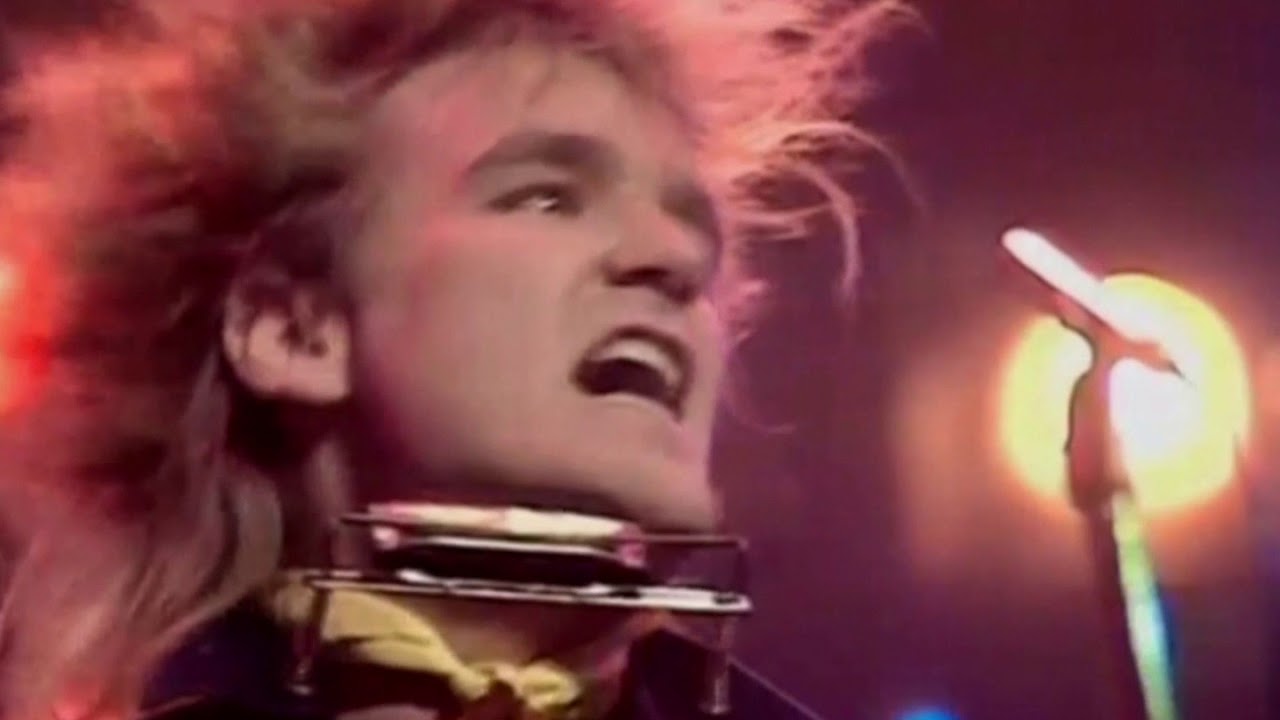
Having finally secured a deal with label IRS, The Alarm hit their stride in 1983 with third single The Stand, an instant classic that was agreeably rough around the edges and carried a rowdy folk charge. The impression was heightened by the band’s debut appearance on Top Of The Pops that September. With his spiked mullet and navy cavalry shirt, harmonica around his neck and acoustic guitar at full busker pelt, Peters looked like some post-punk descendant of Woody Guthrie or Bob Dylan. MacDonald and Sharp took their positions at either side of him, Twist beating out a rhythm behind the trio as The Alarm leaned into a rambunctious Sixty Eight Guns.
It was an auspicious moment. As the single flew into the UK chart, The Alarm arrived in the public consciousness. The following year’s debut album, Declaration, was a major success too, compounded by another hit with an unequivocal message: Where Were You Hiding When The Storm Broke?. Conceived by the band’s main songwriting axis of Peters and MacDonald, it’s an elemental call to allegiance, a day of reckoning amid a Biblical deluge. ‘Get back in your shelter if you can’t come down off the fence,’ a full-throated Peters sings, his commitment to the cause absolute.
Declaration was The Alarm at their most consequential, from the aforementioned big hitters to key tracks like Marching On and Blaze Of Glory. The latter was a damning, battle-scarred riposte to those in the music press intent on questioning the motives of U2, The Alarm and their ilk. ‘It’s funny how they shoot you down, when your hands are held up high,’ Peters declares, as the song doubles down on the band’s core principles of holding true to your beliefs.
The Alarm’s following grew apace. Steady touring overseas also brought them a sizeable US audience. In April 1986, as one of the first nationwide live broadcasts on MTV, Peters and co. attracted 26,000 people to a headline show in Los Angeles. That summer they also supported Queen at Wembley Stadium.
With their undimmed passion and quaking choruses, The Alarm seemed perfect for huge arenas. Their repertoire had advanced, too. Songs like Strength and Spirit Of ’76 (the latter an autobiographical study of Peters’ struggle to further himself on his own terms: ‘I will never give in until the day I die/Get myself some independence, carve out a future with my two bare hands’) were firm favourites. Parent album Strength went silver. By July ’87 The Alarm were supporting U2 at Cardiff Arms Park, regaling a crowd of 50,000.
Behind the scenes, however, things weren’t quite so peachy. A schism was beginning to develop within the band. Prior to recording that year’s Eye Of The Hurricane, primary songwriters Peters and MacDonald were confronted by Sharp and Twist, who demanded that they all begin writing together as a four-piece. A stand-off ensued. Peters and MacDonald held firm through the tense album sessions, no doubt feeling vindicated when it became another big seller.
There were more high points over the next few years – the first Welsh-language single to make the UK Top 40, in the shape of Hwylio Dros Y Môr; performing with Neil Young on stage in New York City; a US tour with Bob Dylan, on which Peters duetted with Dylan on Knockin’ On Heaven’s Door (“It was cheek-to-cheek with Dylan,” he recalled later. “Amazing!”) – but relations within The Alarm were even more strained. In June 1991, during a gig at London’s Brixton Academy, Peters announced that he was quitting the band.
“When any band has its first success, you all think: ‘This is it, we’ve made it!’” he told Classic Rock. “You think it’s going to go on forever. But all the things we have in life are very fragile. They can change in the blink of an eye.”

Having returned to Wales with his family and eased himself into a solo career, life for Peters changed irrevocably in 1995, when he was diagnosed with cancer. He decided to face it head-on. Already committed to live dates abroad and keen to promote his solo debut Breathe, he spent six weeks touring the States.
“I knew I had to focus on something or I wouldn’t get through those next few months,” he told us in 2011. “I thought of Lennon wearing his army jacket, and I went down that route: go to war against the illness. I went to an army surplus store and kitted myself out in green fatigues.”
Remarkably, within 12 months, doctors gave him the all-clear. “I felt so lucky and so glad to be alive,” he said. “It really fuelled the whole of my life from that point on.”
He wasn’t kidding. Peters threw his energies into reinforcing his online presence, releasing exclusive albums to eager fans, performing live and collaborating with others. In 1998, he teamed up with The Cult’s Billy Duffy as Coloursøund, who released a self-titled album the following year.
The new millennium saw Peters revive The Alarm name, as well as take to the road with supergroup Dead Men Walking, alongside the likes of Pete Wylie, Glen Matlock, Captain Sensible and Kirk Brandon. In 2004, he released a riotous single and accompanying video, 45 RPM, under the guise of The Poppy Fields, a fake teenage band from Chester. The media bought it, as did the public, sending it into the Top 30.
Peters revealed the truth live on Radio 1 during the station’s chart rundown. He also pointed out that it wasn’t merely a cheeky hoax. Bands of a certain vintage, he argued, were often dismissed as outdated by radio DJs and controllers. Peters wanted the music to be judged purely on its own merits, “and not by our old hairstyles”. The whole episode led to a Rhyl-set film drama, Vinyl, starring Phil Daniels and Keith Allen, with Peters heading up the soundtrack.

At the back end of 2005, Peters’s cancer returned, in the form of chronic lymphocytic leukaemia. His response was to co-found the Love Hope Strength Foundation, a cancer charity designed to raise money for treatment, awareness and early detection. Just as he’d done when forging a career with The Alarm, he turned adversity into a mission.
He staged all-star fundraisers in challenging terrain, from Everest base camp to Machu Picchu to the summit of Mount Kilimanjaro. In 2007 he raised more than £60,000 for local cancer care by hosting the inaugural Snowdon Rocks, an annual trek up Wales’ highest mountain, which culminated in a celebratory gig.
These initiatives dovetailed with his ongoing music career. Peters’s live shows accommodated his Get On The List campaign, designed to sign people up to the global stem cell registry, thereby increasing the likelihood of potential life-saving matches for cancer patients.
When Big Country invited him to join as lead singer in 2011, he took it as an honour. The resulting tour and album, 2013’s The Journey, proved deeply emotional. “[Big Country frontman] Stuart Adamson was a great friend of mine,” he told Classic Rock. “I’ve had to come back to health to stay alive as a musician and a father, and a lot of inspiration came from hearing Stuart sing ‘stay alive’ on the song In A Big Country. Those words were massive to me when I was in hospital having chemotherapy.”

Most recently, Peters had been “reimagining” The Alarm’s back catalogue with expanded editions of their 80s classics, updated with new lyrics reflecting the roll of time. There was a healthy amount of fresh product, too, the latest being Transformation, the final recorded act of Peters’s extraordinary life. Having twice gone into remission over the years, his cancer returned last winter. This time it didn’t go away. Peters died on April 29, aged 66.
Tributes came in thick and fast. The Waterboys’ Mike Scott fondly recalled his first encounter with The Alarm at London club Dingwalls in 1982; Simple Minds’ Jim Kerr saluted a great ally and “beautiful person”; Manic Street Preachers called him “a true fighter with a heavenly voice”; Stiff Little Fingers’ Jake Burns, a longtime friend who first crossed paths with Peters during those old Seventeen days, marvelled at the fact that “despite all that life could throw at him, I never saw him without a smile”. The Cult guitarist Billy Duffy was inconsolable. “I truly believe a light has gone out in the world today,” he wrote, citing Peters as a major inspiration and noting that he “spread nothing but positivity in every situation”.
Peters himself drew his greatest inspiration from music. Whether it was solo albums, The Alarm or any number of collaborative works, the secret was to constantly shift his perspective, to seek new challenges.
“What I’ve learned is that you’ve just got to remain fluid at all times,” he told us. “You’ve got to be brave in music, you have to be prepared to take risks to survive.”

