


Of all their records, Led Zeppelin’s fourth album, released in November 1971, remains their most admired work. From Jimmy Page’s unimpeachable riffs, through John Paul Jones’ musical invention and Robert Plant’s clarity of vocal to that titanic John Bonham drum sound, Led Zeppelin IV still emits a freshness and mystique that belies its age.
It didn’t appear in a vacuum. The three or four years that lead up to it had been a time of unfettered ambition and boundary-pushing of the kind that had never been witnessed before in music. As rock’s golden dawned, songs became increasingly more intricate and more epic. And nothing was as epic as Stairway To Heaven, the iconic track that would not just become Led Zeppelin’s most famous song, but define an entire era.
Jimmy Page once said that for him, the antecedents of his most famous musical creation lay in the same She Moved Through The Fair/White Summer/Black Mountain Side guitar showcase he had already spent years fine-tuning. But those were mere building blocks. This was a cathedral.
Originally just known as ‘The Long One’, the bare bones of Stairway were laid down during Page and Plant’s stay at their Welsh mountain retreat Bron-Yr-Aur in 1970. Nearly a year on, with the band now ensconced at Headley Grange, a former 18th-century poorhouse in Hampshire, it became the first song they tried to record for their fourth album. Plant and Bonham were sent to the pub, while Page sat down with Jones to work out the final version the band would tackle the next day.
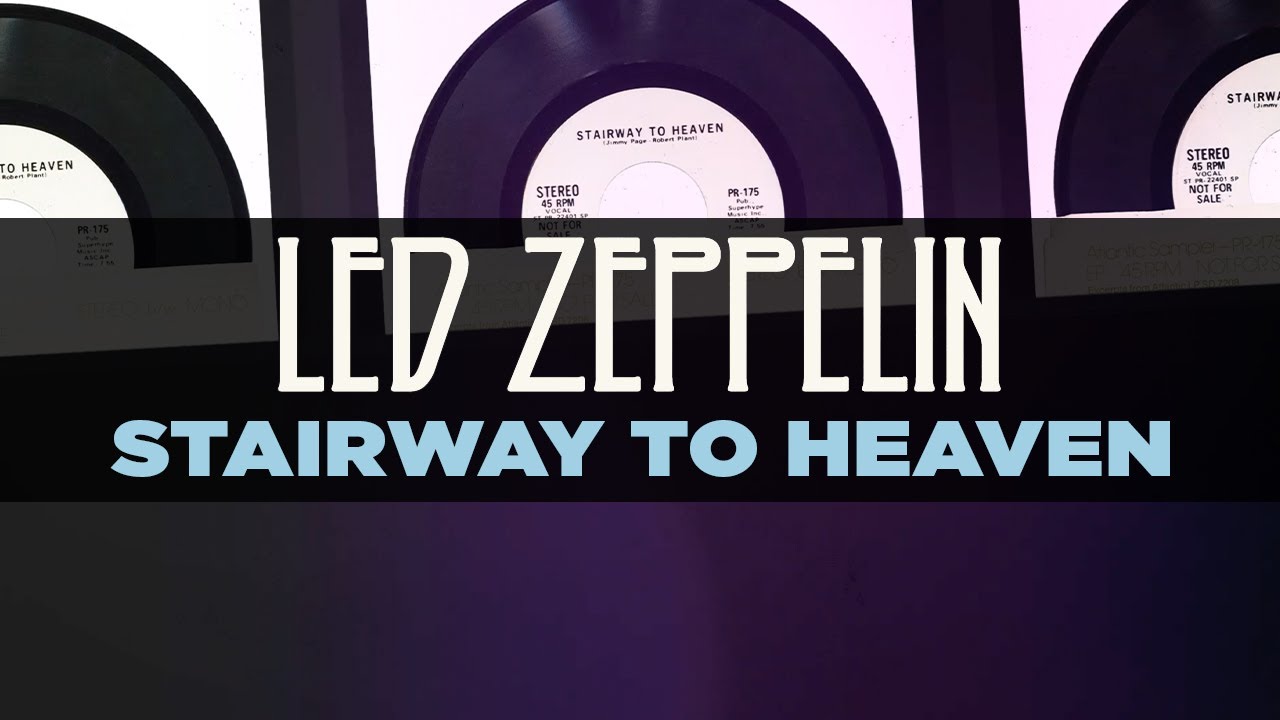
The lyrics, written by Plant, came later as he and Jimmy were sitting by the fire. “I was holding a pencil and paper, and for some reason I was in a very bad mood,” the singer recalled. “Then all of a sudden my hand was writing out the words: ‘There’s a lady who’s sure all that glitters is gold/And she’s buying a stairway to heaven…’ I just sat there and looked at the words and then I almost leapt out of my seat.”
Page liked the lyrics so much that they became the first to be reprinted on a Zeppelin album sleeve. “The lyrics were fantastic,” he said. “The wonderful thing is that even with the lyrics in front of you, you know how you listen to something and you might not quite get what the words are but you get your own impression? With this, the lyrics were there but you still got your own impression of what the song was about. And that was really important.”
The track’s now celebrated crescendo – Page’s goosebumps-inducing guitar solo – was attempted at Headley Grange, but after three hours of trying and failing to get it just so, Page finally gave up. Instead he saved it for a follow-up session at Island Records’ Basing Street Studios in London.
Not using headphones, preferring to play the backing track back through speakers, Page stood leaning against a speaker as he played, a cigarette stuck between the strings by the tuning peg. “I winged that guitar solo, really,” he admitted.
![Led Zeppelin - Stairway To Heaven (Live at Earl's Court 1975) [Official Video] - YouTube](https://img.youtube.com/vi/Ly6ZhQVnVow/maxresdefault.jpg)
He may have winged it, but it worked spectacularly. “The Stairway To Heaven solo is the greatest ever,” says Charlie Starr of Atlanta-based southern rockers Blackberry Smoke. “That solo is put together almost like a piece of classical music. It has all of these twists and turns with it. Stairway is a very singable solo, which is very important to a songwriter. You shouldn’t just play mindlessly in a solo, you should also think about the melody. If you can look out and see people singing your solos then that is very powerful.
"I became familiar with this solo when I first started to learn to play the electric guitar. It was a piece of music that was so impressive on first listen. It was inspiring and I wanted to play it correctly. Me and all of my friends couldn’t play Van Halen’s Eruption so we had to figure out how to play the Stairway To Heaven solo instead.”
The very first time Zeppelin played Stairway live – at Belfast Ulster Hall on March 5, 1971 – it received a muted reception. "They were all bored to tears, waiting to hear something they knew,” John Paul Jones remembered. Obviously, what no one knew was how incredibly popular Stairway To Heaven would become, alongside such comparable cornerstones as The Beatles’ A Day In The Life – whose three-act beginning, middle and arresting finale structure it draws on – and Queen’s Bohemian Rhapsody, which clearly apes the epic grandiosity of Zeppelin’s slow build to a guitar-blazing conclusion.
As its reputation swiftly grew, it became the cornerstone of Zeppelin’s set. It was a classic rock staple long before the concept of ‘classic rock’, though it has transcended that status to become shorthand for music at its most ambitious. Not everyone is a fan – Robert Plant himself has expressed antipathy towards Stairway on countless occasions, viewing his lyrics as a mix of youthful naïveté and hippie-ish pomposity, even donated $10,000 to one radio station never to play the song again. But he’s in the minority. To most other people, Stairway To Heaven stands as the Mount Everest of rock.

