



In a famous scene in series one of Steve Coogan's brilliant TV comedy I'm Alan Partridge, the broadcaster has a business meeting with two Irish television executives (played by Father Ted writers Arthur Mathews and Graham Linehan), and attempts to ingratiate himself with the pair by talking up his affection for Irish rock band U2.
"Sunday Bloody Sunday, what a great song," Partridge enthuses. "It really encapsulates the frustration of a Sunday, doesn't it? You wake up in the morning, you've got to read all the Sunday papers, the kids are running round, you've got to mow the lawn, wash the car, and you think, [exasperated] Sunday, bloody Sunday!"
"I really hate to do this to you, Alan," replies Linehan's character Aidan Walsh, "but it's actually a song about..."
"Bloody Sunday is actually about a massacre in Derry in 1972," Mathews' character Paul Tool chips in.
"A massacre?" says Partridge, grimacing. "Ugh. I'm not playing that again."
The joke within the joke here, which Steve Coogan understood as the son of Irish parents, is that U2 themselves were forever stressing the point that their 1983 single, taken their third studio album War, was not about the events of January 30, 1972, when British soldiers from the Parachute Regiment shot 26 unarmed civilians during a protest march in Derry, in the North of Ireland, killing 13 innocent Catholic men, with a fourteenth man dying four months later from his injuries.
When the Dublin quartet first played the song in Belfast, at the Maysfield Leisure Centre on December 20, 1982, frontman Bono explicitly told the mixed-religion audience that the song was "not a rebel song" - traditionally a folk song glorifying the Irish Republican cause, condemning the British presence in Ireland - but rather "a song of hope and a song of disgust".
"It was very emotional," drummer Larry Mullen recalled in a 1983 interview with Rolling Stone magazine. "It’s a very special song, because it’s the first time that we ever really made a statement."
In addition to being inspired by the band's own despair at the continued political and sectarian violence in the North of Ireland during what was euphemistically known as 'The Troubles', the song's lyrics were partially inspired by an argument that their manager Paul McGuinness, himself the son of a a British military serviceman, had in a New York bar with patrons who were pledging support for the paramilitary Irish Republican Army (IRA).
"I don't care who's who – Catholics, Protestants, whatever," Larry Mullen stated in 1983. "You know people are dying every single day through bitterness and hate, and we're saying, Why? What's the point?
"And you can move that into places like El Salvador and other similar situations – people dying. Let's forget the politics, let's stop shooting each other and sit around the table and talk about it... There are a lot of bands taking sides saying politics is crap, etc. Well, so what! The real battle is people dying, that's the real battle."
To avoid being too literal about the conflict in the North Of Ireland - and very possibly to lower their own chances of being targeted by paramilitary forces on either side - U2 opted to delete the song's original opening lyric, which ran 'Don't talk to me about the rights of the IRA, UDA [Ulster Defence Association]', replacing it with the line "I can't believe the news today", a reference to the fact that seemingly every single day broadcasters in Ireland would share further news of unrest and violence in the Six Counties. Elsewhere, in keeping with U2's shared Christian beliefs, the song is peppered with Biblical references, both an underscoring of their commitment to their faith, and a calling out of the hypocrisy of those involved in the conflict claiming to have God on their side, culminating in the lyric "The real battle just began, To claim the victory Jesus won."
In truth, there's a naivety to the song's lyrics: young men in their early 20s who had spent fewer than 20 days in the North of Ireland in their entire lives were never going to have the deepest understanding of the conflict. Years later, Bono would confess that "it was a song whose eloquence lay in its harmonic power rather than its verbal strength." And ahead of the release of War, in his review for NME, Belfast-born music journalist Gavin Martin wrote, "lyrically and musically it reminds me of a slightly superior Stiff Little Fingers, hardly what the world needs right now."
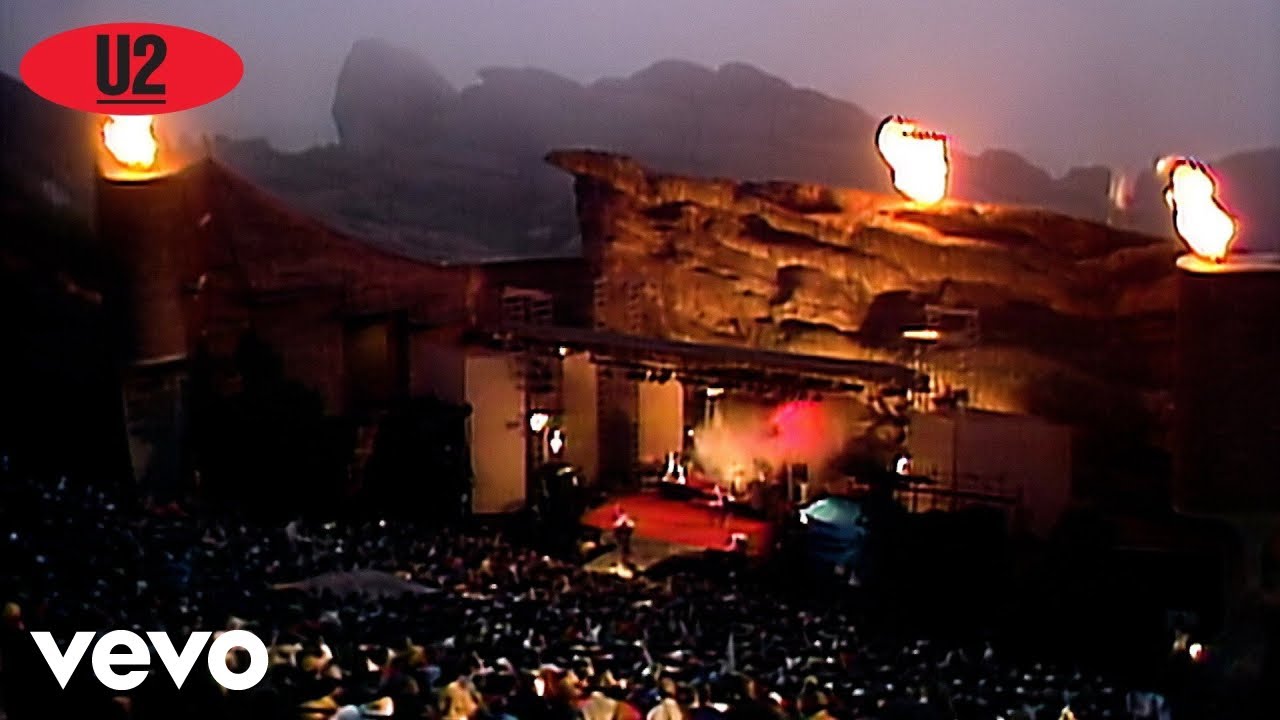
But when the band utilised live performance footage from their triumphant U2 Live at Red Rocks: Under a Blood Red Sky concert film to promote the single, the image of the singer waving a white flag while calling for an end to conflict - demanding the crowd join him in singing "No more!" - was undeniably powerful.
"It was only going to America made us think about Ireland," Bono told NME in 1984. "You just don't think about it until you have people throwing money onstage during Bobby Sands and the whole hunger strike thing. I thought that guy must be so brave, but why? Why be so brave? Why die? There's something not right about this.
"I would like to see a united Ireland, I belive it is an island," he continued. "People then say, 'Do you believe in a cause enough to die for it?' I believe in a cause enough to live for it. These people believe in taking others' lives away. I just can't agree with this whole, 'If you don't agree with me I'll put a gun to your head' vibe. Having had a Protestant father and a Catholic mother I know how grey it is. There are no sides."