




In late 1966, American industry bible Billboard ran a cover story about a trend they predicted to become a potent force on the US chart.
Under the banner headline U. S. Firms Planning Major Push On The Hot Middle Eastern Music, the paper breathlessly described how George Harrison's trips to Delhi to study with sitar master Ravi Shankar were inspiring other musicians to explore music from other parts of the world.
There were already examples in the charts. The Hollies' Stop Stop Stop featured a banjo played through tape delay unit so that it sounded like a Greek balalaika, while the rhythm was influenced by Middle Eastern music. Black Is Black by Los Bravos was based on an old Arabian folk song, and the intro to the Rolling Stones' Have You Seen Your Mother, Baby, Standing in the Shadow? sounded like a muezzin's call to Islamic prayer.
"Arabian music is dance music," said David Rubinson, a staff producer at Columbia Records. "The music is purely emotional and expressive, so there is no regard for flat sounds."
"Much of the spontaneous dancing and emotional instigation strongly ties the exotic flavour of Middle Eastern music with the psychedelic world," wrote Billboard. "Psychedelic drugs are often termed 'mind-expanding.' Eastern and Middle Eastern music aims to have the mind float out of the body (or put another way, to have the mind expand so greatly that it consumes the entire body).
"The music excites the mind. With the increasing influence of Middle Eastern music on the Western pop scene, a new vitality is brought in. Teenagers hear the music and want to dance."
In New York, one band was primed to capitalise on this merging of international music and psychedelia. As scenes sprang up in San Francisco, on Sunset Strip and in Austin, Texas, the Devil’s Anvil – named after a scene in Lawrence Of Arabia and led by future Mountain bassist Felix Pappalardi – made an album that placed them firmly at the epicentre of the excitement: Hard Rock From The Middle East.

The story began on Manhattan’s Lower East Side in early 1966. Pappalardi, a classically trained musician and studio hand, was then earning his reputation as an arranger and session player. Fascinated by the possibilities of cross-cultural pollination, he began working with a group of Lebanese-American musicians who played the Greenwich Village coffeehouse circuit.
These were musicians who brought ouds, dumbeks and bouzoukis into bars more used to acoustic folk whimsy and Bob Dylan wannabes, and Pappalardi saw potential. Together with vocalist and oud player Kareem Issaq, guitarists Steve Knight and Jerry Sappir, and accordionist Eliezer Adoram, he formed The Devil’s Anvil, intending to mix the modal scales and rhythmic intricacies of Arabic music with fuzzed-up rock power.
The group became a fixture at New York’s Café Feenjon, a venue specialising in Middle Eastern and Mediterranean music, and at an Israeli cafe, the Havah Nigilah on Broadway. Word spread fast. Columbia Records came calling, intrigued by this strange hybrid. Pappalardi, who by then was also producing the Youngbloods and the Vagrants (who included another future member of Mountain, Leslie West), convinced the label to take a gamble.

Hard Rock From The Middle East, produced by David Rubinson, sounded shockingly alien. The opening Wala Dai featured a muscular electric guitar riff snaking around an ancient Lebanese melody, propelled by clattering percussion and Issaq's impassioned, Arabic-language vocals.
All but one of the songs (a version of Misirlou, made famous earlier in the decade by Dick Dale and later by Quentin Tarantino) were sung in Arabic, Turkish or Greek. Tracks like Karkadon (released as the first single from the album) and Isme blended fuzz guitar with modal chanting, while Nahna Ou Diab sounded like the soundtrack to an acid-fried Bedouin march through the desert.
"Hard Rock From The Middle East by the Devil's Anvil is one of the most colourful, fascinating, exciting and unusual rock and roll albums we've ever heard," wrote Hit Parader. "But these American and Middle Eastern musicians keep a strong, modern beat behind every song that gives the music a universal appeal.
"We especially dig Wala Dai with its Rolling Stones-ish rhythm, the 6/4 beat in Besaha, the exotic Shisheler and Misirlou. The Anvil should add English lyrics to more of these songs. They could be hits. This album suggests a number of future directions for pop music."
"The way they play makes me feel stupid as a musician," said Youngbloods guitarist Jerry Corbitt. "I love them."
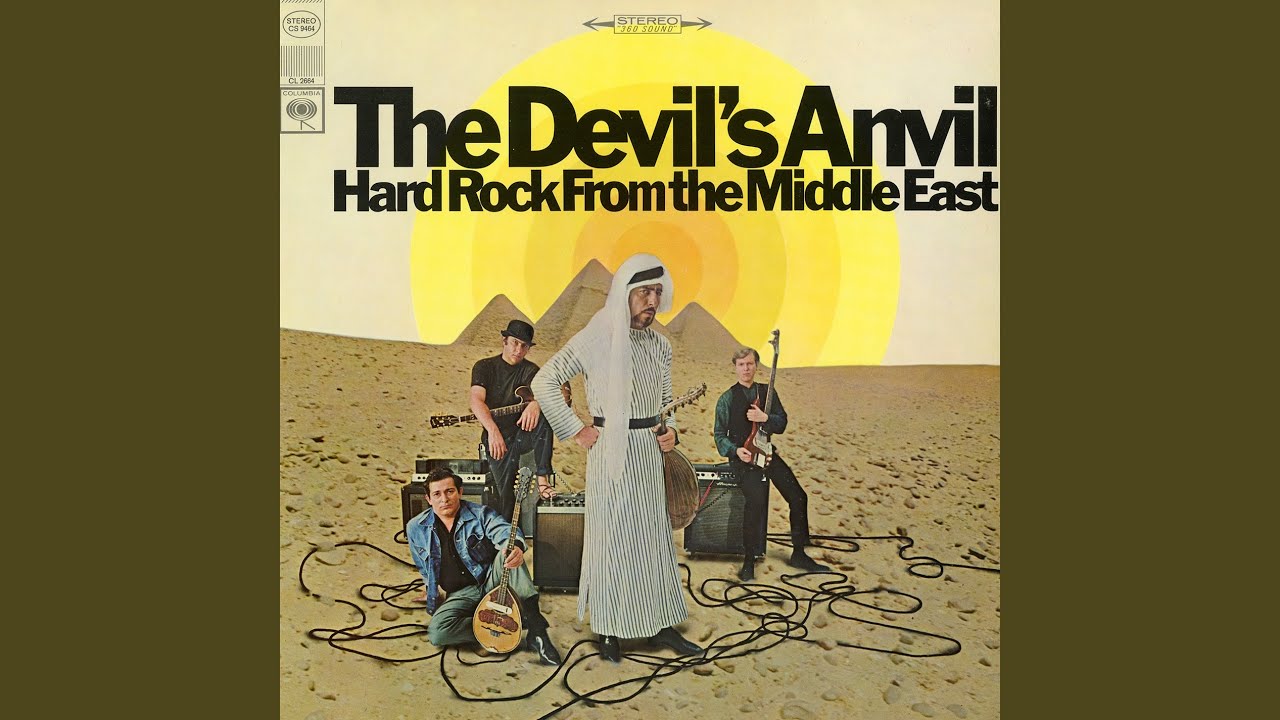
Despite the rave reviews, Hard Rock From The Middle East was doomed, its timing disastrous. Released just weeks before the outbreak of the Six-Day War between Israel and several Arab nations, the album's title and Arabic lyrics suddenly carried political baggage its creators had never intended. Radio programmers shied away. Columbia's promotions department froze. An LP called Hard Rock From The Middle East was suddenly a liability.
Within months, the record disappeared from shelves and the band dissolved. Pappalardi moved on to produce Cream's Disraeli Gears before forming Mountain with Leslie West. Steve Knight eventually joined them on keyboards, ensuring at least a flicker of The Devil's Anvil's pioneering spirit lived on in their sound. The rest of the group disappeared. Only Jerry Sappir made a noise, appearing briefly as a soloist in the original Broadway production of Zorba The Greek.
For decades, Hard Rock From The Middle East remained a curiosity, known only by crate-diggers and psych-rock scholars. But those who found it were often stunned by how modern it sounded: an early forerunner of what would much later be dubbed "world music," but with much more grunt.

When Columbia finally reissued Hard Rock From The Middle East in 2006, a new generation finally heard what Pappalardi had attempted. Critics drew parallels with everything from Led Zeppelin's flirtations with Arabic music (Kashmir, obviously) to the experimental fusion of bands like John McLaughlin's Shakti and desert blues veterans Tinariwen.
But The Devil's Anvil had been there first, with an album that sounded like it came from an alternative, more honest version of the 1960s, when the counterculture didn't just look to the East for inspiration but actually met it halfway. There's still nothing like it.

