


When Spooky Tooth agreed to collaborate with composer Pierre Henry, the resulting album – 1969's Ceremony – turned out to be a brave but misguided disaster that, as far as one band member was concerned, ruined their career. In 2013 Prog argued that, with the passage of time, Ceremony deserves a second look.
In the spring of 1969, Spooky Tooth could have been forgiven for thinking they had the world at their feet. Their second album, Spooky Two, had been canonised in the music press – and with just cause.
Shortly afterwards, the band were approached by avant-garde French composer Pierre Henry, who was seeking a rock band to collaborate on his next project.
Formally trained at the Paris Conservatoire, Henry had developed an interest in studying the art of noise, which led to him becoming an exponent of musique concrète. He exhibited the results in Symphonie Pour Un Homme Seul (“Symphony for One Man Alone”) – a work based entirely upon sounds made by the human body.
He’d also scored the ballet Messe Pour Le Temps Present (“Mass For The Present Time”) in 1967, including a piece called Psyché Rock, which was later remade to become the Futurama theme tune.
Henry proposed the concept of a holy ritual, and Spooky Tooth keyboardist Gary Wright warmed to the idea, composing six numbers laden with Gothic overtones and laced with enough Wagnerian chords to give the Hellfire monks of Medmenham the heebie-jeebies.
While other band members may not have shared the same level of enthusiasm, they nevertheless entered wholeheartedly into the concept; and mad vicar Mike Harrison’s gutsy, gospel-tinged vocals conferred much authority upon proceedings.
Henry had no contact with the band during his recording process; upon receiving the two-track tapes, he overdubbed his own contributions.
The result was a work which possessed a kinship with Terry Riley’s A Rainbow In Curved Air, and An Electric Storm by White Noise; and held a direct lineage to Louis and Bebe Barron’s soundtrack for sci-fi classic Forbidden Planet.
Ceremony (An Electronic Mass) was released by Island Records in the December of 1969 – without the consensus of the band. “That wasn’t our album,” Wright said in a later interview. “It was with this French electronic music composer named Pierre Henry. We told the label, ‘You know, this is his album, not our album. We’ll play on it just like musicians.’”
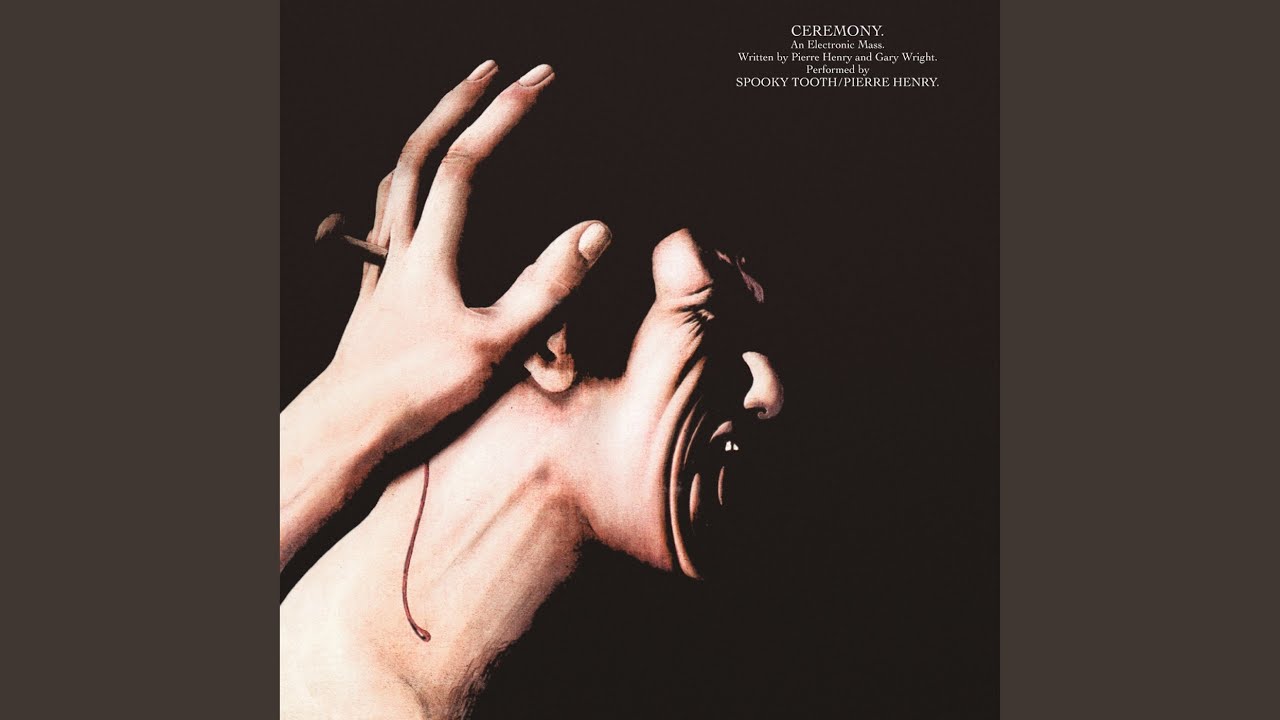
The release drew scathing reviews and divided fans – as did John Holmes’ provocative cover art. After recently gained notoriety for the jacket of Germaine Greer’s book The Female Eunuch) Holmes depicted a man with a hand nailed to his head – an image that some believed irreligiously aped the crucifixion of Christ.
Although a commercial success in France, the album failed to chart elsewhere. It fractured the original Spooky Tooth line-up as a disillusioned Wright (who died in 2023) quit the band, declaring the work “an utter failure.”
“When it was finished they said, ‘It’s great – we’re gonna release this as your next album,’” Wright recalled. “We said, ‘You can’t do that. It doesn’t have anything to do with the direction of Spooky Two and it will ruin our career.’ And that’s exactly what happened.”
But he was wrong, even if it felt like that at the time. Ceremony may have been flawed – but fusing electronic music and rock became the cornerstone of an entire progressive movement, with proponents directly related to Ceremony including Robert Fripp and Brian Eno. The artists who made the 1969 proto-prog experiment should be proud of it.
