


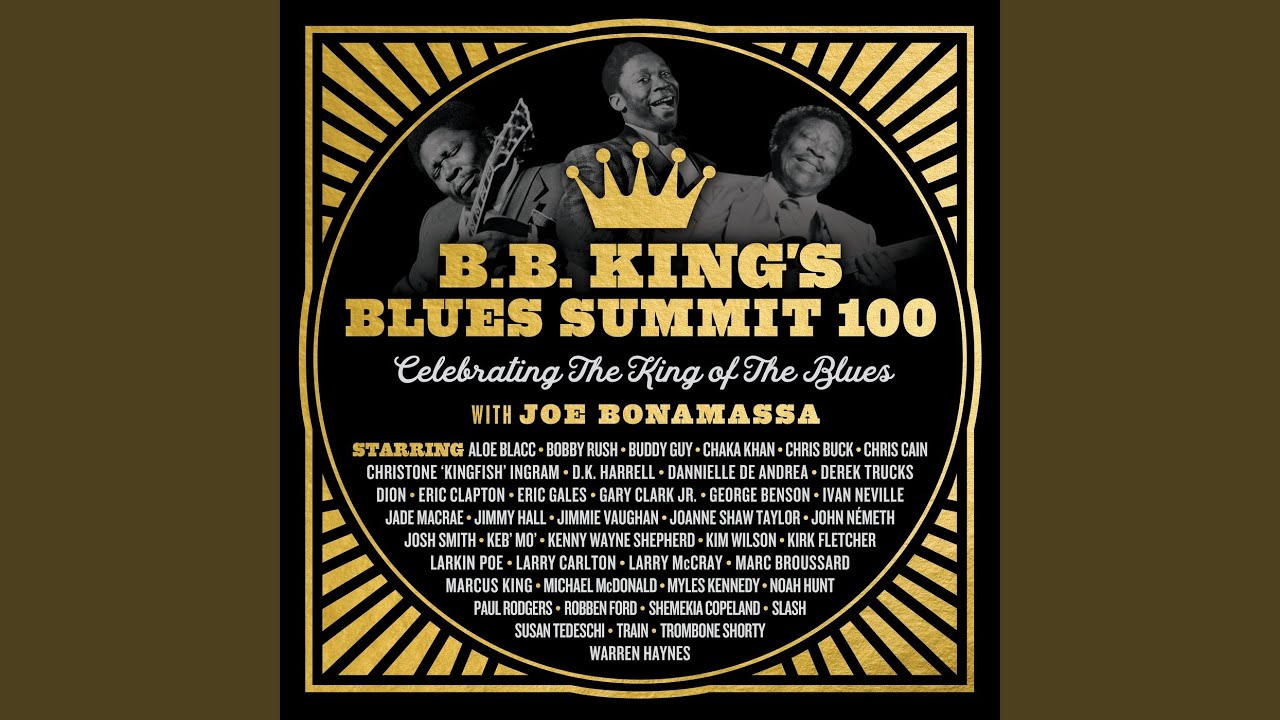
“Why did I organise the B.B. King’s Blues Summit 100 project? Because it was like: ‘I can’t believe nobody’s doing anything for his 100th birthday. Somebody’s gotta do something.’ And I’m certainly not going to do a tribute album for his 150th birthday, when I’m 97, y’know?
“B.B. was such a total artist. He was such an entity. The singing, the playing, the songs. I think he made, like, sixty records over the years. He had some real bangers. For me, you should start with Live At The Regal [1965] or Blues Is King [1967]. Or for studio records, Indianola Mississippi Seeds [1970], then the record with The Thrill Is Gone, Completely Well [1969].
“When people say: ‘Oh, B.B. King doesn’t play much on guitar’, it’s like: ‘Are you fucking kidding me?’ He’s one of the only guitarists to ever play that you can identify with one note. If you listen to B.B.’s playing, he actually had a lot of jazz in him; he had some Wes Montgomery and definitely Charlie Christian, but also some T-Bone Walker. But once you got into the sixties, his approach and phrasing were so uniquely him.
“I think, most of all, what he was able to do was time. Y’know, where he would place notes. He was never in a hurry. And I think one of the most overlooked things about B.B.’s playing is that every solo he took had a great story.
“When I first met B.B. [in 1989], I didn’t really grasp the gravity of it. When you’re twelve years old, you know what I mean? But he was this larger-than-life personality and figure. I was blessed to know him for twenty-five years. He showed me the right way to tour, taught me about the professionalism. The band was always immaculately dressed, on time, respectful. And if you can live by that, then you got no worries.

“The fact that this tribute record exists is a miracle. These people are all active touring musicians. One day, the secret tapes will come out, with me playing and singing on every track, because as we got guests to commit, we’d strip away my parts. But almost everyone we pitched said ‘Yes’, without even hearing the tracks. It came down to Slash and Eric Clapton at the very end. But they all came together for B.B. There’s Paul Rodgers, George Benson, Buddy Guy… and not just blues players, either. I mean, Train’s not a blues band, but Pat Monahan was so into it. You can’t play rock guitar and not have at least some of that influence.
“I know that if B.B. heard this record, he’d be really chuffed with it. I think he’d be really happy with the versions that we did, and that the whole community came out to support him. There’s a lot of love for B.B. in the room and you can hear it on the record. Everybody brought their A-game. Because it’s him. He’s the king of the blues, y’know?”
Joe Bonamassa, 2026

ABC Records
The blues had a baby, so the saying goes, and its name was rock’n’roll. Unfortunately, by the mid-50s the offspring was eating the parent. With the afterglow of early singles like 3 O’Clock Blues having faded – and before his hand-up from the British Invaders – King played to thinning audiences as a new generation sought heavier pleasures. The tide turned in 1962, when he left the Bihari brothers (four label bosses with a fast ’n’ loose attitude to writing credits) for ABC Records, and three years later the deathless Live At The Regal sparked his second coming.
Big Red
As the son of a Deep South sharecropper, it was unthinkable that, by 1955, King would have the means to commission his own custom tour bus. (“It had my name on it,” he proudly told Rolling Stone of the converted Greyhound bus.) But the original Big Red would become synonymous with tragedy, after one Saturday in 1958, on a road outside Dallas, the band’s ride was involved in a head-on collision that killed the driver and passenger of a butane truck (almost ruining King, who hadn’t renewed the insurance).
Cook County Jail
King admitted to having had nerves in September 1970 when he arrived to play at the Chicago penitentiary that even the Illinois Crime Commission described as a “jungle”. On the live album that resulted – 1971’s classic Live In Cook County Jail – his jitters are evident on opener Every Day I Have The Blues. But as keyboard player Ron Levy pointed out, the 2,000-plus inmates were B.B.’s flock and he soon warmed up. “A lot of the people who are incarcerated, they were in his audience at one point or another.”
Deep South
King was the sweetest-natured of the postwar bluesmen, but don’t ever imagine he was a naif who had floated past the endemic racism of his home state. As a teenager in Lexington, Mississippi, he recalled standing transfixed on the sidewalk as a lynch mob beat and castrated a young black man, dragged his shattered body behind a car, then left him to swing. “The white men, they’d hang some youngster nearly every week or so,” King told The Blues. “I grew up knowing that I didn’t have a name but ‘boy’.”
Eric Clapton
The British guitarist was still a member of Cream when he jammed with King for the first time, at New York’s Cafe Au Go Go in 1967, and his endorsement was a decisive factor in the older musician’s career uptick. “Finally – finally – when the kids started to play blues, they opened up a lot of doors for B.B. King,” he told Guitar Player.

Fillmore
King’s first thought was to fire his booking agent when he pulled up at San Fran’s Fillmore Auditorium in February 1967 (“All these guys with long hair,” he said of the white hippie audience thronging the venue’s steps, “they didn’t seem bothered with us at all”). But promoter Bill Graham assured the bluesman that this was indeed the place, and brought King on stage to a standing ovation that announced his mainstream crossover. By the time King left the Fillmore West stage, he remembered, he was so overcome that “I cried back up the stairway”.
Gibbons
The little ’ol band from Texas might never have boogied were it not for King’s formative advice. “I was about twenty-two and just starting out with ZZ Top,” Billy Gibbons told Guitarist. “I was in the dressing room and B.B. said to me: ‘Can I play your guitar?’ I said: ‘Sure man.’ He strummed it a few times and handed it back. He looked at me rather quizzically and said: ‘You got heavy, heavy strings.’ I said: ‘Well isn’t that how to get the heavy, heavy sound?’ He said: ‘No! Don’t be working so hard!’ I guess he was right there at the beginning when super-light strings were beginning to show up.”
Hells Angels
Such was the strength of King’s charm, he could even disarm the biker gangs who prowled the US music festivals of the late 60s. “They come by and one of ’em says: ‘B, you want a ride?’” he once recalled of beating the gridlock before a performance in Augusta, Georgia. “They put me on the bike behind him and, boy, he was in and out of traffic. Scared the hair off me but I got to the place!”
Internal Revenue Service
Big Red’s crash in ’58 also wrote off King’s balance sheet, forcing him to cover costs with money earmarked for taxes. For years to come, he would be visited on the circuit by officials chasing late payments, and when Johnny Winter asked to sit in at the Raven Club in Belmont, Texas, the paranoid King feared he was an IRS spy. “B.B. asked to see my union card,” Winter told The Blues. “He wanted to check me out. It took him a long time before he decided to let me play.”
Jake and Elwood Blues
B.B. King was a gaping omission in 1980’s Blues Brothers movie (“His manager, Sid Seidenberg, didn’t make time in his schedule to do it,” explained biographer Daniel de Visé. “Now, B.B. was very upset about this, when he found out, many years later”). Amends were made in 1998, when King led fictitious supergroup The Louisiana Gator Boys in Blues Brothers 2000.
Keresene
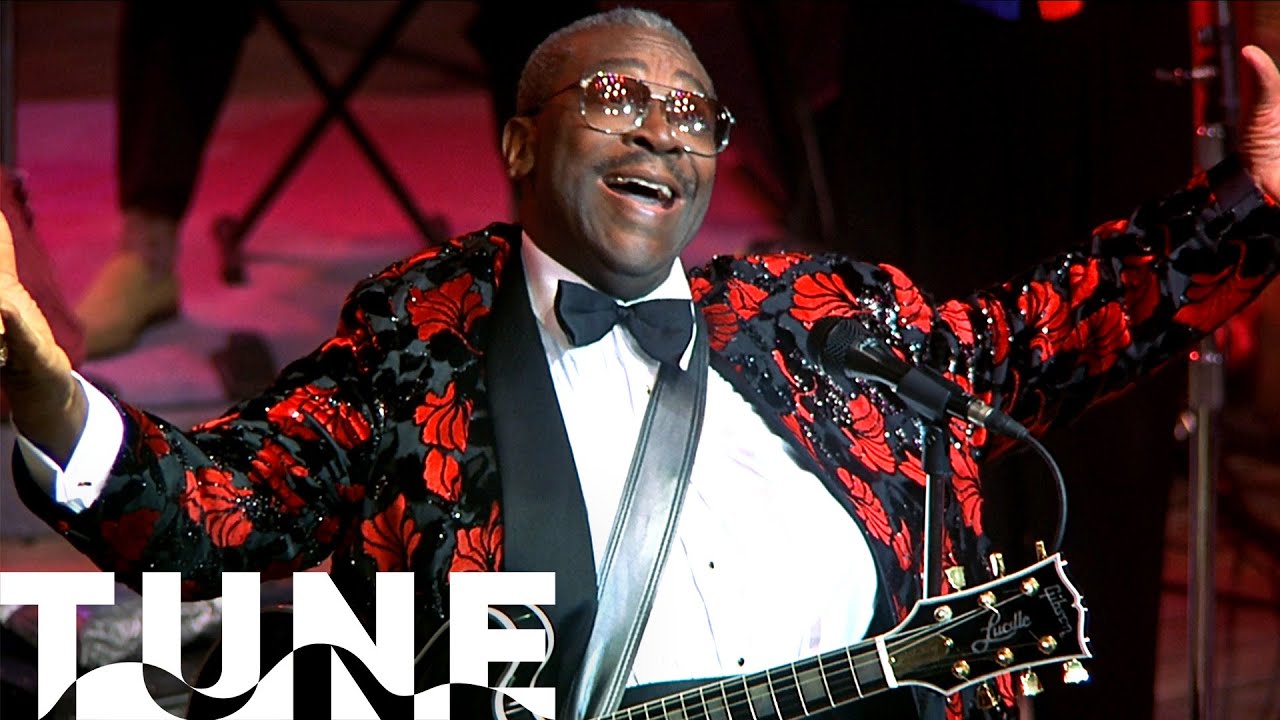
Twist, Arkansas, winter 1949. In a bitterly cold chitlin’ circuit nightclub, B.B. King performs for a rowdy crowd – and watches in horror as two slugging punters spill an open barrel of blazing kerosene across the dancefloor. “When I got outside, I found out these two guys was fighting about a lady in the nightclub whose name was Lucille. But then I realised I’d left my guitar inside. So I went back in for it – and I named it Lucille to remind me not to do a thing like that again. And I haven’t!”
Lucille
In the early 80s, Gibson launched King’s Lucille signature guitar as a production model, sparking the eternal misnomer that a ‘Lucille’ is an ES-355 with ornate gold hardware and the F-holes removed. King did play that design for almost his entire career, but he also gave the name ‘Lucille’ to whatever guitar he happened to be playing at the time. The original Lucille, rescued from the aforementioned blaze, is believed to have been a Gibson L-30 archtop.
Memphis
The Tennessee city’s famed Beale Street had appeared to King in dreams, and in the late 40s, having damaged his tractor and scared of the consequences, the farm boy took off to stay with his cousin, Bukka White. Soaking up the electric sounds of T-Bone Walker, Charlie Christian and Django Reinhardt – alongside the founding influence of Blind Lemon Jefferson and Lonnie Johnson – King forged his tone and early career here. He went on to open the first B.B. King Blues Club on Beale Street, in 1991.

Nightly banter
Heavily scripted and regular as clockwork, King’s working of an audience was still a thing of joy, evolving from his teasing asides on Live At The Regal to the oft-repeated joke about how he hoped to kick the bucket: “When I do eventually drop, I pray to God that it’ll happen in one of three ways. Firstly, on stage or leaving the stage. Secondly, in my sleep. And the third way? You’ll have to figure that out for yourself.”
Offspring
‘I gave you seven children and now you want to give ’em back!’ ran the best line on How Blue Can You Get? – but it was likely a conservative estimate. Most sources believe King fathered at least 15. No surprise, given his eye for the ladies. “As a tractor driver, sex was always on my mind,” he wrote in his autobiography. “It didn’t take much to get me going. If I drove past a girl picking cotton, I’d notice the way she bent down. The way her buttocks outlined the back of her dress could fire me up for hours.”
Poisoning (alleged)
King’s death in 2015 took an unseemly turn when two of his daughters accused the bluesman’s inner circle of foul play. “I believe my father was poisoned and that he was administered foreign substances to induce his premature death – I believe my father was murdered,” stated Patty King and Karen Williams in twin affidavits. The coroner felt otherwise, citing cause of death as a combination of Alzheimer’s, coronary disease, heart failure and complications from type-2 diabetes.
Queen
It’s testament to King’s immense cultural ripples that his influence lives on in bands who at first glance contain not a lick of blues. “I played with him just once, at the Montreux Jazz festival, along with Etta James,” Brian May wrote on his Soapbox blog. “It was a great night, and I had the chance to see B.B. up close weaving his magic. I noticed he was always focused on where his ‘voice’ was. He’d talk and sing and even tell jokes while the song thundered on, and only when he was ready would he take to the guitar, at which point that became his voice – and what a voice!”
Regal Theatre
King himself considered the show at Chicago’s Regal Theater on November 21, 1964 to be just another date in the diary. With due respect, he’s wrong. The following year’s Live At The Regal is the blues genre’s (original) Live At Leeds: an unvarnished snapshot of a showman at the dizzying peak of his powers, utterly in control of the performance and the audience. “I stumbled across Live At The Regal,” recalled Jeff Beck. “It’s an electrifying live performance of blues guitar and B.B. is a master of microphone technique. He brings his music down to a whisper then bursts out with amazing solos.”

Segregation
Even as a star name, King couldn’t escape the dividing lines of road life in the early 60s. “I’ve put up with more humiliation than I care to remember,” he recalled in the 2012 documentary The Life Of Riley, adding that he was staying at Alabama’s black-only Gaston Hotel when it was bombed by white supremacists in 1963. “Touring a segregated America – forever being stopped and harassed by white cops hurt you most cos you don’t realise the damage. You hold it in. You feel empty, like someone reached in and pulled out your guts. You feel hurt and dirty, less than a person.”
The Thrill Is Gone
In the summer of 1969, King partnered producer Bill Szymczyk to record the Completely Well album, little realising that the final track – The Thrill Is Gone, written in 1951 by Rick Darnell and Roy Hawkins, and here draped in orchestration – would change his fortunes for ever. It became his highest-ever chart placing, winning a Grammy for Best Male R&B Vocal Performance (and closing in on a billion Spotify streams). For the new Summit 100 album, Joe Bonamassa felt that only Clapton could handle the responsibility. “You either need to have icons themselves do it,” he said, “or you need to find an unsuspecting young artist that wants to do it and you make them the sacrificial lamb!”
U2
In 1988, the Dublin band’s back-to-the-roots album Rattle And Hum was rubber-stamped by King’s cask-aged holler on its track When Love Comes To Town (which as a single became a worldwide hit).“I gave it absolutely everything I had in that howl at the start of the song,” recalled Bono. “And then B.B. King opened up his mouth and I felt like a girl. We had learnt and we had absorbed, but the more we tried to be like B.B., the less convincing we were.”
Vibrato
While it’s a little glib to reduce King’s seminal guitar playbook to a single move, there’s nothing and nobody else out there quite like that one-note shiver. As the bluesman explained, his technique grew from mimicking Bukka White. “He used to play slide using a bottleneck. I wanted to do that, but I got stupid fingers, see. So I devised my own technique for producing the tremolo without the slide. I swivel my wrist from my elbow, back and forth. With my other fingers stretched out, my whole hand makes a fluttering gesture, a bit like a butterfly flapping its wings.”
Workaholic
By his early thirties, King was burning the kind of tarmac that would virtually kill today’s so-called road warriors. “In 1956 I did 342 one-nighters,” he told Esquire. “But I was young then, and I was doing something I love to do. I didn’t pay any attention until my agents told me at the end of the year: ‘B.B., do you know how many dates you did?’ Even I was surprised at that.”

X marks the spot
King didn’t check out on stage, as was his wish. He played his final show on October 3, 2014 at Chicago’s House Of Blues club, before being diagnosed with dehydration and taken off the road. He died in Las Vegas the following May. His body was flown to Memphis for a funeral procession down Beale Street, and thence to burial at The B.B. King Museum in his hometown of Indianola, Mississippi. “I thought once about being cremated,” he’d mused in American Blues Scene. “Then I thought about that some more and said: ‘Oh, no’. If there’s any such thing about coming back again, I want all my parts with me!”
Young Man Blues
The usual suspects – Clapton, Beck, Page, Richards etc – have cited King’s playing since the 60s. But as Bonamassa points out, the tracklisting of Summit 100 saw a new wave of acolytes – from Marcus King to Christone ‘Kingfish’ Ingram – tip their hat. “I remember getting a message from Gary Clark Jr when we asked him to cover Chains And Things,” said Bonamassa, “and he was like: ‘Wow, it’s a big sing.’ But they’re all big sings.”
Zaire 1974
Mounting a major overseas tour for the first time in the early 70s, King was amazed to find how far and wide his music had spread. The UK, Japan, Sweden and Australia would all welcome him over the years. But one of his most enduring performances was his headline set at the Zaire 74 festival, captured on both the Soul Power documentary and the Live In Africa ’74 concert film. “I’m ready!” he booms before taking the stage, and by the end of this powerhouse mid-period tour de force, no one was arguing.
B.B. King’s Blues Summit 100 is out now on KTBA Records.

