


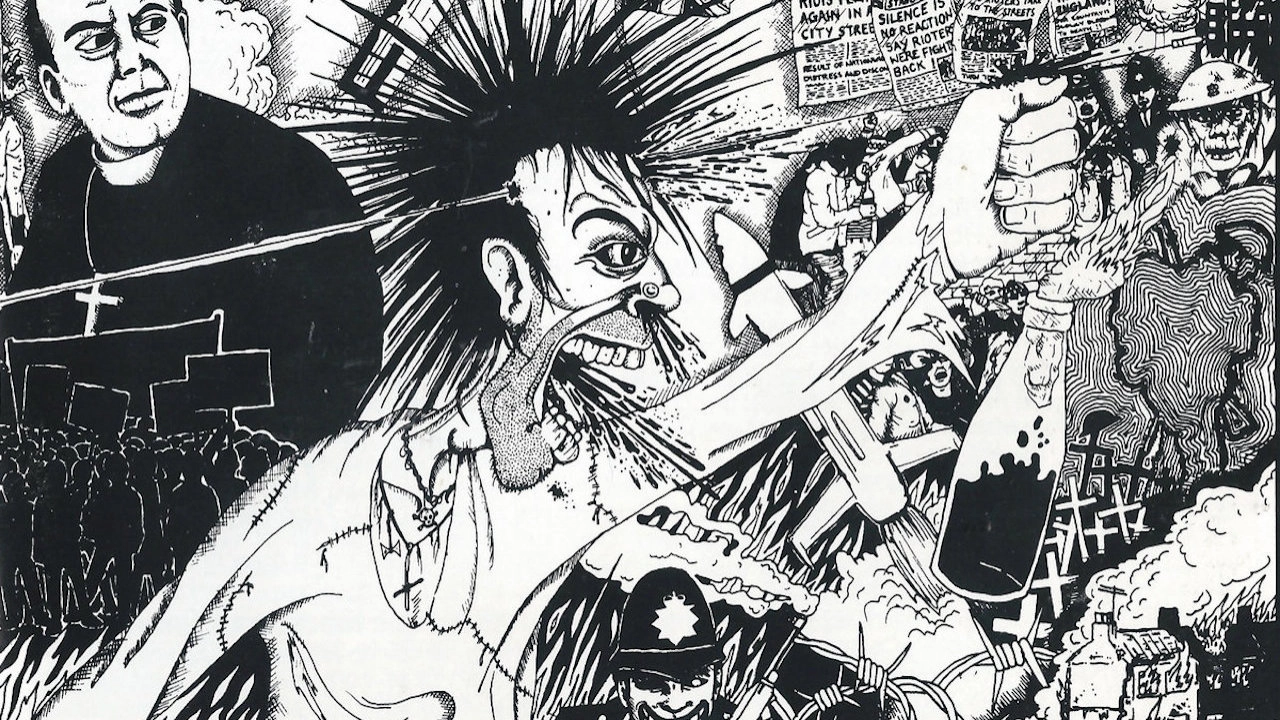
A country economically divided and in the midst of a nuclear crisis, Thatcher’s Britain was the perfect setting for an album that would go on to define an entire decade.
The Day the Country Died by Subhumans was released at the height of the Cold War in 1983. Since forming in 1980, the Wiltshire four-piece had previously released three EPs, Demolition War, Reasons for Existence and Religious Wars. By the time The Day the Country Died had hit the record shops, Subhumans were well on their way to establishing themselves as pioneers of punk’s most reactionary sub-genre, Anarcho.
Along with Subhumans, the two other bands that were spearheading the Anarcho scene were Essex art collective Crass and Stoke-on-Trent hardcore crew Discharge. Their abrasive take on punk purposefully distanced itself from the likes of the Sex Pistols and The Clash. Discharge were known for their extreme speed and heaviness, while Crass adopted a more straight ahead sound that later experimented with free improvisation. Overall it’s the lyrical message that determines a band’s place within the Anarcho movement and this places a lot of freedom in the music.

While bands like Crass and Discharge broke new ground musically, lead singer Dick Lucas, guitarist Bruce Treasure, bass player Grant Mulry and drummer Trotsky were still heavily influenced by the sound of ’77. In the case of The Day The Country Died, the band backed their socio-political commentary with the kind of roaring guitars and pumping bass lines that first catapulted punk into the mainstream.
Subhumans had so much more to offer than your typical three chords. They mangled jagged guitars and breakneck beats, injecting it with their own caustic charm. The Orwellian Big Brother is by far the meanest track on the album, offering double the attitude and twice the rage. Subvert City on the other hand, is over four minutes long, and incorporates a gloomy acoustic introduction and a soaring guitar solo.
Like Subvert City, album opener All Gone Dead is fuelled by post-apocalyptic imagery, a common trait in Anarcho music. Subhumans even went so far as to include a sample of a nuclear bomb blast in the album’s first five seconds. “The world has ended, the gas is gone, it killed the people, now the mutants live on,” declares Lucas in his ill-tempered, snotty tone.
The nihilistic behaviour is pushed further on No.
“No, I don’t believe in Jesus Christ,
No. I don’t believe in religion,
No, I don’t believe in the police force… No, I don’t believe in the system!”
Lead singer Dick Lucas holds nothing back as he tackles topics ranging from the police state (Till The Pigs Come Round) to smokers (Ashtray Dirt), with Bruce Treasure’s snarling backing vocals adding an abrasive texture to the already ferocious wall of noise. This is a coherent body of work set against a backdrop of anarchy and chaos and whose message still resonates today.

