


Rob Halford was disappointed. It was April 1975, and Judas Priest had been invited to make their TV debut on music show The Old Grey Whistle Test. Halford, their lead singer – and later self-anointed Metal God – presumed this meant visiting the BBC’s flagship facility at London’s White City; not a quick trip from their native Walsall to the Beeb’s Pebble Mill Studio in Edgbaston.
“I was dying to meet the show’s legendary presenter, ‘Whispering’ Bob Harris, who always talked as if he was sharing a sacred secret,” Halford recalled years later. Instead, the group trundled up to Pebble Mill in their Ford Transit. There, they found the studio amps covered with carpet off-cuts to muffle the noise, a cardboard box full of earplugs, and no sign of ‘Whispering’ Bob.
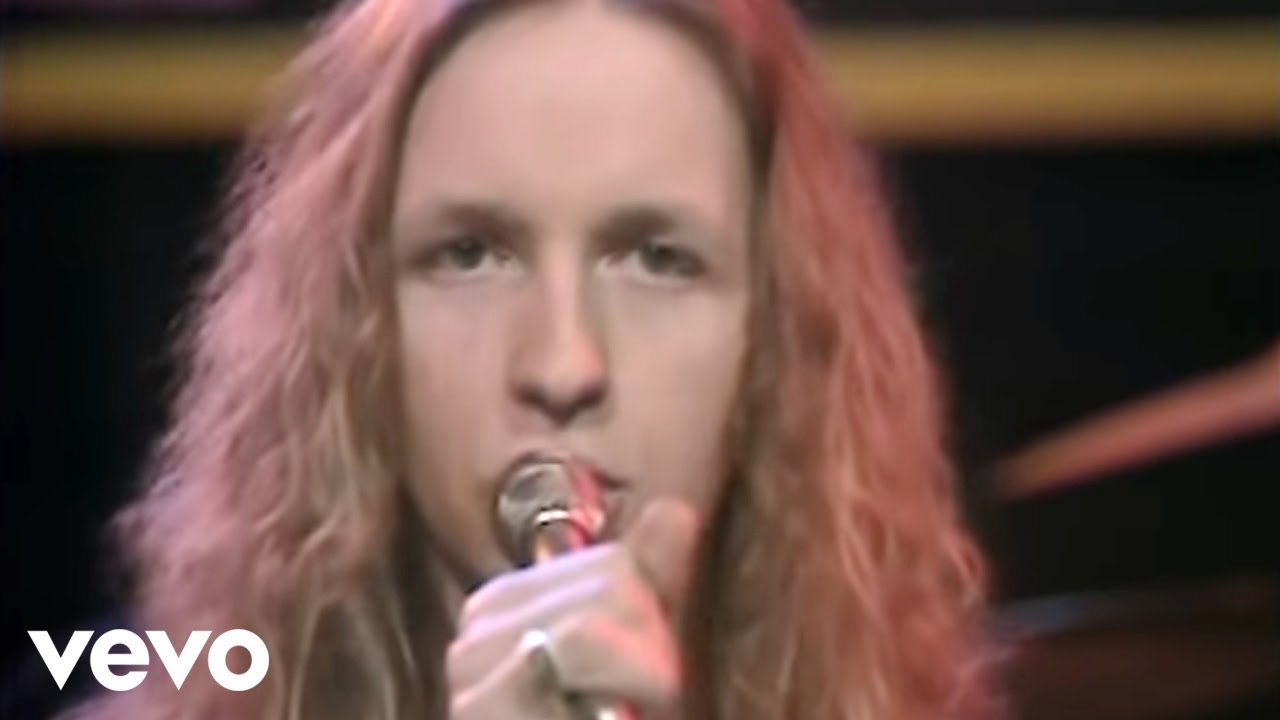
Judas Priest performed a new song, Dreamer Deceiver, and the title song of their first album, Rocka Rolla, with the Whistle Test logo behind them and an unseen audience of cameramen, presumably wearing earplugs, in front.
“Thank god that footage still exists,” Halford says today. “The BBC constantly reused tapes, but that one was saved, and it’s become legendary.”
Thanks to the joy of algorithms, the clip sometimes pops up when Halford is scrolling online, affording him an unexpected glimpse of his 23-year-old self, wearing curtains of blond hair and his sister Sue’s blouse, flanked by guitarists Ken ‘KK’ Downing sporting a white fedora hat and Glenn Tipton in a spangly blue jacket.
“We looked like three bands in one – a tin of heavy metal Quality Street,” Halford wrote in his 2020 memoir, Confess. “But when I look at that clip now, I see so much self-assurance, so much confidence,” he marvels. “It was as if we’d been around for ages, and we were practically a new group. But the day after, we probably walked a bit taller. You think: ‘Well if we can get on the BBC, where can we go next? Anywhere?’”
Judas Priest were everywhere this summer. It’s the 50th anniversary of their second album, Sad Wings Of Destiny; their Faithkeepers tour arrived in the UK for a headline appearance at the Bloodstock festival in Burton-On-Trent; and their story so far is the subject of a new Best Of collection, as well as a documentary, The Ballad Of Judas Priest.
Rocka Rolla is the oldest song on this new compilation, and an ideal starting point for Halford to explore his journey as a writer and lyricist. He joins Classic Rock from his home in Phoenix, Arizona, materialising on screen all in black, with sunglasses shielding his eyes, his neck draped with heavy metal bling, and a silver ring through his columella (that’s the medical term for the flesh at the bottom of your septum, apparently).
Despite having a home in the US for more than four decades, Halford hasn’t lost his Brummie burr. If Black Country accents were shades of brown on a Dulux colour chart, then Halford’s would be ‘Gentle Fawn’. For comparison, his near neighbour growing up, Slade’s Noddy Holder’s is ‘Intense Chestnut’.
Halford has spent more than half a century helping create the lexicon of heavy metal, with songs about power, corruption and biblical doom and pestilence. Or, in his words, “psychological and philosophical traumas via dramatic, apocalyptic tales of gods, devils and warriors fighting epic battles”.
But he has written about more than just those subjects. “If you want to go deep into the territory, then it’s pretty wild where some of those messages were coming from,” he says.

Halford, who grew up on the working-class Beechdale Estate in Walsall, once described himself as an “ordinary boy doing ordinary things at the end of the 1950s”. He discovered his phenomenal singing voice after belting out the Scottish lullaby The Skye Boat Song in a music lesson. At sixteen, he took a part-time job working the lights at Wolverhampton Grand, which fuelled his love of theatre and performance.
In May 1973, at his sister Sue’s recommendation, he joined her future husband, bassist Ian Hill, and guitarist KK Downing’s struggling local group Judas Priest. The band’s first deal, with independent label Gull Records, was comically bad (“They couldn’t afford to pay us a fiver each in wages”), but it led to Rocka Rolla and its breakthrough follow-up, 1976’s Sad Wings Of Destiny.
The old adage that ‘necessity is the mother of invention’ is borne out by Judas Priest’s early hand-to-mouth existence. “It was a case of: ‘Do we spend this five pounds on some chips, or do we buy petrol?’” recalls Halford. “And we always chose the petrol so we could get to the next gig. But most bands go through the same.”
In their early days, Ian Hill lived in a drab block of flats in Handsworth Wood, where Halford and Downing often crashed after listening to records and trying to write songs.
“I honestly can’t remember what the first song I ever wrote lyrics to was,” Halford insists. “But it’s probably something like Rocka Rolla or Winter’s Retreat on that first album. These days I look at the words to Rocka Rolla and do a bit of an eye roll. But we were young and I was a different person then – and we had to write our own material.
“Priest had been out on the road doing pubs and clubs before we got the deal with Gull, but I don’t recall doing covers. From day one we were playing songs like Never Satisfied or Whisky Woman, which later turned into Victim Of Changes, and whatever else we were noodling with at the time.
“But I took inspiration from everywhere,” he continues. “We were at the beginning of something new and experimental in music. We were passing from the hippie phase into a time when everything was getting louder. I can remember sitting with KK, listening to Hendrix, Wishbone Ash, Yes and Jethro Tull as well as the obvious stuff like Sabbath, Zeppelin and Purple.

Glenn Tipton’s arrival in Judas Priest in May 1974 was a game changer.
“Glenn had this ability to create unusual, abstract riffs, which put him apart from other guitarists,” says Haford. “He came up with that riff for Rocka Rolla – which we played recently for the first time in living memory – and it’s an unusual arrangement.”
This experimentation fed Halford’s imagination as a lyricist. “I hated how so many heavy rock songs were about getting drunk or fucking women – lame predictable stuff,” he said in 2020.
“It was accepted I’d be the lyricist, that it was my job,” he says now. “The seeds for many of these lyrics were planted by books and movies and all this other stuff in my life. If there’s a theme to my lyrics, then it’s probably the battle between good and evil – and good usually wins.”
For a time, Halford was, in his words, “obsessed” with author Mervyn Peake’s Gormenghast trilogy: Titus Groan, Gormenghast and Titus Alone. These escapist gothic fantasies were written after the Second World War, but became popular again in hip 60s and 70s circles.
“Peake made me want to look further than the simple framework of songs in heavy rock,” Halford explains. “It was his attention to detail. If someone walked past a wall in one of his books, it was never just a wall. He’d tell you exactly what it looked and felt like. Peake made me think you can take one word, like ‘light’, and think about what it can mean. It can illuminate, it can mean fire, it can destroy.”

Mott The Hoople’s 1972 hit All The Way From Memphis includes the line: ‘And you look like a star, but you’re still on the dole.’ It could have applied to Judas Priest. Despite having made their first TV appearance, some of the group had to take part-time jobs while recording Sad Wings Of Destiny; Gull allowed them just 50p each to spend in the studio canteen while mixing the record. Back on the Beechwood Estate, Halford sometimes glimpsed Noddy Holder’s white Rolls-Royce parked a couple of streets away outside his mum’s house, and wondered if Judas Priest would ever make it like Slade had.
Priest’s penury rarely impacted on Halford’s swashbuckling image or grand ideas, though. In August 1975, the band made their Reading Festival debut, with their singer promenading in a red cloak and waving his father’s silver-topped walking cane. Meanwhile, his lyrics to Sad Wings Of Destiny song Island Of Domination were inspired by novelist Isaac Asimov’s prescient tales of artificial intelligence and galactic social unrest. “I always found classic authors such as Chaucer and Shakespeare a bit foreboding. I got well into science fiction and fantasy. I loved the escapism of it.”
Sad Wings Of Destiny scraped into the UK chart at No.48 – good enough for the band to improve their living conditions by signing with Columbia. But the new label started pushing for more radio-friendly songs: “We were told this was what was needed if we wanted to make a footprint in America.”
The new Best Of includes Priest’s cover of folk singer Joan Baez’s Diamonds And Rust, a song suggested by Gull but rejected by the band while making Sad Wings. There was a tenuous connection, in that it was about Baez’s ex-boyfriend Bob Dylan, from whose song The Ballad Of Frankie Lee And Judas Priest the group had taken their name.
“We were in the studio, and someone at Gull sent us a copy of Diamonds And Rust and a note: ‘Have a listen, we think you can do magic with this.’ So we played it, and started laughing,” Halford recalls. “I couldn’t make the connection to us. But as the song progressed, we all looked at each other and said: ‘Okay, we know what we need to do.’ Which was to give it some big heavy metal balls.”
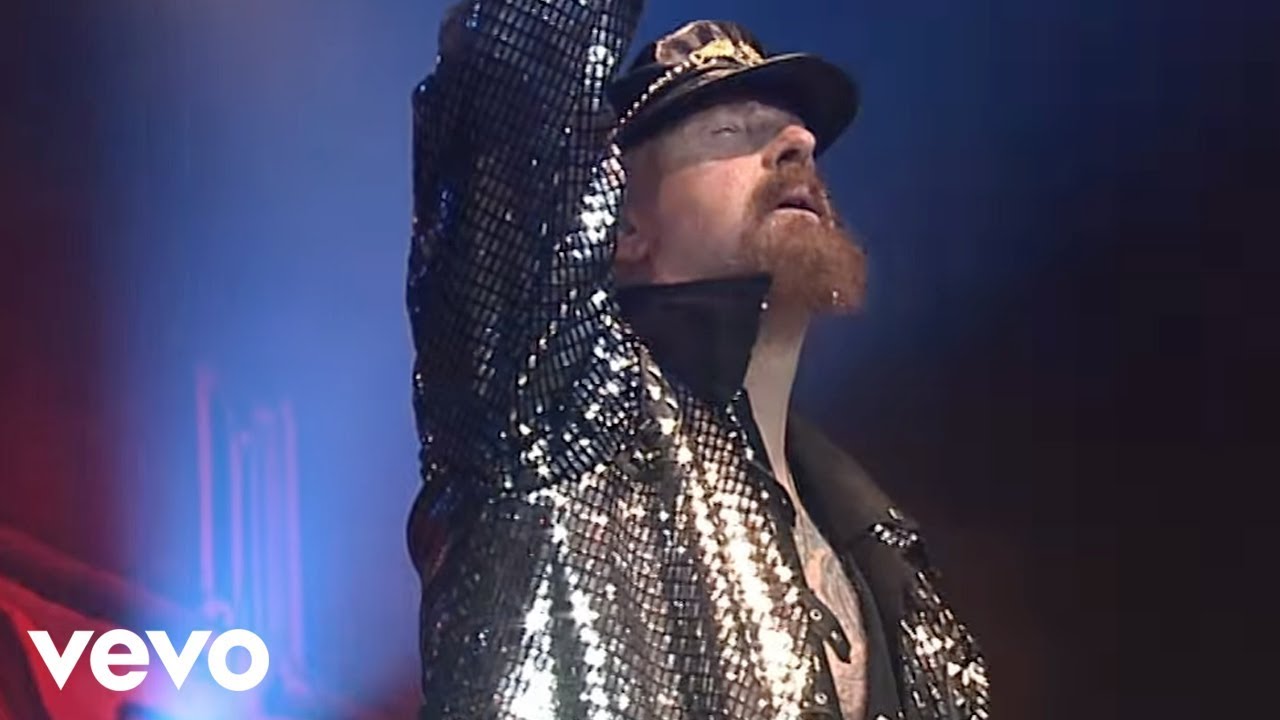
Diamonds And Rust became the only single from 1977’s Sin After Sin, Priest’s third album, and wasn’t a hit. “But we’d learned a valuable lesson. That is, if you’re going to cover someone else’s song it has to become a Jekyll-and-Hyde thing. You have to stamp your identity on it, or there’s no point. We did the same when we covered [Fleetwood Mac’s] The Green Manalishi and [Spooky Tooth’s] Better By You, Better Than Me later on.”
When Priest started work on the album, with former Deep Purple bassist Roger Glover producing, Halford brought his copy of Roget’s Thesaurus into the studio. Glover mistook it for something else: “He said: ‘Is that a bible, Rob?’” In a way it was: “It’s helped me write the lyrics for every Judas Priest album from Sin After Sin onward.”
The gothic mausoleum on the album cover could have been one of the gateposts on Mervyn Peake’s Castle Gormenghast, but the lyrics to one of its most powerful tracks, Dissident Aggressor, were inspired by Halford’s first visit to the Berlin Wall: “I was looking over from West Berlin, and there were these Russian guys in East Berlin looking back at me with binoculars.”
“Rob was always a reader and a watcher of the world generally,” KK said Downing in 2018. “He has a naturally inquisitive nature about all things.”

Halford had known he was gay since childhood, and his bandmates accepted his sexuality. On Sin After Sin’s Raw Deal he smuggled in a lyric about cruising gay bars on New York’s Fire Island without having ever been there.
“It all came from my imagination,” he says with a laugh. “All that stuff about walking into a bar, asking the bartender for a bourbon and slapping him across the face, and the leather dudes and denim dudes… But at the end of the song there’s a line: ‘Love knoweth no laws.’ It’s a famous quote by someone I can’t remember. [The proverb is generally credited to the 16th-century dramatist John Lyly.] But it’s true, love doesn’t have a law attached. Everybody in the band trusted me so much that they never questioned that lyric. They just said: ‘Here’s the song, put some words to it.’”
Despite his bandmates’ acceptance, this was 1977, when in the UK homosexuality had been decriminalised only 10 years earlier, and there were few ‘out’ gay musicians. While Halford deploys a lot of droll humour (“I’m a vanilla type of gay”), he doesn’t hide the loneliness and frustration he felt at times.
Beyond The Realms Of Death, from 1978’s Stained Class, is widely regarded as the grandest of Priest’s grand epics. “Glenn is responsible for one of the most glorious lead breaks in the history of metal on that song,” Halford claims. “But subconsciously there’s a lot of yours truly in it. [Recites the lyrics] ‘He’s had enough, he couldn’t take any more, he found a place in his mind, and slammed the door… I’m safe here in my mind, I’m free to speak with my own kind.’
“It’s about isolation and rejection, a feeling of darkness,” he reveals. “I think for men particularly there’s this angst about growing up – how do I fit in? And you just want to shut yourself away in your room. That’s the story behind Beyond The Realms Of Death.”
There was a similar sense of isolation in the ballad Here Comes The Tears, which Halford has since described as “me, aged twenty-six, wallowing in self-pity”.
“Although there were these little steps into my world and sexual identity, I’ve never had an agenda,” he stresses. “I never tried to use the band for my own ends. We never discussed the lyrics or what they meant, only whether they worked for the song or not. Nobody else knew.”
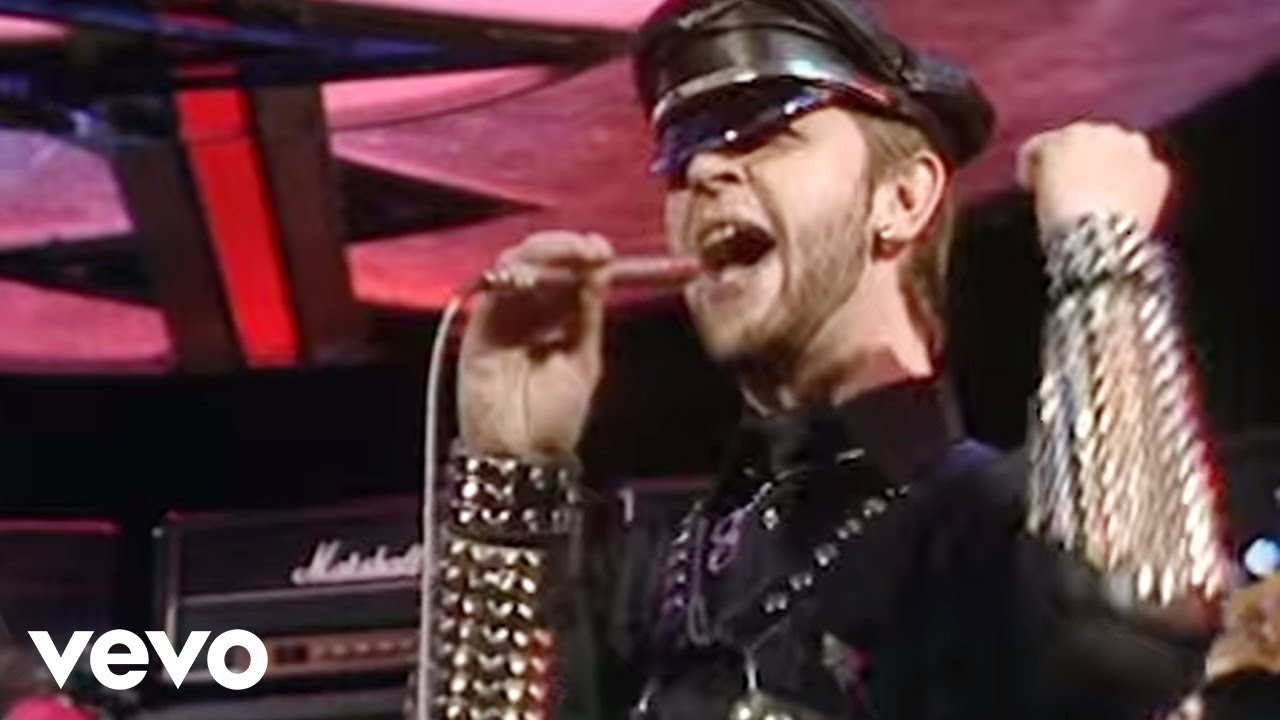
Rob Halford saw out the 70s invariably clad in black leather and chainmail and occasionally brandishing a whip on stage. All of Judas Priest had adopted an image that would become heavy metal’s visual lingua franca, and allowed their singer to effectively hide in plain sight.
It was this version of Judas Priest that made their Top Of The Pops debut with Take On The World in February 1979. The song’s lyrics were unashamedly on the nose (‘You got to leave your seat, you got to get up upon your feet’), its football-terrace chorus led to it being adopted by Wolverhampton Wanderers as their club song, and Halford admits it was heavily influenced by Queen’s We Will Rock You.
“I’d seen Queen early on at the Birmingham Odeon, and it was very inspiring,” he recalls. “But it wasn’t just that song. When we did Tyrant [for Sad Wings Of Destiny], and that line ‘Tyrant, capture of humanity, tyrant, conqueror of them all’, we said let’s do it like Queen and take certain words and stick a load of vocal harmonies on them. Queen made us think: ‘We can do whatever we want. We can do anything.’”
This self-belief paid off when 1980’s British Steel album reached No.4 in the UK, with the hits Living After Midnight, Breaking The Law and United helping to attract a broader audience.
“I’ve always been a pop tart,” Halford admits. “As much as I loved Ian Gillan and Janis Joplin, I also liked Marc Bolan and T.Rex and Bowie, and I’d grown up on The Beatles and Gerry And The Pacemakers and looking at Top Of The Pops.”

Living After Midnight was a route-one pop-metal song with a universal theme. “It might sound simple, just like The Beatles’ ‘She loves you, yeah, yeah’ sounds simple, but it’s not. People hear ‘Living after midnight, rocking to the dawn, loving til the morning and I’m gone’ and they all go: ‘Yeah, now I know what that’s about.’ It’s the simplest thing in the world to write songs. It’s the hardest thing in the world to write songs that live for ever.”
Even today, no Priest show or ‘best of’ is complete without that track or Breaking The Law. In the documentary The Ballad Of Judas Priest, Billy Corgan, Scott Ian, Lzzy Hale and the film’s co-director Tom Morello listen to US rapper/producer Darryl McDaniels comparing Breaking The Law’s lyrics to a hip-hop protest song (“like some Ice Cube shit”).
Grim footage of 80s-era protestors clashing with police, and the then-prime minister Margaret Thatcher denouncing those who “attempt to substitute the rule of the mob for the rule of law” are also shown alongside Halford declaring it “a revolutionary song”.
Judas Priest recorded British Steel at Ringo Starr’s Berkshire manor, Tittenhurst Park, in barely more than a month. “We worked all day and didn’t put the telly on until after dinner,” Halford recalls, “and it was always the same news – riots, riots, riots. That was stimulating enough for me to come up with the words ‘There I was completely wasting, out of work and down.’ So Breaking The Law was about a rough time in the UK. But sadly it’s still relevant today – and it’s worldwide.”
The 1980s brought some personal challenges. While Priest’s career accelerated in the States with Screaming For Vengeance (1982), Defenders Of The Faith (1984) and an appearance at 1985’s Live Aid charity concert, Halford was still hiding his sexuality from the world, “for fear of destroying the band”, and self-medicating with cocaine and alcohol.
But his sense of humour didn’t desert him. Years later he would cheerily divulge that Defenders Of The Faith’s Jawbreaker and Eat Me Alive were “about a giant cock, and the joy of getting a good blow job”, respectively. “But the moral of the story is probably write lyrics when you’re sober,” he admitted.
Halford finally hit the wall while making 1986’s Turbo. He checked into rehab, and claims not to have touched booze or an illicit substance since. Returning to the band clear-headed made him self-critical, too. The band still play Turbo Lover (“a song about car sex”) live regularly, but Halford dismisses the album’s Wild Nights, Hot And Crazy Days and Rock You All Around The World as the nadir of his lyric writing: “Rubbish, just clichés,” he scoffs.
Halford still believes that 1990’s Painkiller is Judas Priest’s Sgt Pepper (“It’s the definitive metal album”). But, weary of the group’s infighting and keen to explore elsewhere, he left the band after its release for what turned out to be almost a decade. While on sabbatical, Halford formed two groups, Fight and Halford, and collaborated with other musicians, including Nine Inch Nails’ Trent Reznor, before returning to the fold for 2005’s Angel Of Retribution, the first of five more Priest studio albums.

During this time, Priest have weathered the departure of KK Downing and been re-energised by his replacement, Richie Faulkner. Later, Glenn Tipton’s retirement from touring due to ill health led to the band bringing in guitarist/producer Andy Sneap.
“There’s a lot of love for each other in this band, then and now,” Halford insists. “But there will always be creative friction. Every fucking musician thinks they’re the greatest in the world – ‘How dare you suggest I change this lead break?’ Or ‘How dare you suggest I change my lyrics?’ I have a lot of difficulty with compromise, but that’s because I’m a diva and I want the best things to happen. But sometimes you have to try a different angle. I’ve learned to accept that.”
Whether on The Old Grey Whistle Test in 1975 or at Bloodstock in 2026, Rob Halford remains Judas Priest’s ringmaster, and he’s still singing about psychological and philosophical traumas. ‘I’ll bring you the head of the demon, I’m peeling the skin from his face,’ he declares on 2018’s Lightning Strike – with utter conviction, although presumably one eyebrow raised.
“It’s a hundred per cent never po-faced,” he says, smiling. “Priest music is about escapism and joy. I’ve always said we take our music deadly serious as professional musicians, but if you can’t have a laugh and a good time then you might as well pack it in.”
In February this year, Halford’s musical life flashed before his eyes when he and his husband, Thomas, watched The Ballad Of Judas Priest at the Berlin Film Festival. “It was very powerful,” he says. “I didn’t know what to expect, and there were lots of emotions – laughter, tears – all the different elements that make up this band. I left that movie theatre and walked back to the hotel with my head held high, the same way I did leaving Pebble Mill Studios after The Old Grey Whistle Test.”
Halford pauses, puts his fingers together like a priest about to recite a prayer and cracks a sly grin. “And back at the hotel I had a cup of Yorkshire Tea and a Hobnob biscuit, and felt very good about myself.”
Surely the perfect way for any Metal God to end his day. Amen.
The Best Of Judas Priest is out now. The band are currently on tour in Europe, and play London on September 21.

