




The first time Bruce Dickinson sang on stage with Iron Maiden, he kept his eyes shut for the first half of the set. “I don’t think I opened them until we did Killers,” he says today.
The band endured an arduous three-day bus journey before that show, on October 26, 1981, at Palasport in Bologna. “When we got to Italy, it was a bit dodgy – people being threatened with hand grenades and all that,” understates the singer. “None of which bothered me in the slightest, because the main event was my big moment with Maiden.”
So why the closed eyes?
“Because I had to get my own world straight before I could go into the outside world."
Dickinson joins Classic Rock, via modern technology, from a living room devoid of gold discs or images of Maiden’s immortal mascot Eddie; just exposed woodwork and a tasteful paint job that might be magnolia. With his gunmetal grey ponytail and habit of heading off at tangents, Dickinson has the air of an upbeat, but easily distracted, hippieish university lecturer.
Iron Maiden have two high-profile events taking place this summer. Last month saw the release of a new documentary, Iron Maiden: Burning Ambition, which tells their story through archive footage, animation, and interviews with fans and celebrity supporters, including Hollywood royalty Javier Bardem.
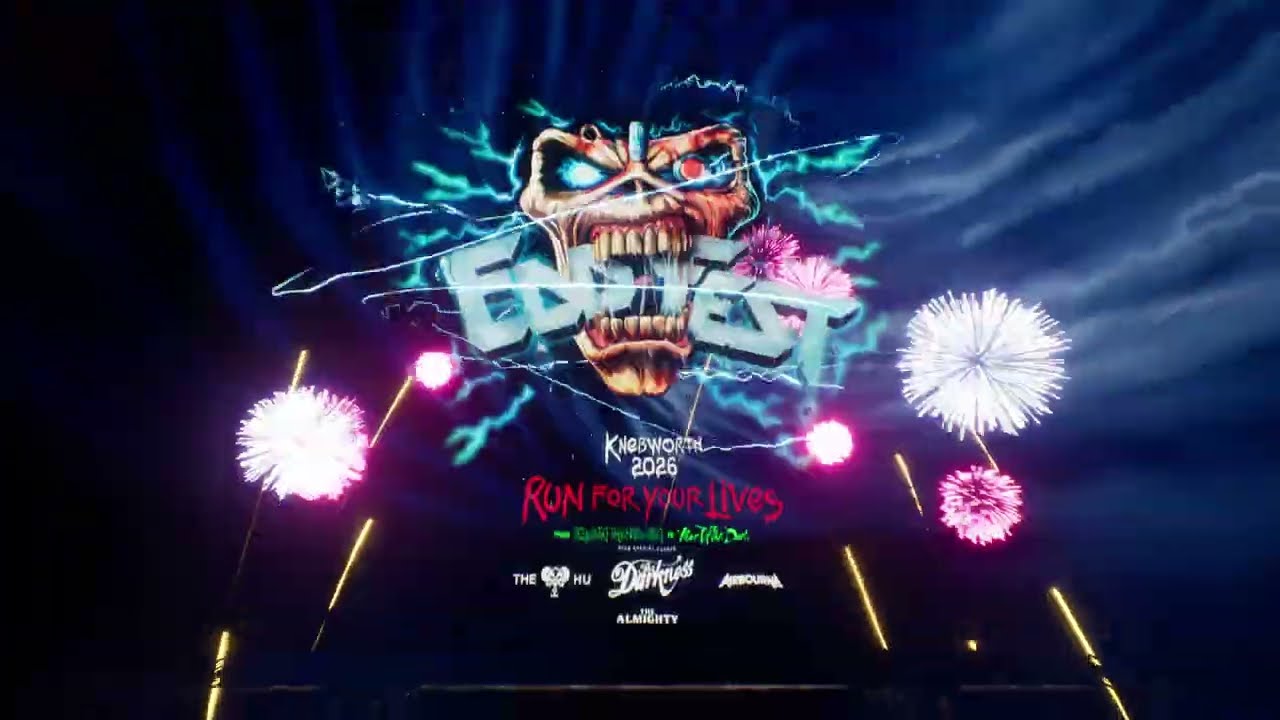
In July the band headline ‘Eddfest’ at Knebworth Park as part of their Run For Your Lives 50th-anniversary tour. There, themed bars, fairground rides and the Infinite Dreams Museum Experience promise to transform the grounds of the Hertfordshire stately home into ‘Maiden World’.
The idea of Iron Maiden existing in what Dickinson later describes as “its own bubble” is a prevalent theme in the documentary. Dickinson, bassist Steve Harris, drummer Nicko McBrain and guitarists Dave Murray, Adrian Smith and Janick Gers (as well as Dickinson’s predecessor, the now late Paul Di’Anno, and his former temporary successor Blaze Bayley) are all interviewed, but appear in the film only as their younger selves. “Because we’re not as good-looking as Eddie,” Harris deadpans.
Instead, an animated Eddie (a constant presence on every Maiden single, album sleeve and piece of merchandise since the dawn of time) illustrates some episodes, while the modern-day Maiden narrate off-camera, like a crew of seasoned ancient mariners.
Steve Harris came up with the idea for Iron Maiden in 1975, and burned through singers, guitarists and drummers until hiring vocalist Paul Di’Anno in ’78. Following one disagreement too many, Di’Anno quit after Maiden’s second album, 1981’s Killers. Enter Dickinson, from fronting jobbing hard rockers Samson.
“Never has anyone been better equipped for world domination in his mid-twenties than Bruce Dickinson,” suggests one of the film’s talking heads, Classic Rock and Metal Hammer writer Dom Lawson.
Would you agree with that?
“Yeah, no… maybe,” replies Dickinson. “It’s very nice of someone to big me up, but I didn’t quite view it in those terms. I do think me and Steve was a really good match up, though. The film’s title is Burning Ambition, and that’s what Steve’s all about too.”
With Dickinson on board, Iron Maiden built on the success of the first two albums and turned themselves into what he calls “a global band”.

Harris entrusted band manager and “bombastic Yorkshireman” Rod Smallwood to help him realise his vision (“To build a creative fence around the band,” as Smallwood says in Burning Ambition). But there would be conflict. Not least with his new lead singer.
The dynamic between East End-born ex-Waltham Forest Borough Council road sweeper Harris and former Oundle public school boy-turned-rock star, champion fencer and airline pilot Dickinson is a constant presence in the Maiden story.
“Steve is the introverted, quiet, thoughtful young man from the East End working class,” explains Burning Ambition’s director Malcolm Venville. “And then you’ve got this public schoolboy, who is very expansive, very educated and – how can I say it? – volcanic. There’s a lot of mutual respect, but I think over the years there’s been a crazy energy between them.”
Dickinson gleefully recalls Harris jockeying with him for a centre-stage spot at Newcastle’s City Hall, and the pair almost coming to blows later. “We needed to butt heads, though,” he says, “because Steve needed to realise I wasn’t a pushover.” Harris also needed Dickinson’s voice to help realise his musical ambition (that word again).
“I’m never going to slag Paul Di’Anno,” Dickinson insists. “His voice was very charismatic and intrinsic to those first two albums. But Steve wasn’t just into heavy metal. He was into prog rock too. When he was looking for a singer, he wanted someone who could encompass a bigger range – not just notes, but storytelling, dramatising… all that stuff.”

The drama went up a notch for 1982’s The Number Of The Beast. Dickinson – like a heavy metal town crier in a studded leather jerkin – became the voice of persecuted Native Americans in Run To The Hills, and a prisoner facing the gallows in Hallowed Be Thy Name, and Iron Maiden scored their first UK No.1 LP.
“We’d changed the singer and everyone went: ‘Oh god!’ But then we put down the marker with the magic third album… And then we changed the drummer,” he adds, laughing.
The widely experienced Nicko McBrain replaced Clive Burr for 1983’s Piece Of Mind, and occupied the drum stool for the next four decades.
“I loved Clive, but the range of things we were able to do with Nicko was pretty much limitless,” admits Dickinson. Or, as Javier Bardem puts it, “Nicko was a gift from the gods of metal.”
Some of the documentary’s footage is poignant; both Di’Anno and Burr are no longer with us, and McBrain announced his retirement from touring in 2024. However, Piece Of Mind marked the beginning of Iron Maiden’s first imperial phase.
“Look at the difference from Number Of The Beast to Piece Of Mind to [1984’s] Powerslave, which was just banger after banger,” suggests Dickinson, who thinks this is the era when he learned how to write an Iron Maiden song. “If I were to choose two songs of mine from that time it would be Revelations and Powerslave. But there are others too – Flash Of The Blade, Slice Of Liquorice…”
Pardon?
“Flight Of Icarus,” he says, grinning. “We have lots of stupid names for our songs. We take the piss gently but frequently.”
Is it ever written down as ‘Slice Of Liquorice’ on the set-list?
“God no,” he shudders. “Because one night I might actually say it – ‘Hello Cleveland! Slice Of Liquorice!’”

Adrian Smith made his Iron Maiden debut on Friday, November 21, 1980, in the Sports Barn at Brunel University in Uxbridge. I know it was a Friday, because this writer (then an impressionable schoolboy in a Rush T-shirt) was in the audience.
“I remember it vividly,” Smith says today. “Because Steve said to me before the show: ‘I’m going for a walk in the audience. Come with me.’ He was happy to go out and talk to people. And – I’ll never forget – someone looked at me and said: ‘You better be good.’”
While Dickinson, in the nicest way possible, loves the sound of his own voice, Smith is more reserved. Talking to Classic Rock via Zoom from Milan, where he’s performing with his own group Smith/Kotzen, he yanks down his baseball cap and fumbles with his beard while talking.
Smith was childhood friends with guitarist Dave Murray, and his band, Urchin, and Iron Maiden sometimes shared a bill, including a gig playing in front of drunk American servicemen at the USAF base in Upper Heyford, Oxfordshire.
“Maiden played a few Van Halen songs that night, including Ain’t Talkin’ ‘Bout Love,” Smith remembers. “They were more aggressive and heavier than Urchin. But they had to use our PA, so I had to ask Steve for five quid after the gig.”
One week Smith was travelling to a pub gig with his wah-wah pedal in a Tesco carrier bag; the next he’d replaced fellow East Ender Dennis Stratton in Iron Maiden, and his world was about to change forever.
In reality, though, Smith was a frontman who gave it up to become part of a band.
“I’m a bit of a contradiction,” he says. “People think I’m shy, but really I’m a bit of a ham. In Urchin I’d been the lead vocalist, the songwriter, and I’d taken on a lot of responsibility. But when I joined Maiden I quickly found my place.
“Paul, Steve and Rod were all strong characters. Dave Murray was incredibly important musically but just happy up there playing guitar. Sometimes you have to curb your natural instincts to make it work as a collective. A band is a compromise.”

Maiden’s newest arrivals, Smith and Dickinson gravitated towards each other. “The other guys had regular girlfriends, who they all used to call ‘the missus’. After rehearsals they’d say: ‘I’ve got to see the missus.’ I couldn’t understand that, because it’s not like they were married,” Smith says, smiling. “I was footloose at the time and I think Bruce was, so we’d go for a beer and a game of pool, and then we started writing together.
“Eventually, we were on the road so much I gave up my flat. So when we played London I’d stay at my parents’ place in Clapton. Bruce would come round, we’d do a bit of writing, and my mum would bring us tea and sandwiches.”
From this cosy domestic set-up a writing partnership developed, which eventually lead to songs such as Flight Of Icarus, Two Minutes To Midnight, Moonchild…
At Brunel University, Eddie was still a disembodied head, spewing dry ice from behind the drum riser. A month later, Eddie was on stage at London’s Rainbow Theatre, brandishing a hand-held spotlight. Every generation of Maiden’s mascot is represented in Burning Ambition. “You’ve got ‘Beginning Eddie’, ‘Middle Eddie’, ‘Powerslave Eddie’…” Malcolm Venville explains.
“Eddie was Rod Smallwood in the early days,” recalls Smith. “When we went to the States the first time [summer 1981], Rod would drive us to a radio station and say: ‘Right, you and you – meaning me and Clive – you’re doing this interview.’ He’d put the Eddie mask on in the car, drag us into the building so we were cowering behind him, and then go roaring around the office, chasing the secretaries.”
Did Eddie give the band something to hide behind?
“To an extent, yes. Years later, when my son was about eleven or twelve, him and his mates were looking round the house, picked up the Maiden albums and all went: ‘Wow, look at this!’ They got drawn in by Eddie and the artwork.

Burning Ambition also revisits footage from Iron Maiden’s first Polish tour, in 1984. The country was then still part of the Communist Bloc, and the authorities treated Western heavy metal bands with suspicion.
The group look stunned as cheering fans surround their bus, banging on the windows and waving banners. “They could not believe we’d come there to play for them, because so many bands didn’t,” explains Smith. “It was the same when we first went to South America. The more deprived people are of comforts, the more music becomes important.”
After one of the Polish shows, Dickinson and the then Kerrang! writer Howard ‘HoJo’ Johnson broke curfew and went with a couple of fans to what the singer calls “a Soviet-style apartment complex in the middle of nowhere”.
“We were in the back of a Trabant and our hosts told us to stay quiet and look Polish if we got stopped by the cops,” Dickinson recalls. “It was all very Spy Who Came In From The Cold.
“‘HoJo’ and I sat up drinking with them, and they played us compilation cassettes they’d made of Western rock music. All they wanted to do was play that music, to let us know they were civilised people and they loved what we did. It was humbling.”
Burning Ambition’s true stars are the non-famous interviewees. Like the retired NYPD cop who used Maiden to blot out the horrors of 9/11, and the journalist who says that 1992’s Fear Of The Dark soundtracked her experience growing up during the Lebanese civil war.
“It’s about the resilience of people,” Dickinson suggests. “The resilience and hope that music gives people.”
Being in Iron Maiden from the mid-80s onwards also required resilience. “By then we didn’t have much chance to draw breath,” admits the singer. “Because it was tour, stop tour, start writing, start recording. Boom! Off you go again.”
In the documentary, 1984-85’s aptly named World Slavery tour (189 shows in 331 days) is illustrated by an animated Eddie struggling to scale a pyramid. This was Maiden in their stadium pomp, with on-stage sarcophagi and a giant mummified Eddie.
“We were in Brazil doing Rock In Rio, then back to America and six-foot snowdrifts,” Dickinson recounts. “We had seven nights booked at [New York’s] Radio City. But I got bacterial bronchitis and had to cancel two.”
Dickinson wasn’t the only one affected. Nicko McBrain’s hands became so severely blistered that he contracted blood poisoning. “All the veins in his arms turned red and they had him in hospital on an intravenous drip.”
“There was a lot of drinking and, yes, late nights too,” admits Smith. “When you start a band, you need money for petrol, food and guitar strings. Drugs are way down that list. Then you make more money, and what starts as a bit of fun starts to take the energy out of you.”
The absurdity of this period peaked when Dickinson was detained at Montreal airport for having a studded wristband in his hand luggage.
“A fan had given it to me, but it was a fashion wristband, with flattened decorative studs,” he protests. The Mounties were called, and claimed Dickinson was in possession of an offensive weapon. He was fingerprinted but eventually released without charge.
Yet the wristband returned to haunt him when he was flagged up as a person of interest at Baltimore airport. But a security official took pity and erased the incriminating entry on the computer: “She told me she’d had to do the same for one of The Beatles when he was caught with a quarter of a joint in 1968 or whenever.”
“The concerts and the people were great,” Smith says in the film. “Everything else was horrible.”
The only person that didn’t seem to be affected was Steve Harris.

In Burning Ambition, Iron Maiden’s bassist lists some of the names he’s been called over the years – “Sergeant Major, Ayatollah, Headmaster” – in a voice that no matter how many times he travels the world hasn’t lost one iota of its Waltham Forest accent.
Harris talks to Classic Rock from his home in Cable Beach in the Bahamas. It’s 10:15am his time, but he’s not catching any rays. “Nah, not at all,” he says, surprised by the suggestion. “I’m doing some DIY on the house.”
In Steve Harris’s world, if a job’s worth doing – be it writing 90 per cent of Iron Maiden’s music or undertaking home improvements – then it’s worth doing yourself.
Even when playing with older musicians during Maiden’s formative years, 20-year-old Harris was always in charge. So much so that one of his lasting memories of the band’s first gig, on May 1, 1976 at St Nicholas’s Church Hall in Poplar, East London, is the brief moment he lost control. “I was so nervous I cocked up the bass intro on one of the songs, and the rest of the band thought I was tuning up,” he sighs.
Playing gigs is still everything. Burning Ambition includes footage from 2025’s homecoming show at the London Stadium; Harris bounding on stage like a greyhound out of the traps the same way he’s done almost since Iron Maiden began.
“In the early days when we had frontmen that didn’t move so much, I had to cover the stage more. It was my job,” he stresses. “After Bruce arrived, I didn’t need to be in the middle of the stage – despite what he says,” he adds, laughing. “But I always wanted to keep moving. These days it takes more effort to get across the stage, without slipping over in my own sweat. I’ve always done a lot of sports, though. I still do a lot of running and I just played tennis this morning.”
Harris thinks Maiden took their biggest leap between the first and second records (“I know people love the first one, but Killers was a more professional-sounding album’), and that the greatest lesson he learned, from supporting the likes of Kiss and Judas Priest in the early days, was “to be nice to people”.
“No, I’m not naming names. But there was a lot of things going around, with headline bands worrying you were going to go down better than them. I’ve always felt you should give up if you’re worried about support bands. Any band supporting us, their job is to go out there, push us hard and try and take our audience.”

After Maiden played Rock In Rio, Brian May cornered Harris before Queen’s headline appearance. “Brian said we’d frightened the life out of them. I thought: ‘Good, we’ve done our job.’ Of course it didn’t make any difference to Queen, they still went down amazing. But it’s good to ruffle feathers.”
While the others were going mad on the World Slavery tour, how did he manage to keep his head? “I figured I had to be more sensible. Someone had to keep it all together and get on with it, whether I wanted to or not.” He pauses. “You know, it was boring at times. Sometimes I wanted to get a few beers down me. But there’s a time and place for it, and I always felt I was walking a bit of a tightrope.”
In early 1986, Iron Maiden hired an out-of-season hotel in Jersey in the Channel Islands to prepare songs for a sixth album, what would become Somewhere In Time.
“There was no one there, it was freezing cold, Bruce was off fencing, and, frankly, I was depressed,” recalls Adrian Smith, who channelled the experience into his songwriting. “If you look at the lyrics for [the album’s first single] Wasted Years, they’re written by someone who’s feeling alienated.”
Encouraged by Smith and Dickinson, Maiden broadened their palette with acoustic guitars and synthesisers on Somewhere In Time and 1988’s Seventh Son Of A Seventh Son.
But for 1990’s No Prayer For The Dying Harris insisted on going back to basics musically, and instead of using high-end facilities such as Compass Point studios in the Bahamas he wanted the band to use his Essex home studio.
“It seemed like going backwards, bashing it out in Steve’s barn,” says Smith, who quit during the early sessions. Dickinson followed Smith out the door three years later. Maiden soldiered on for two albums with new guitarist Janick Gers and ex-Wolfsbane vocalist Blaze Bayley.
Burning Ambition doesn’t gloss over this period, and one fan recalls watching the group playing to just 500 people at Philadelphia’s Electric Factory.

Harris, who was also going through a divorce at the time, seemed to take a perverse pride in such adversity. “I liked it,” he says.
In the film, however, Nicko McBrain complains bitterly about Dickinson revealing his plans to quit while they were halfway through a tour. “I had to look at his sorry arse every night,” the drummer grumbles. “We could have all handled it a bit differently,”
Dickinson agrees today. “The problem was the first person I told was Rod Smallwood, and he tried to control it. That creates a conspiracy. I don’t do shit like that any more. Nowadays I’ll come right out and say it to someone’s face. And I don’t mind what Nicko says about me in the film. We’re like a family. People say things and do things and people get over it.”
What did he learn during his six years out of Iron Maiden?
“Oh, I learned how two-faced fifty per cent of the world was,” he says, grinning. “And, after I’d gotten over that I learned an awful lot about creativity and singing that, frankly, I would never have learned if I’d stayed in Maiden.”
Both musicians returned to the band, now with three guitarists, in time for 2000’s Brave New World, with Smith, Murray and Gers nicknamed the Three Amigos.
“I was much stronger as a person,” says Smith. “If there’d been three Ritchie Blackmores or three Yngwie Malmsteens it would have been like an atomic explosion. But we’re all band guys, so it works.”
“I think Steve was suspicious at first and thought I just wanted to trouser some money,” Dickinson acknowledges. “But my attitude was: ‘The band are underdogs right now, so let’s start again and nip everybody in the nuts.’”

Unlike some of their peers, Iron Maiden never embraced hair metal, grunge and the rest to try to stave off obsolescence, and No.1 albums such as The Final Frontier and The Book Of Souls re-established them as a global band and brand. Yet watching Dickinson singing about the Charge Of The Light Brigade while clad as a 19th-century ‘redcoat’, or Harris, wearing his West Ham FC shirt, foot on a monitor, mouthing the lyrics, it’s difficult to imagine a more quintessentially English group.
“I’ve just made a documentary about Churchill [2024’s Churchill At War mini-series],” says Malcolm Venville. “And there is an Englishness to Iron Maiden.”
Today, Harris compares the forthcoming Eddfest at Knebworth, with its Friday-night preshow party, to a “medieval fair”. Maiden also handpicked Saturday night’s opening acts, who include vintage blues rockers Stray, The Almighty, The Hu, Airbourne and The Darkness. “I know The Darkness are a different type of band,” he stresses. “But I think they’re really entertaining.”
Either way, Harris knows it’ll be better than the time he went to see the Rolling Stones headline Knebworth in 1976.
“Oh it was ridiculous,” he says. “As soon as you put your foot out, you had to step over somebody, people were getting really ratty. I watched [opening acts] Lynyrd Skynyrd and Todd Rundgren and thought: ‘Nah, I’ve had enough, I’m out of here.’ Do you know, I’ve still never seen the Stones, which is a shame.”
Dickinson claims they’ve been speaking about an event like this for years. “Eddfest could even become a festival that didn’t have Iron Maiden in it, just bands in the same spirit,” he marvels.

Bruce Dickinson claims that Iron Maiden has always been “run in a very eccentric way, and that’s never changed”.
Would he describe it as a benign dictatorship, then?
“No, it’s not even that,” he replies. “Maiden is a very big bubble that seems to be getting bigger. But it’s never going to be a Metallica-sized bubble, because we didn’t do the Black Album and the ballads.
“But the difference is, we have a creative little world in Maiden. There’s the musical world and a weird little social world. Our families are interlinked – quite literally. So we look at the outside world as weird.
“The BRITs, the Grammys, the Rock And Roll Hall Of Fame, all of it is utterly irrelevant to us. What’s Number One at the moment? I couldn’t tell you. It’s meaningless. All I care about is what Iron Maiden are doing next week.”
Dickinson stops and laughs. “Of course, one of the reasons I left the band is because I was in that bubble. I had to escape to find out if there was anything I could do in the outside world. When I came back, I realised it was actually possible.”
Dickinson has another solo album in the works (“And it’ll blow your mind”), Smith has his ongoing collaboration with fellow guitarist Ritchie Kotzen (they recently released a second album), Harris has his side project British Lion.

Will there be another Iron Maiden album?
“I keep saying to Steve: ‘Do you want to do another album?’ And he’s like: ‘Well, no, not really,’” claims Dickinson.
“I’d be up for doing one,” Harris insists. “So you can’t rule it out, but we haven’t planned one as yet. The rest of them wanted to take next year off, and I didn’t, to be honest. But it is what it is.”
Harris is fixing up his house before a visit from his friends, including “all my football herberts”, for his 70th birthday.
“Steve’s as old as the speed limit,” quips 67-year-old Dickinson.
“Oh I don’t want to talk about that,” Harris groans. “It’s just a number. I’m always busy doing something, because I’ve known people who retire or even semi-retire and a few months later they pop their clogs. I was talking to a guy the other day who said his boss was ninetyone and still busy. I thought: ‘Well there’s hope for me yet.’”
Dickinson is not long back from a much-delayed honeymoon in Vietnam with his wife Leana. “And it provoked at least one new song,” he announces. “There’s always that little musical radar going.”
Unlike Harris, though, Dickinson claims that he’s also happy to spend time at home doing nothing. Daytime telly?
“Yeah, absolutely,” he says with laugh. “And if I can’t watch daytime telly, I’ll record daytime telly. How sad is that? With all the adverts it has for funeral arrangements and what to do if you have thrombosis.”
“Of course, there will be an end at some point,” one fan says in Burning Ambition. Not right now, though. Iron Maiden’s big bubble isn’t ready to burst yet.
Iron Maiden celebrate their 50th anniversary headlining their two-day Eddfest at Knebworth Park, Hertfordshire on July 11. Tickets are still available.

