


Eighteen months can be a long time in show business. In the spring of 1965, The Byrds exploded into the public consciousness with their chiming cover of Bob Dylan’s Mr. Tambourine Man, topping the charts on both sides of the Atlantic. Fêted as avatars of folk rock, the band suddenly found themselves on Top 40 stations across America and Europe, appearing on TV and staring out of teen magazines.
By late ’66, however, all that had changed. After a run of successes and having experienced the full mania of the record industry, The Byrds were no longer guaranteed hit makers.
“We’d watched [The Beatles film] A Hard Day’s Night just as we were starting out and were so enamoured of it,” explains bassist Chris Hillman. “Then it all did happen. We started doing shows and girls were running after us and jumping on the car. But within a matter of two years, all of a sudden we were like jaded old men who’d been around the block a few times. It was sort of comical.”
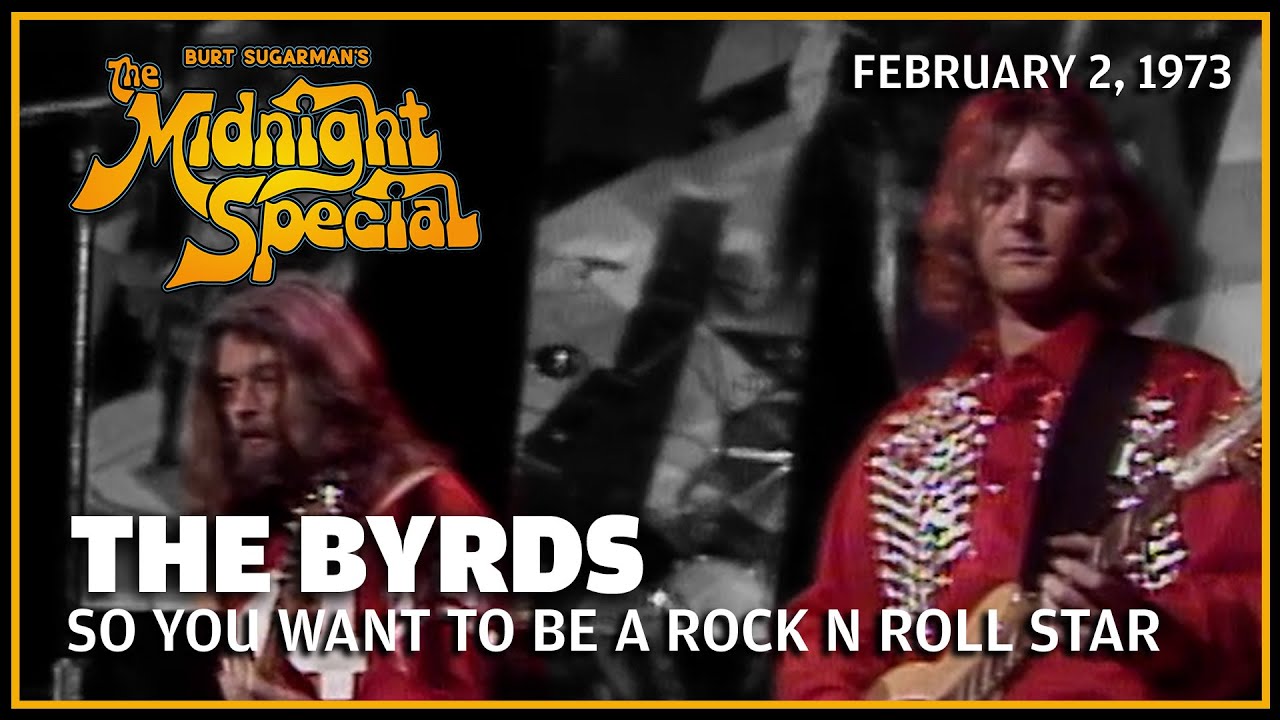
Hillman and lead guitarist Roger McGuinn poured their cynicism into So You Want To Be A Rock’n’Roll Star. The song served as a two-minute manual for overnight fame, a potted guide to pop stardom with an essential checklist: electric guitars, the right hair, tight pants, money-worshipping agents.
“We’d had such a quick rise to fame, and it went to our heads a little,” McGuinn admits. “But by late sixty-six/early sixty-seven, we were going out of business. We were up at Chris’s house and going through the pages of some teen magazine, cracking up at all these one-hit wonders who would be gone by the next week.”
So You Want To Be A Rock’n’Roll Star was released on January 9, 1967, on the same day as The Monkees’ second LP, More Of The Monkees. This may have been purely coincidental, but there seemed to be no more fitting target for The Byrds’ dry critique of manufactured pop than the band often derided as the Prefab Four. The Monkees were by then starring in their own hugely popular TV show and riding high on a series of massive hit singles that were mostly the work of session players.
“The song was a slight jab – not at The Monkees as individuals, they actually had a very good gig making money, but at how contrived it was,” says Hillman. “Roger and I weren’t blatantly writing about The Monkees. To me, it was more like we were jabbing at Hollywood’s smarmy, controlled process of that. It strips away all the soul and depth of the experience of a rock band. It makes it so vanilla, too clean and pretty. Since the late fifties, with songs like Itsy Bitsy Teenie Weenie Yellow Polkadot Bikini, manufactured pop music had been there. It all comes down to square one: profit.”
“Some people think [Rock’n’Roll Star] is about The Monkees, but I never felt that,” McGuinn concurs. “I was friends with them – I knew Peter Tork and Mike Nesmith, we used to hang out together – so I wasn’t trying to put The Monkees down. The whole song was kind of tongue-in-cheek. It wasn’t a bitter condemnation of the music business. We found it funny; it was a superficial Beatles thing.”
On a musical level, the song is motored by Hillman’s driving bass motif, lush harmonies and the distinctive peal of McGuinn’s 12-string Rickenbacker guitar. Also aboard is South African musician Hugh Masekela, whose surging trumpet blasts add to the sense of growing hysteria. Hillman, previously a minor creative presence in The Byrds, had been inspired to write more after playing on a recent Masekela session.
“What we’d been doing with Hugh was sort of light jazz,” he explains. “It was great, they were all South African players. When I came home it opened the floodgates and I wrote Time Between. Then I had this idea and it was the Rock’n’Roll Star riff. You could say that was a major inspiration from working with Masekela.”
Meanwhile, another South African icon had rubbed off on McGuinn. In his pre-Byrds days he’d toured with singer Miriam Makeba as a member of the Chad Mitchell Trio.
“I showed Chris this lick that I’d learned from Miriam Makeba’s guitar player, Millard Thomas, which was a really cool South African riff,” he remembers. “Chris and I both liked it and we decided to use it as a musical basis for the song.”
His appropriation of Thomas continues through the bridge, which ends with the arrival of a horde of shrieking teenagers. McGuinn had instructed publicist Derek Taylor to record The Byrds’ fans at selected gigs during their UK tour in August 1965. The sample on So You Want To Be A Rock’n’Roll Star was taken from Bournemouth Gaumont.
“I just thought that the screaming fans from one of those shows would be interesting to incorporate into it,” McGuinn says. “While we were recording the song it occurred to me that we could use it after the line: ‘The girls’ll tear you apart.’ Those teenage kids could be kind of wild, they’d tackle you or try to rip something off as a souvenir. It could be downright frightening at times. One time, they stole my little square glasses that I used to wear, right off my face.”
Alas, the sound of the yelling masses proved to be an ever-fading echo for The Byrds. Despite a concerted promotional campaign that took in Italy, Germany, Sweden and the UK (including an appearance on Top Of The Pops in March ’67), So You Want To Be A Rock’n’Roll Star failed to register on the charts. It fared better back home in the US, creeping just inside the Billboard Top 30, though its success was hardly spectacular.
More than half a century after it was written, So You Want To Be A Rock’n’Roll Star remains a satirical minor classic. “I’ve always loved that track,” Hillman concludes. “We really nailed it.”
This feature originally appeared in Classic Rock 244, published in December 2017.

