


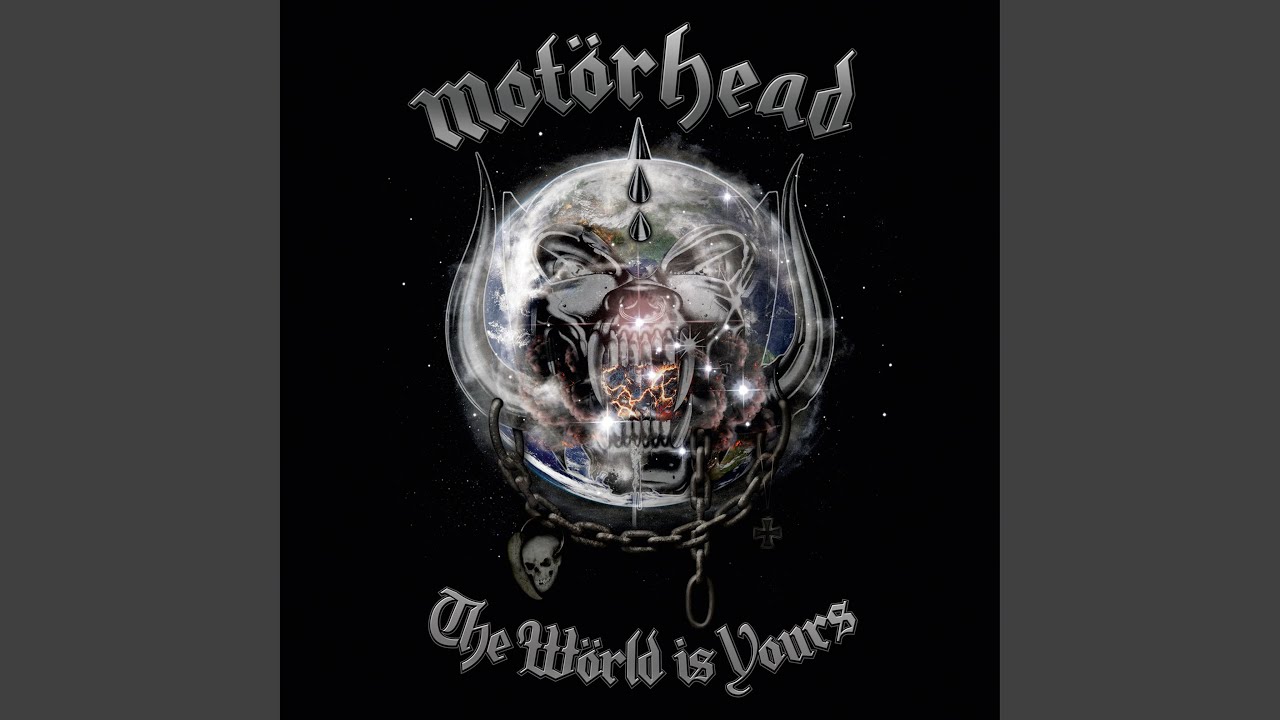
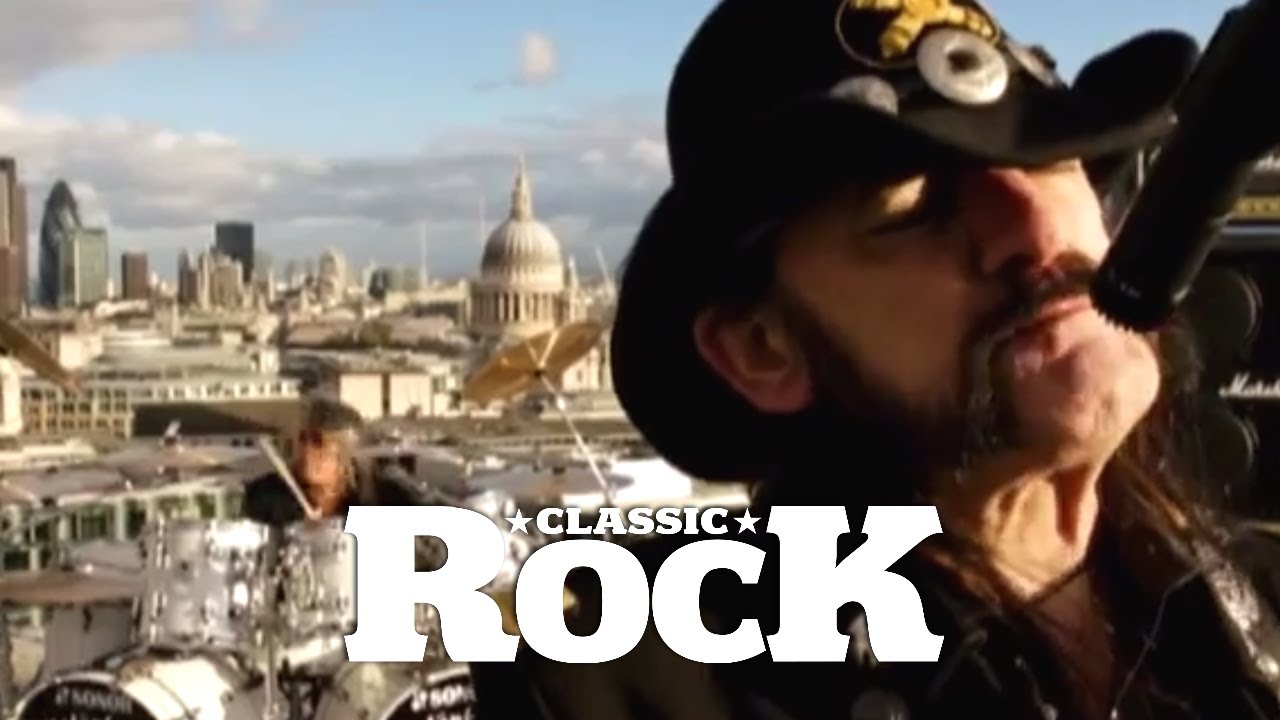
In late 2010, Classic Rock published a fanpack edition of Motörhead's then-upcoming album, The Wörld Is Yours. In addition to retrospective features and reviews of Motörhead's back catalogue, the fanpack included exclusive interviews with band members Lemmy, Mikkey Dee and Phil Campbell. The interview with Campbell, whose death was announced over the weekend, is reproduced below.
Very little seems to last for very long in these days of quickie divorce annulments, prenuptial agreements, soundbite-driven politics and reality TV celebrity. Even so, way before the dawn of this culture of the temporary, when Philip Anthony Campbell joined Motörhead in 1984 – a time when Ronald Reagan was still the President of the USA, O Level certificates were being scrapped for GCSEs and Prince Harry had just sprung kicking and screaming into the world – there seemed very little possibility that the Welshman would still be doing that same job more an a quarter-century later. But so it has proved.
Born in Pontypridd, 12 miles north of Cardiff, Campbell discovered rock music at an early age and began playing the guitar at ten, taking his cues from Black Sabbath’s Tony Iommi, Jimi Hendrix, Led Zeppelin maestro Jimmy Page, Michael Schenker of UFO, Focus’ Jan Akkerman and the musical chameleon that is Todd Rundgren (an influence so significant that Phil later named his first born son Todd Rundgren Campbell).

Just three years taking up the six-stringed instrument Campbell was playing semi-professionally with a cabaret band called Contrast before joining Roktopuss, who played many dates on the Welsh pub-rock circuit.
It was the formation of Persian Risk, whose singers Jon Deverill and Carl Sentence, would later spend time with the Tygers Of Pan Tang, Accept and Krokus, that begin to cause ripples of interest. Persian Risk’s drummer Steve Hopgood also found fame with former Iron Maiden singer Paul Di’Anno in Killers. Campbell played on both of the group’s seven- inch singles, Calling For You (1981) and Ridin’ High (’83), before joining Motörhead as part of a two-for-one deal with Michael Burston, AKA Würzel.
Phil has been by far the group’s longest-serving lead guitarist, debuting on several tracks from the double-album collection No Remorse and appearing on all of their studio albums from Orgasmatron (1986) to the present day.
Away from the walls of amplifiers he uses at work Phil has a taste for soft rock artists such as the Eagles, the late Dan Fogelberg, Electric Light Orchestra and ABBA as well as Led Zeppelin, preferring to save his aggression for the stage and the studio.
Having long since come out of his shell as a live performer (“I’ve more confidence now,” he told Classic Rock in 1999. “Lem has said from day one, ‘If you can blow me offstage then go for it’, and that suits me”), the likable, talkative 49-year-old deserves more credit that he receives for his role in this most legendary and enduring of bands.

Does it feel remotely possible that you have been a member of Motörhead for 26 years?
Not at all. Nothing like that, especially as I asked Lemmy for his autograph [after a gig by Hawkwind] at the Capitol in Cardiff when I was 12. I’ve still got it on the programme, in fact. If somebody had said to me that night, "You’re going to be in a big band with that guy you just met, and you’ll stay there for 26 years," I’d have laughed at them. It goes to show that anything is possible.
So being in Motörhead really is a life sentence?
It’s beginning to look that way, isn’t it [laughs]. No, it’s a privilege.
Isn’t it true that you owe something of a debt to your wife, who suggested you send in a single by Persian Risk when the Motörhead job came up?
That’s right, yeah. She persuaded me to give it a try because we [Persian Risk] had supported Motörhead on the last gig of the Another Perfect Day tour at Cornwall Coliseum.
At the time, you were delivering frozen chickens to restaurants, right?
Correct again; I was working for my father’s company. I saw the advert in the Melody Maker and I knew that Brian [Robertson] had left but had been thinking: ‘Oh, what’s the point?’ But she said, ‘No, go on. Give it a try, send some stuff in’. One day I came back from delivering the chickens and there was a message from their office. I had to learn 18 Motörhead songs by Friday.

At the audition Lemmy was unable to separate yourself and Würzel, offering the job to you both. Have you ever wondered how your life might have changed had he tossed a coin instead?
[Frowning]: That’s a good question. It would have changed drastically, I know that, but it’s not something I’ve given a lot of thought to.
Might you still be delivering chickens?
I doubt it. I could be working at McDonalds, who knows? I’m just glad that things turned out the way they did, really.
When you and Würz went onto the payroll, how did the reality match the fantasy? There was a lot of turmoil going on behind the scenes.
That’s right. On the evening after the auditions Philthy stunned everybody by deciding to leave, which didn’t help matters. That was quite a shock for Würz and me. There was a lot of crap to be sorted out with the record company [Bronze Records]. It looked slightly grim, I don’t mind telling you.
You forged a very strong bond with Würzel, didn’t you? That partnership came together very quickly?
[Nodding]: Yeah, he was great, really up for it. Always laughing and joking. That lasted for quite a few years, but towards the end he wasn’t quite so interested. Don’t get me wrong, Würzel’s a great guy and we’re still in touch, but there was something going on in his head and he just decided to leave one day.

On that day in 1995, Motörhead were reduced again to a trio. Did you enjoy the extra responsibility of being its sole guitarist?
I remember saying to Lem and Mikkey: ‘Look boys, we can do this. Let’s try it as a three-piece, believe me if we need another player I’ll be the first to admit it’. We went into rehearsals and it worked just fine. And all this time later, it still does.
Let us offer our condolences about your father, who passed away during the completion of The Wörld Is Yours.
Oh, thank you. Both of my parents were really supportive when I got into music, which is a path I’ve tried to follow.
This must have been an impossibly difficult record to make?
I was in LA as the songs were being written and then my dad got ill, so I came home. All my guitar parts were done in Cardiff, the rest being done in LA. I’d go and see my dad in the morning, and found I was able to concentrate on the guitar playing afterwards. Not having Lem there to ask: ‘What would you like me to do with this part?’, I just had to use my intuition and my knowledge of the way the band works, but Lemmy was really happy with it all.
Where do you think The World Is Yöurs belongs in the Motörhead canon?
It’s not heavy metal; I don’t know what it is. It’s a rock ‘n’ roll kind of thing. There are very few guitar overdubs.
Do you have a favourite track on the record?
That would have to be Brotherhood Of Man. It’s a monster riff; so simple but very effective. It could turn out to be the new Orgasmatron. Bye Bye Bitch Bye Bye is another that I like a lot.
Although Lemmy is perceived as ‘being’ Motörhead, he has gone on record as saying that yourself and Mikkey Dee are the heart and soul of the band. Can you explain the way that you contribute to the writing process?
Well, we are responsible for a lot. A hell of a lot. I come up with riffs and half-completed songs, verses and choruses, which then get played to the boys to add their own bits.
Does that leave you creatively satisfied, or might there be a solo album dying to get out?
I’m very happy within Motörhead but I’ll definitely do an album of my own. I’ve got seven or eight songs ready. There will be lots of piano and stuff on it; it won’t sound like a copy of Motörhead. I might even tell jokes between the tracks. I’m also going to do a book with [writer] Steffan Chirazi, who says he’ll help me.
What type of a book would that be?
It won’t be my life story, just the ridiculous stuff that has happened to me. I’m going to call it Suspect Out Of Control.
The ongoing relationship with producer Cameron Webb seems to be paying dividends.
[Laughing]: Yes, but I’ve told him that if he rubs my piano off the album again without telling me, I’ll have a prostitute turn up at his door claiming to be carrying his baby. That should bring him round to my way of thinking.
Nevertheless, he’s become part of the family.
For me, it wasn’t a very close relationship at the start. I’d met him once before, like, but on the first day together in the studio, within 30 minutes of working on the first song I’d picked up my guitar and thrown it at him saying, ‘You can fucking do it yourself’ and driven off in my car. That was my professional introduction to him. But it worked out okay in the end.
Talking of families, Motörhead shows are now attended by several different generations.
Yeah, that’s a great thing. The audiences are getting younger and younger and at the other end of the spectrum older and older. Grandparents bring their kids, who bring their own kids. We’re very lucky. We don’t just have to play the greatest hits – or ‘hit’, should I say? It probably has to do with the fact that we did all the wrestling things with Triple H, even something with SpongeBob Squarepants.
In this enviable run of creative form, how far would you have to look back and say, ‘Okay, that album was perhaps a bit weak’?
Wow, that’s tough. Orgasmatron [1986] was a great album, but for me the production [by Bill Laswell] let it down slightly; he did some strange stuff here. I know Lem was quite disappointed, too. But Rock ‘N’ Roll [1977] was recorded in just ten days and written in 11 and it still stands up. 1916 [1991] and Sacrifice [’95] are still very good albums but my favourite is still Bastards [’93], and of course the ones with Cameron are great. I don’t think we’ve done a really crap album; not a complete duffer.

Motörhead’s winter tours run the length of country and have become as regular as clockwork, whilst the band also still appears at the key open-air festivals. Do you perhaps feel that, due to all of that visibility, you are taken for granted?
Well, I don’t know. The tours still sell out. There may be a little bit of truth in that statement but I do know that our fans look forward to seeing us: It’s the highlight of their year. That’s what they tell us anyway.
Lemmy is based in California, Mikkey resides in Sweden and you have a place in South Wales. Has that played its part in the longevity of this line-up, now into its 18th year?
It probably has, yeah. But I live in Los Angeles now, just a five-minute walk from Lem’s place [laughs]. I’m living at Matt Sorum’s place now.
So we can expect the band to split up within a year, then?
[Laughing]: I don’t see that happening. We do see a lot of each other on the road, though, which is why we have separate dressing rooms. People ask us: ‘Aren’t you supposed to be friends?’ Of course we are; we’re best friends. But before a gig if somebody wants to take a nap, or someone else wants to read and a third person wants to throw a bit of a party, it’s not going to work. By now we know one another’s weaknesses and strengths…
You respect each other’s little foibles…?
Yes, that’s it exactly. Basically, we try to be understanding of one another. This is a deep-seated relationship. We’ve been through a lot of shit together. Why would we jeopardise that?

Away from the band you’ve said that your son Todd, who plays the bass, is already a better musician than you?
The three of them are, actually. Todd and Dane [a drummer] are in a band called Straight Lines, and my youngest son Tyla is [the guitarist] in Tiger Please. In fact, Straight Lines, Tiger Please and Motörhead were all at this year’s Download. I’m pretty sure that it’s the first time that a dad has played at a festival with his three kids, in three different bands – all on the same day. I started them all off by showing them some drums and guitar, but it seems they’ve got talent. Straight Lines got a better review than we [Motörhead] did at Download.
After all the career fluctuations you’ve experienced with Motörhead, you must have been wary of their wishes to following in your footsteps?
At first, yeah. With their other earlier bands we found that using my name didn’t do much good to help them. So they purposely don’t mention that connection anymore, and it seems to have done the trick [laughs].
The band’s hell-raising ways have long since become part of rock ‘n’ roll folklore. Do you think that Lemmy has mellowed in recent years?
A little bit, maybe. But he can still kick up the dust like the rest of us, no problem. Lem will never change. He’s not afraid to say want he wants to say and fucking annoy people if that’s what happens. Half of the time, he’s been there and done it all. There’s not much stuff he hasn’t experienced, so there’s not much left him to excite him. But he hasn’t lost his edge; no way.
Would you say he is your best friend?
Yes, absolutely. Even after all this time.

Can you tell us a secret about Lemmy?
[Grinning]: He hates onions. That might surprise you because he looks like the type of person that might like them. But, no, he won’t go anywhere near onions.
Have you even considered what you’ll do when Motörhead is no more?
Don’t be ridiculous. Lemmy will be around a lot longer than the rest of the world’s population.
Can we push you for a serious answer?
I don’t think about that, really. Fifteen years ago I thought: ‘Well maybe I’ve got another two or three years left [in Motörhead] but look at us now; we’re still here and still selling out all of the gigs. People still like the records. We might slow things down slightly as the years roll by; maybe do three gigs in a row [without a night off] instead of six. But there is no plan to stop anytime soon, let’s put it that way.
This interview originally appeared Motörhead's The Wörld Is Yours fanpack, published in December 2010.

