

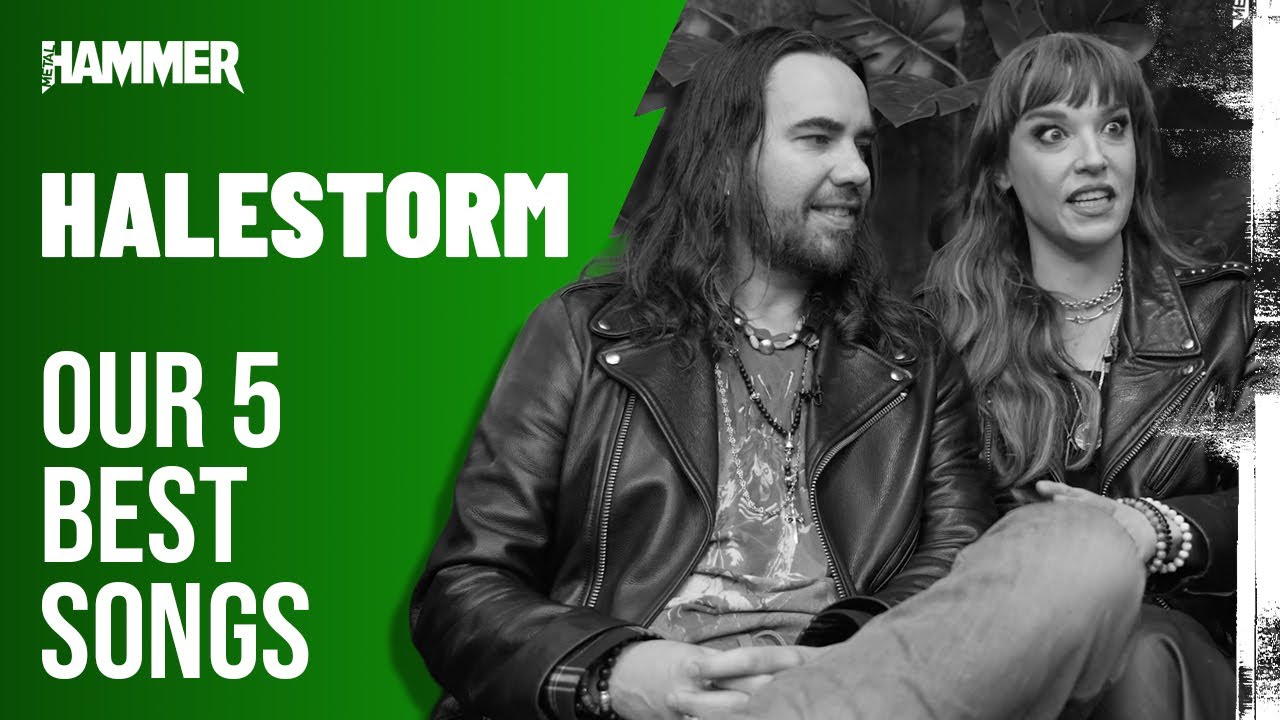
Lzzy Hale wants to clear the air. Backstage in Birmingham on her band’s first headline arena tour of the UK – an achievement 15 years in the making – she’s been animatedly discussing the band’s many accomplishments. Among them: Grammy nominations and wins, massive gigs with bands like Black Sabbath, Iron Maiden and Slipknot, and bringing sex positivity back to metal long before Baddiecore was a stirring in the sheets. Then Hammer puts our foot in it by asking how a band who’d later make it big with songs like Love Bites (So Do I), Do Not Disturb and I Get Off fall under the “Christian rock” banner.
Lzzy gives us a ‘Really?’ look, shrugs and clarifies: “Halestorm were never a Christian rock band. We just got marketed that way for a while.”
“My brother and I grew up Presbyterian, went to church all the time, and my first time singing in front of people was in choir,” Lzzy explains. “But when we started getting into rock’n’roll in middle school, our teachers would berate us – ‘Where is Jesus in this?’ It made me realise that religion, this man’s idea of what Christianity should be, isn’t the goal. The goal is to be the best person that you can and go after what you love, see people for who they actually are and not judge them. Our band was the last act of defiance.”
Halestorm were never a Christian rock band. We just got marketed that way for a while
Lzzy Hale
Although formed in 1997, it wasn’t until 2009 that Halestorm released their self-titled debut. By that point, Lzzy had been in the band almost half her life. The Hale siblings were the only constant members until guitarist Joe Hottinger and bassist Josh Smith joined in the 2003 and 2004, respectively. Joe recalls his first meeting with Lzzy was… intense.
“She came at me!” He chuckles. “She was shaking my hand really vigorously and I was amazed because her speaking voice was really low. It was like, ‘This is very aggressive, it’s intimidating…’ Arejay was like 15 by that point, so he was basically bouncing of the walls.”
Much like the Hale siblings, Joe had dreamed of being a rock star for years. Growing up in Wisconsin, he’d heard Nirvana and decided he wanted to form a band. After a year living in the UK (“I’d go to the market in Worcester to buy cheap CDs,” he fondly recalls), his family moved back to the States, and he formed his first bands.
“We found out, I played my first ever show in mid-August 1997, the same month Lzzy played her first gig a few counties away,” Joe reveals. “We were on a collision course.”

But like everything in Halestorm’s story, it would take time for things to come together. To secure a record deal, the band played showcases for just about every major label that dealt in rock. They faced a serious uphill battle.
“There was a lot of, ‘We love what you do, but the girl-fronted thing isn’t really happening right now,’” Lzzy recalls. “We bottled that into defiance – we’d keep doing what we were doing, making enough noise that they would notice us eventually.”
It paid off. In June 2005, the band signed to Atlantic Records. A first attempt to record, at Johnny K’s studio in Chicago, didn’t result in any usable material. Still, they kept working on their craft. Halestorm songs were written with the live experience in mind, every song built around “moments that could make the crowd scream,” Lzzy says. In 2006, they went out on their first major tour, opening for Flyleaf, Shinedown and Seether on the 2006 SnoCore Tour. It was an educational experience.
“It was like going to war every night because nobody’s expecting you, you’re not the headliner – they’re just waiting,” Lzzy muses. “To turn that crowd around, get them on our side was the biggest rush in the world. But some of those early tours were also utter debauchery.”
Some of those early tours were utter debauchery
Lzzy Hale
“We’d see other groups getting fully fucked up,” Joe says. “On one tour, we watched a guy fall out his bus and smash his face on the ground, doing the rest of the tour with this cast on his nose. He was crying before he went onstage the next day because he was so fucked up. It was like… ‘This doesn’t look worth it.’”
That tour may also have saved Halestorm’s career. Although their only release at that point was a live EP, fan enthusiasm was such they could shift up to 500 copies a night.
“So many baby bands we knew that were at our level were getting dropped from their record labels at that point,” Joe says. “The sales we made while on tour really saved us.”
Although their Chicago adventure hadn’t worked out, Atlantic invited Halestorm out to Los Angeles to try again at recording material for their debut album. Rock’n’roll nerds that they were, Halestorm delighted in spending nights on the Sunset Strip, retracing the steps of their favourite bands. They ended up staying in LA for a whopping 19 months.
“We lived through it all – mudslides, floods, fires… It was the full LA experience,” Lzzy recalls with a chuckle.
The band’s first single, I Get Off was written in the lobby of an LA hotel. Playing a weekly residency at the Viper Room, Halestorm had been roadtesting material and quickly recognised that they wanted something bold as their opening statement. I Get Off certainly was that. Anchored on a powerhouse vocal from Lzzy, the song’s lyrical content appeared to relish in exhibitionism. But as Lzzy admits, the meaning was less about sexual themes and more tied to her experiences as a vocalist.
“The phrase started out as something really dumb – I love the fact you love me,” she reasons. “That steadily devolved into ‘I get off on you getting off on me.’ It’s funny, the reaction, even from management, went from like, ‘This is amazing!’ to, ‘Are you sure you wanna say this?’”

So far as bold opening statements go, I Get Off did the job. Released on March 10, 2009, it quickly climbed the Billboard Mainstream Rock Airplay chart, peaking at number six. It was the first indication that all of the band’s hard work had paid off, and for Lzzy the first real validation that speaking openly about her sexuality could be celebrated.
“Over the years, because I’ve had a lot of parents come up to me and instead of going, ‘Oh you’re not a good role model because you talk about sex’, they say the opposite,” she says proudly. “When you talk about sex in music, it’s empowering personally. You’re talking about something that, besides eating and sleeping, really keeps all of us going.”
Not everyone agreed, however. After the hedonist heights of the 80s, sex had become a surprisingly dirty topic in heavy metal and some reviewers denounced Halestorm’s debut for its “unappealing” sexual themes, one site decrying it as “low-grade stripper music.” Lzzy has no regrets, though.
“It makes a lot of people uncomfortable… I like doing that!” She says with a cheeky grin. “It’s a you problem, not a me problem.”
It makes a lot of people uncomfortable… I like doing that!
Lzzy Hale
The haters were quickly outweighed by new fans. Among them were the members of recently-resurrected metal legends Heaven And Hell, the Ronnie James Dio-fronted iteration of Black Sabbath. On August 29, 2009, they invited Halestorm to open for them. It turned out to be Ronnie's final gig.
“I remember seeing Ronnie and Geezer [Butler] up on the balcony watching our set like, ‘Oh god, don’t fuck it up!’” Lzzy recalls.
“Geezer wrote about it in his book,” Joe adds. “They wanted to take us on tour with them.”
Even having supported the likes of Iron Maiden, Slipknot and the Ozzy Osbourne-fronted Black Sabbath (coincidentally, also for Ozzy's last show), Lzzy is practically bouncing as she recounts getting advice from Dio.
“We ended up spending the night with them, hanging out till like 2am,” she says happily. I remember saying, ‘Thank you for taking the time for us – I’d have understood if you were too tired.’ He turned and wagged his finger in my face and said, ‘Lzzy, this is a moment in time. You won’t remember everywhere you play or all the people you’ll meet, but they’ll remember you for the rest of their lives. So make it good for everyone.’ At the time I figured it was just advice for my fans, but afterwards I realised he made that moment for us.”
I Get Off remains a staple of Halestorm’s sets today. It was a big, bold declaration from the band that announced their arrival unto the world, and a song that still holds a special place in Lzzy’s heart almost 20 years on.
“We’re still getting off!” She grins. “For as long as we’ve had that song, every time I play it live it’s new for me. We start the song and look out, and not just the front row but everyone is singing their heads off. It’s amazing how different people react to it differently.”