


What unites a mysterious god said to be older than Odin, the motto of Blackadder’s General Melchett and a cross-country skiing blastbeat? The surprising answer is Heimdal, Enslaved’s 16th album, released in 2023. Just before its arrival, Grutle Kjellson and Ivar Bjørnson took Prog inside the masterpiece.
In Norse mythology, when the great and terrible Ragnarök arrives to lay waste to the Nine Realms, the gods will know the hour has come when Heimdall blows the Gjallarhorn to rally the warriors to the final battle. Heimdal, the 16th album from Enslaved, opens with the sound of that fabled horn – and the god who guards the Bifröst bridge casts a long shadow over the band’s career.
The track Heimdallr appeared on 1994 debut Vikingligr Veldi. “That was one of the first songs we wrote; it was even included on a demo tape we recorded in 1992,” says vocalist and bassist Grutle Kjellson.
“Heimdall is one of the most important figures in Norse mythology and yet he is surrounded by mysticism. All the other gods and deities have clear origins. Heimdall hasn’t. He’s always been debated amongst scholars – where does he come from? Does he come from a pre-Norse mythology cult? Does he have an equivalent in other mythologies? Has he been around for longer than Norse mythology? And the answer is: probably.”
Ancient rock carvings indicate Heimdall may have been worshipped since the Bronze Age, when the cults around Odin and Thor arose. His mystery is further complicated by the fact that precious few texts have survived the passing of the centuries. “There’s The Heimdall Spell that only exists as a small fragment – it’s like two sentences and the rest is gone,” says Kjellson.
“That makes the whole thing even more interesting, even more obscure. He’s a very important figure and very fascinating. He’s been lurking in the background of our concept ever since the beginning, so we thought it was time to honour him with an album.”
To create the sound of the Gjallarhorn, the band brought in Eilif Gundersen from Wardruna, who used a replica of a 3,000-year-old bronze horn found in a bog in Denmark. “He’s a good friend of ours. He really appreciated being asked and he loved the concept,” says Kjellson.
“You can find rock carvings from the Bronze Age of horn blowers that might have been a forerunner of Heimdall. So we decided to connect the story of his horn with the replica bog horn. We also tried to simulate paddling a Bronze Age boat – that was a cool experience. It was done at a lake just nearby my house. I have some boats, so it was just a question of bringing the hornblower and his instrument.”
The album’s lyrics were written by Kjellson and guitarist Ivar Bjørnson (the pair co-founded Enslaved 32 years ago). The lack of records on Heimdall afforded them the freedom to explore their own interpretations. “It’s a more liberal way,” says Bjørnson. “You reach a node and that gives you an association in one direction, and you just go with it – you don’t have to stay on topic, so to speak. It takes on a life of its own.”
He says he can’t imagine making an album without a unifying concept, continuing the tradition of 2017’s E and 2020’s Utgard. “When we first talk about what universe to explore and the concept, it’s all floating around like inflammable gases, and it needs a spark to ignite, to go off in a direction. Then it’s all chaos from there on – everything happening at the same time, and we’re trying to manoeuvre and organise it somehow.”
Composing the music is even more instinctive, “because it’s really hard to put into words and that has a tendency to become limiting,” says Bjørnson. “On the title track for Heimdal, when the god appears on the scene, the music needs to be heavy so it’s understood. Music is the current that flows through; the lyrics are made as we go along and that influences the music and back and forth.
“It’s hard to separate – and really, I don’t think I would separate them. It’s like a bike ride down a very steep slope; you just have to keep going because the moment you start thinking, it’s going to get ugly.”
Tou have youngsters in the first rows, then middle-aged, grumpy black metal people, then the old prog hippies in the back. It’s diverse
Grutle Kjellson
Bjørnson says his relationship with the band’s catalogue and chronology is not really linear. Many things in life can give me something to measure against, to tell you, ‘This is 30 years ago,’ but with the band it’s not like that. Some things that are distant, from the beginning, feel like they just happened. In some places time is folded, in other places it’s crumbled up, and in other places it’s a straight line.”
He continues: “I guess ‘Enslaved’ is a pretty good description of our sound. It’s an abstraction – it doesn’t really deal with everyday frustrations or teenage heartbreak. It’s more of a summary of life lived over 30 years, like the human experience, I hope, in a broader sense. We are partly human at least… Half bionic!”
Enslaved inhabit a singular place in the musical pantheon, after outgrowing the Norwegian black metal scene they emerged from in Bergen, western Norway. “To the diehard metal fans, we’re definitely too experimental, too proggy, whatever you want to call it,” says Kjellson. “And we might be too heavy for the equivalents on the proggier side. But it’s been crucial not to have those things in mind. We just want to make our own contemporary, favourite music, and that obviously changes. Your musical horizon hopefully expands.”
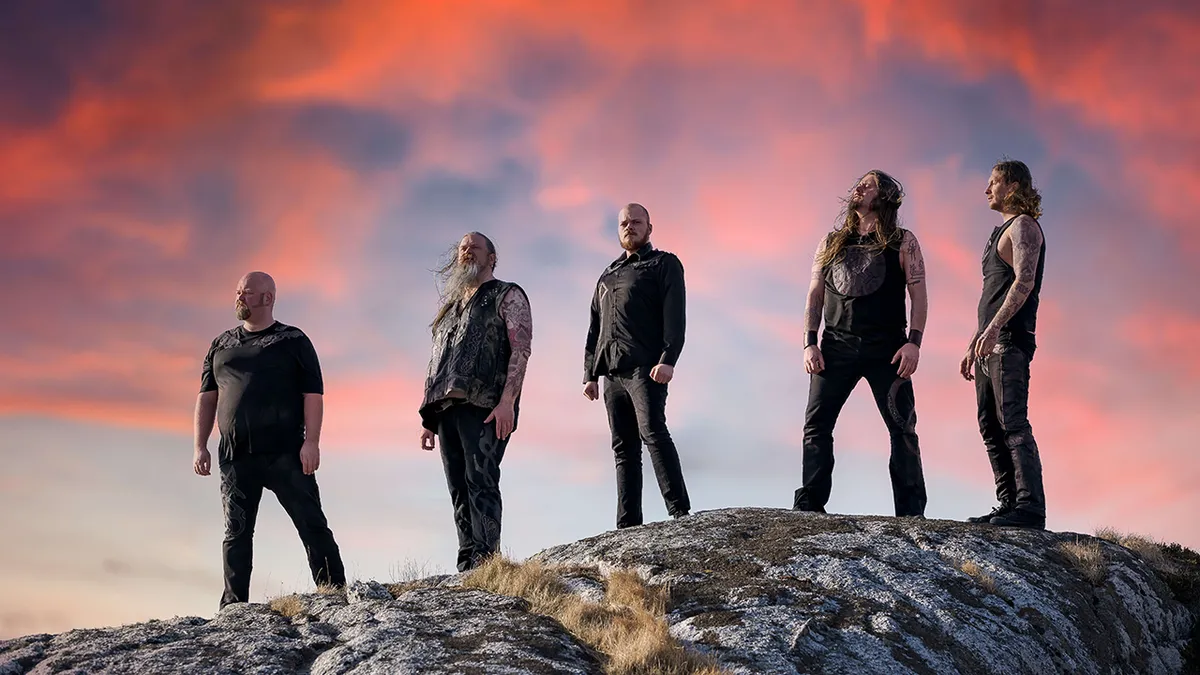
They’ve found that their breadth of vision pulls in a wide range of listeners, as Kjellson notes: “There’s a wonderful audience in the United States because you have the youngsters in the first five rows, then you have the middle-aged, grumpy black metal people in the middle, and then you have the old prog rock hippies in the back. It’s diverse – I love it!”
Heimdal spans the acoustic folk moments of Forest Dweller and the slamming heaviness of Caravans To The Outer Worlds, while Congelia taps into their metal roots. Bjørnson wrote that song around an idea from drummer Iver Sandøy. “Iver suggested there should be a song that’s based on the black metal cross-country skiing blastbeat and accompanying riff. I don’t know if that was done because he knew it would make life hard for me!
We’re experimental and some might call us progressive, but we listened to a fair share of classic rock and pop
Grutle Kjellson
“I wanted to mix it up with the things I really love: 70s, early 80s heavy metal guitar riffs and that 70s sequencer, synthesiser thing. How to mix that in with the proto black metal? It’s the other way around from a lot of stuff when you just add some black metal on top of something, like a catchy rock riff with some screeching or a blastbeat, or ‘classical meets heavy’ – yawn. This was turning it around: having a total black metal thing and trying to mix other things in with it.”
The difficulty of forcing such disparate ingredients together required a degree of stubbornness from Bjørnson, who refers to the immortal words of General Melchett in Blackadder Goes Forth: “If nothing else works, a total pig-headed unwillingness to look facts in the face will see us through.”
He says: “It turned out to be true! With the drumming and Grutle’s vocals – the very definition of black metal vocals for me – I knew that Jens [Bogren] would get it glued together in the mix. It was a bit nerve-racking until we got the mix set with Jens. Then I could take down my General Melchett avatar in my room and stop sacrificing animals to him every night!”
From the melodic metal of Kingdom to the frantic barrage unleashed in The Eternal Sea, there’s one principle that guides the writing process. “Although we’re experimental and someone might call us progressive,” says Kjellson, “we listened to a fair share of classic rock and pop in our childhoods. So we know we need to write songs. It’s not 72 different parts; we have to make songs. That’s a good thing to keep in mind.”
After four decades and 16 albums, the music has evolved and the fanbase might be more diverse, but the essential visceral thrill of making music together in front of an audience remains undimmed. “The energy is still there – the anticipation before we go onstage,” says Kjellson. “Of course, everything else has changed. It’s a lot different to go on tour in 2022 compared to van-touring in Mexico in 1995. In those days even the plane ride was fantastic because I had free drinks. Wow!
“It still feels almost exactly the same as it did on the first shows in 1991, and I think that’s amazing. That’s the main driving force. If those feelings disappear, it’s time to call it a day, but that’s still present, and that’s fantastic.”
“It’s such a big part of who we are,” adds Bjørnson. “Enslaved have become juggernauts of their own and, as Grutle says, the core is still there – being a performing musician. We’ve done somewhere between 1,500 and 2,000 gigs since the start. I still have that one second where I think, ‘I should just take off and not do the gig.’ I still haven’t done it. But it would be awesome to do it one night. The guys turn around: ‘Where the fuck did Ivar go?’ I text them, ‘Couldn’t do it. Too nervous.’
“But I love feeling, ‘This is the last thing I want to do in the world – I’m really nervous now.’ And you just do it, and it’s great.”

