


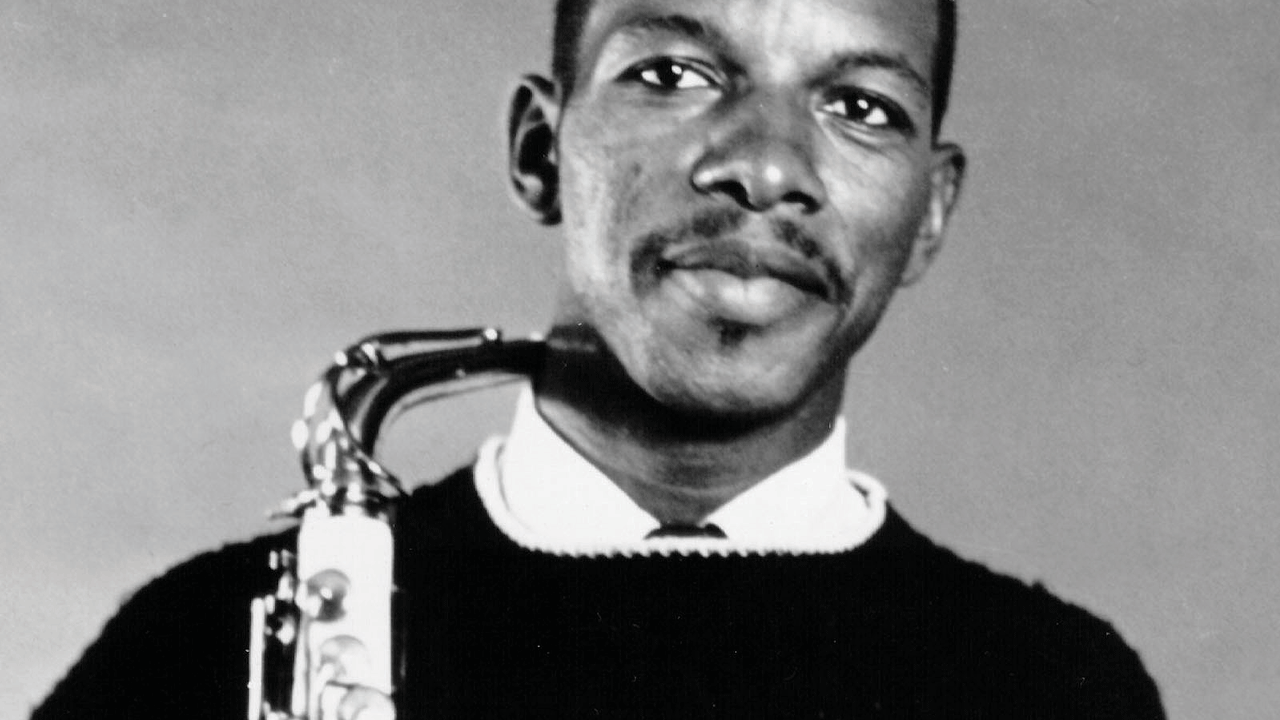
It is 1960, four days before Christmas, and at New York’s A&R Studios a pair of quartets – two drummers, two bassists, two trumpeters, a clarinettist and a saxophonist – have assembled to record what will prove an epochal piece of music.
The musicians present number some of the finest of their generation, including Don Cherry, Freddie Hubbard, Eric Dolphy and Charlie Haden. Their leader (though the afternoon’s session will be characterised by a most democratic musical freedom that seems to border on anarchy), Ornette Coleman, has already proven himself a visionary within the post-bop landscape, and the titles of the albums he had recorded, for Contemporary and then Atlantic records, spell out a questing, restless spirit: Something Else!!!!, Tomorrow Is The Question!, This Is Our Music and The Shape Of Jazz To Come.
Still, this session will prove a quantum leap, both for the alto saxophonist and for jazz itself, though as with any giant step forward, those left behind will bleat loudly and sourly about that which they cannot comprehend. Following a 17-minute false start, Coleman and the other seven musicians begin playing. There is no sheet music, no recognisable tune or changes to follow, no map or game plan whatsoever. Instead, the musicians listen to each other as they play, reacting and responding in real time, soloing in harmony and discord and taking turns in a spotlight that never entirely obscures the tumult in the background.
On first listen, the 37-minute track seems chaotic, a coarse din. On subsequent listens, like a magic eye poster, a torrential flow of unexpected melody, bristling and electrifying, courses forth. When released, it proves the most controversial jazz recording until Miles Davis’ infamous (and similarly brilliant) On The Corner a decade or so later. The piece is released on two sides of vinyl, with a Jackson Pollock painting on the sleeve and titled, by a bod at Atlantic, Free Jazz. The title was not Coleman’s choice. “I didn’t call the music I was making ‘free jazz’,” he told the Chicago Tribune, in 2003.
But Coleman’s music surged with freedom, with energy, with fearlessness and with gloriously untrammelled melody. Born and raised in Texas, he moved to New Orleans to play rhythm and blues, andthenontoLosAngeles. Heassembledhis classic quartet with Haden, Cherry and drummer Billy Higgins, signed to Atlantic and ignited a sky- rocketing career by pioneering a new jazz avant garde in the vacuum left by the bop era.
And that rocket never stopped. Surging forth with a kinetic, super-creative and hyper-imaginative energy impervious to crusty critical brickbats, he would create new sounds and then shed them like snake-skins and move on to new vistas. In 1972 he recorded the third-stream masterpiece Skies Of America, entwining jazz and classical. By the mid-70s he’d embraced electric funk and jazz with his band Prime Time, recording the divisive Dancing In Your Head and coining the rich, dense style of harmolodics, again tapping into the group improvisational power he’d pioneered with Free Jazz.
He collaborated with Jerry Garcia, with John Zorn, and never really stopped touring and playing, following an inimitable and seemingly endlessly rejuvenative muse, playing to ever-younger audiences drawn by his quixotic brilliance. Even in his 80s he seemed forever young, and so his death, of cardiac arrest, is as shocking as it is tragic. But what a life to have lived, and what a testament to freedom in all its forms.
