


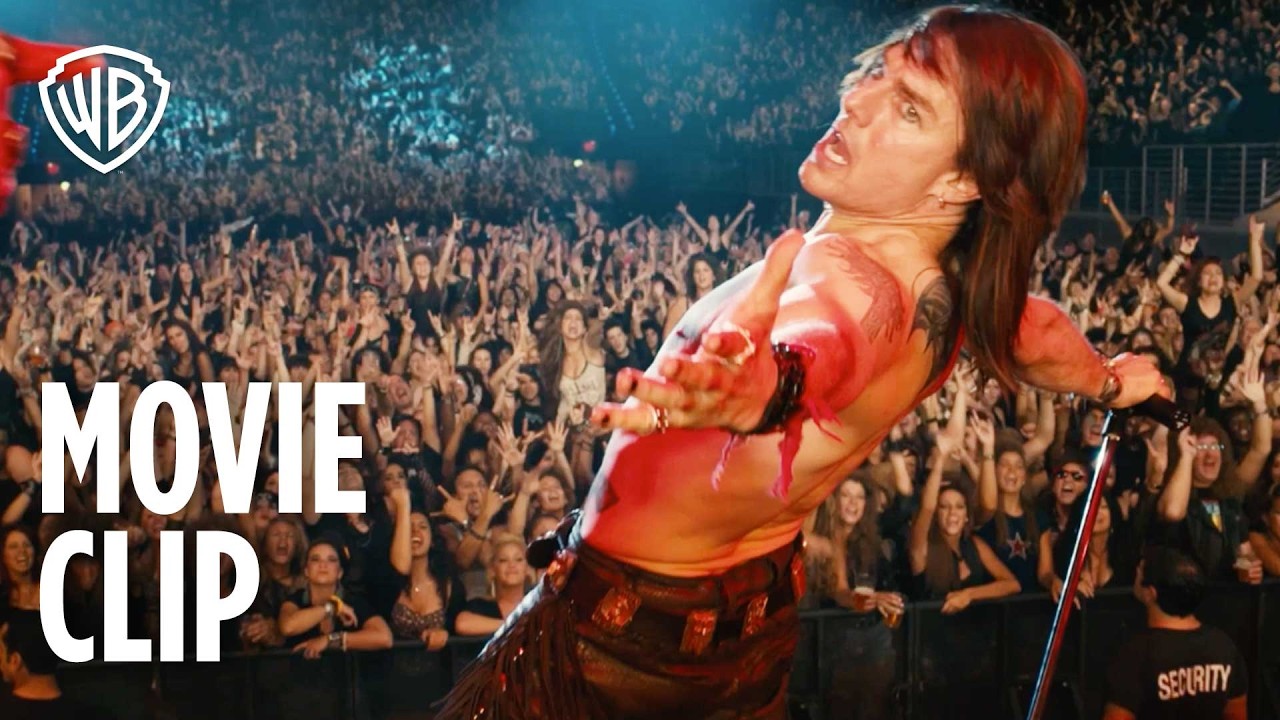
Tom Cruise’s divisive new movie, Digger, is the subject of much talk – not all of it good. But it’s not the first time he’s attracted a critical pile-on. Fourteen years ago, he donned a flowing wig to star as fictional singer Stacee Jaxx in the much-reviled hair metal musical Rock Of Ages, adapted from a more successful stage play. In 2012, when the film came out, Classic Rock spoke to the people behind this misfire to find out how Hollywod’s biggest movie star ended up singing Def Leppard songs.

A crisp March night in London’s West End, and things are getting hairy. The crowd inside the Shaftesbury Theatre is on its feet, waving electric torches and roaring along to a rowdy soundtrack of hits by Whitesnake, Bon Jovi, Poison, Twisted Sister and more. In other words, tunes that were last popular 25 years ago, when spandex-clad peacock rockers turned LA’s Sunset Strip into a gigantic open sewer of booze, sleaze and sexually transmitted disease. Good times.
Settling down to watch a hair-metal jukebox musical that one broadsheet reviewer compared to a steaming turd is a daunting prospect, but Rock Of Ages works pretty damn hard to bludgeon the viewer into enforced enjoyment. Middle-aged metalheads mosh in the aisles alongside 20-something couples and teenage girl gangs. The premise isn’t new, but rather than singing along to ABBA or Queen, they’re celebrating an era of big-haired debauchery and cartoon bad-boy posturing that even some of its original participants now find embarrassingly naff. How the hell did this happen?
Rock Of Ages was launched by a bunch of theatrical amateurs in an LA bar in July 2005. They initially rushed to exploit a 1980s glam-metal revival that they feared would be a fleeting fad, only to find mainstream culture turning their way with the runaway success of Glee and the retro-rock soundtrack to Mickey Rourke movie The Wrestler. From scratchy beginnings the show slowly built into a worldwide phenomenon. After transferring to Broadway in 2008, it finally made its London debutlast August.
Now even Tom Cruise is in on the act, starring in a big-budget Hollywood film of Rock Of Ages. Cruise stars as fictional 80s rock star Stacee Jaxx – a mash-up of Axl Rose, Keith Richards and Jim Morrison. Catherine Zeta Jones, Russell Brand and Alec Baldwin co-star, along with a lengthy guest list of rock-star cameos. The director is Adam Shankman, who previously adapted the Broadway version of the John Waters musical Hairspray for the big screen. Shankman has swapped the stage show’s spoofy, self-referential humour for more straightforward comedy; ironic celebration of this deeply uncool music has given way to something deeper, broader and weirder. So is Rock Of Ages just a mullet-haired Mamma Mia!, a glam-metal Glee – or could it actually bring these overlooked 1980s anthems back from the dead? And should rock fans be cheering from the front row or throwing rotten fruit from the balcony?

The Rock Of Ages phenomenon began with an amateur production first staged in a small LA bar seven years ago by film producer and novice theatrical impresario Matt Weaver. “The genesis of it was I wanted to develop a musical that guys would go to,” Weaver explains. “I’d never done theatre before, but it completely changed my life. I’m like the Forrest Gump of theatre.”
Weaver hired screenwriter Chris D’Arienzo and director Kristin Hanggi to flesh out his retro-rock concept. D’Arienzo grew up in Michigan listening to Elvis Costello and The Smiths, but he insists glam-metal was part of his musical DNA.
“My first kiss was to a Warrant song, my first dance was to Paradise City,” he says. “That music defined my adolescence. I kind of dig that it was not trying to be well-received by critics. It was just trying to be fun and express the feelings these young guys had when they were making it, which is: I wanna party, get drunk and fuck the prettiest chicks.”
Set in a Sunset Strip metal club in the late 1980s, Rock Of Ages features innocent young lovers, sleazy rockers, strippers, groupies, record company goons and cartoon villains in the shape of rock-hating German property developers. A live band remain on stage throughout, thumping out raucous versions of Whitesnake’s Here I Go Again, Bon Jovi’s Wanted Dead Or Alive, Twisted Sister’s We’re Not Gonna Take It and similarly anthemic songs from glam metal’s glory days.
Securing the music rights was the first big hurdle. The producers were smart enough to secure Journey’s Don’t Stop Believin’ as their closing number long before The Sopranos and Glee turned the tune into a post-modern karaoke classic, but Mötley Crüe, Guns ‘N Roses and Van Halen all refused to let their songs be used. Ironically, so did Def Leppard, even though the show was ostensibly named after one of their hits.
“The initial pitch didn’t sound appealing,” says Leppard singer Joe Elliott. “Quite honestly it was everything we were trying to avoid – look, I’ve spent 25 years trying not to be part of the New Wave Of British Heavy Metal. I’ve always said, being part of the herd, sooner or later you get culled.”
Weaver admits that knockbacks were inevitable. Of course, some bands may have been reluctant to co-operate because history hasn’t necessarily been kind to the era Rock Of Ages was inspired by. But Weaver insists that he set out to celebrate the music, striking the same kind of affectionately satirical balance as Steel Panther or even The Darkness.
“We are not mocking it at all,” Weaver insists. “We are putting it on a pedestal. In our heart and soul, we believe these songs are as good as any Broadway song out there. I mean, Every Rose Has Its Thorn, Here I Go Again – show me better songs than this! If anything we mock LA a little bit, and we like to have fun with the period: big hair, big music and big dreams.”

Kevin Cronin of REO Speedwagon, whose 1980 power ballad Keep On Lovin’ You appears in the show, believes it is both spoof and celebration. “That’s why I like it,” he says. “When I first saw the play I felt equal parts honoured and horrified. But you have to be able to laugh at yourself, especially if you look back at some of the videos we made in the 1980s, and some of the hairstyles we had. They were hilarious.”
Just as the original hair-metal bands were lambasted by the critics, so Rock Of Ages got a rough ride. Reviews for the initial LA run were sniffy, and a Las Vegas version folded after 11 nights. But once the show opened off Broadway in 2008, a rave notice in the New York Times sealed its fate. Twister Sister’s Dee Snider took over role of sleazy club owner Dennis Dupree for several months while Styx, REO Speedwagon and Foreigner played after-show concerts. Its Broadway success sealed a film deal with Warner Brothers.
Inevitably, transferring to London last year proved a little bumpy – partly down to the fact glam metal never had the same cultural impact here first time around, and partly down to the show itself. The Guardian savaged it as ‘almost entirely free of laughs… with an unvarying and unpleasant tone of careless sexualisation’, while the Telegraph reviewer branded it ‘as unpleasant a pile of theatrical poo as it has ever been my misfortune to tread in’.
“We thought that would make a great T-shirt,” says Weaver with a laugh. “But I can’t make someone love Whitesnake and Poison, you know?”

However harsh the reviews, Rock Of Ages remains a runaway smash, riding the same wave of nostalgia that has seen Van Halen, Mötley Crüe and Whitesnake enjoy the sort of success they haven’t had for years. The show’s success may even have helped fuel a few resurgent careers.
“I think it’s the opposite,” argues Kevin Cronin. “Its success is more the result of bands like us continuing to tour and our music just being such a big part of people’s lives. So when people got wind of the fact that there was a show that
uses all their favourite rock songs, that’s why it became a success. It started with the music.”
But how did it become so huge? Dee Snider believes the show struck a populist chord by reminding us that rock music still had rebel-outsider edge in the 1980s. “I call it a middle-finger factor,” he says. “It had a fuck-you attitude that people miss in contemporary music. There is not enough of that reckless abandon now.”
Joe Elliott is not convinced. He suggests that Rock Of Ages proves that rock has become safe family entertainment. “It became institutionalised,” he says. “It ran out of danger after Alice Cooper. It’s part of the establishment, you can’t shock anybody any more. There’s nothing left to do except entertain.”
Whatever the pros and cons, the fact remains that Rock Of Ages is now one of the longest-running shows currently on Broadway, which bodes well for the film version. Director Adam Shankman has reworked D’Arienzo’s original script, ditching the German villains. “I had to open the whole thing up to make the experience as epic as the music,” Shankman says. “The biggest change was making the villain a more period-realistic antagonist. So in the movie, we’ve got Catherine Zeta Jones who plays a conservative public official’s wife, trying to kill off rock and roll.”
Ever the canny businessman, Joe Elliott admits the prospect of a big-budget Hollywood movie softened his initial doubts about Rock Of Ages. Especially when he heard Tom Cruise would be singing a classic Leppard song.
“Not being in the stage show is one thing, not being in the movie is another,” he says. “If we say yes to this, Tom Cruise is going to do Pour Some Sugar On Me – you know, this is the Mission Impossible dude! A movie is a different beast to Broadway. This is way cooler than just being one of the songs in the stage show.”
Naturally, all the bands involved receive royalty payments, but some are smartly using it as leverage for their own projects. Dee Snider says the exposure he received from the Broadway show boosted his reality-TV career and partly inspired his new showtunes album, Dee Does Broadway. Has Rock Of Ages been good for business?
“Abso-fricking-lutely!” laughs Snider. “Corporate rock and hair metal are forms of music that it seems the industry would like to disavow; they would prefer they don’t exist. A show like this has reminded people these were cool songs.”
Meanwhile, Def Leppard will tour with Poison this summer under the Rock Of Ages banner. But whether a stage and film musical can actually make 1980s glam metal cool again is a moot point, as these revved-up anthems still remain divisive, even among rock fans.

“It polarised opinion,” Elliott admits, “because pouffy-haired, spandex-wearing poodle rock doesn’t go down well with somebody who owns Sabbath Bloody Sabbath. But a polarised opinion is great for banter – when people say an album is ‘alright’, what the fuck is that? It’s either shit or brilliant as far as I’m concerned.”
And is Rock Of Ages shit or brilliant? Despite what Joe Elliott says, it falls somewhere in between. The script slips into cheesy slapstick in places, and some of the jokes are as stiff as Vince Neil’s face. But the self-referential humour is much smarter than it appears, the panto aspect isn’t a world away from your average Ozzy Osbourne or Iron Maiden stage show, and as long as you’re willing to embrace rock’s sillier side, you’ll have a blast. And while you can criticise the
kitsch nostalgia, the laboured jokes, the clothes and the hair, the songs themselves have lasted.
“This music is not a gimmick,” nods Weaver. “It’s iconic, classic music that is going to be around for a long time. One of my greatest accomplishments, long after I pass, is that I was the man responsible for putting Whitesnake on Broadway. I take a lot of joy in that.”
Originally published in Classic Rock issue 171 (March 2012)

