


"I’m a lifelong student,” Bruce Hornsby says. “I’m always trying to push what I do into new, exciting vistas, and make a sound I haven’t heard before. That’s the challenge, for me.”
The piano man, today wearing jeans and a blue crew-neck shirt, talking to Classic Rock at his at home in Virginia, is an expressive conversationalist, speaking in long, complete sentences that are often punctuated by side notes and bursts of easy laughter.
He’s not kidding about that “lifelong student” thing. For an artist who’s just turned 70, with decades’ worth of laurels that he could easily rest on, and recycle lucratively – Grammy Award-winning classic hits such as The Way It Is, The Valley Road and Mandolin Rain, collaborations with rock and jazz royalty including Bonnie Raitt, Don Henley, Sting, Pat Metheny and Jack DeJohnette, not to mention his years as a member of the Grateful Dead – the need to keep moving forward and experimenting is one that Hornsby laughingly describes as taking his career “to the dark side”.
“A lot of my artist friends are out there mining the old gold,” he says. “It’s like: ‘Here’s the set-list for the year’; every night’s the same. I’m just not that person. I understand the idea that popular music is a vehicle for a stroll down memory lane for ninety-plus per cent of the audience. But I’m scratching and clawing for that seven per cent who are interested in some adventure in the music – a place for dissonance and atonality. At the same time, though, those people should realise that I still love to write a simple song, and I do it every record, two or three times.”
His latest album, Indigo Park, fits his mission statement perfectly. There are challenging, extended songs such as Entropy Here (Rust In Peace), Silhouette Shadows, Ecstatic and the title track, which combine rock, jazz, classical and hip-hop with stream-of-consciousness poetic lyrics. But they co-exist easily alongside pared-down, piano-driven songs like Take A Light Strain and North Dakota Slate Roof, which hark back to his mid-80s sound with Bruce Hornsby And The Range.

“While I’ve been studying modern classical pieces, like the Ligeti Etudes, I also live in a world of Muddy Waters and Bob Dylan. I’m influenced very literally and specifically,” Hornsby says.
Appropriately for a record with such wide-ranging, disparate inspirations, there’s a lyrical theme running throughout, of time passing and memory. The track that digs deepest into it is the album’s standout, Memory Palace, a quick-pulsing duet with Vampire Weekend main man Ezra Koenig.
“It’s really about my dotage and senescence,” Hornsby says with a smile – those things that make being a lifelong student “a bit more challenging”.
“In the New York Times science section recently, there was an article about aging memory. It could be summed up like this: you have a lot more information in your head, so you have to sift through a whole lot more mental files to find something. But it will come. It might be twenty seconds later or a day later, but it will come. I like the idea of creating these memory palaces, where you conjure up this building in your head. Like the chorus of that song says: ‘I’m building my memory palace, item placement and long-thought chains/Prime numbers, I’m running in sequence behind the eyes.’”

Hornsby’s musical memory stretches back to his home town of Williamsburg, Virginia, and a particular drive that he took with his brother John in the early 70s.
“We were going to the Hornsby Christmas party, that had become so big you had to wear a name tag to get to know all the second cousins,” he says, laughing. “My brother puts in this tape of Elton John’s Tumbleweed Connection. It’s funny to think of Elton as somebody who wasn’t mainstream. But that record didn’t have a hit on it, so it was not popular. I remember the song Amoreena came on, and the chills ensued. That was an epiphanic moment for me.”
Prior to that, Hornsby had dreams of becoming a professional basketball player – he’s six-foot-four, tall enough to be an NBA guard. “But I gave up trying to shoot hoops and crash the boards to deal with the piano, all because of Elton, and also Leon Russell, a big influence on me. It’s a pure emotional reaction to music with Elton and Leon. And it’s amazing to me that I got to know and work with both of them eventually.”
The usual apprenticeship with cover bands followed, taking Hornsby through his years at the University of Miami. He played everywhere from hotel bars to cruise ships to bar mitzvahs, honing his chops, delving into every genre. Would he have been content to continue that life as an unknown but steadily gigging professional?
“I don’t think so,” he says. “I was fairly consumed and driven and tunnel-visioned about succeeding. This thing was staring me right in the eyes, and I was just deeply involved and spending the time dealing with the piano. I also had started getting into jazz – Bill Evans, Keith Jarrett, McCoy Tyner and Herbie Hancock. Then when I got into songwriting, that became another obsession. The obsessions didn’t allow me to think about the alternative of not breaking through.”

The obsessions took him all through his twenties, from Williamsburg to Miami to Los Angeles, but still without the holy grail of a record deal. In LA there were a few almosts. He had a short stint as a staff writer for 20th Century Fox. He had a production deal with hit maker David Foster. He played demos for David Geffen, who jumped up and yelled: “Brucey, I want you to make records for me!” But none of that panned out.
“And that was good, because I wasn’t ready,” Hornsby admits. “I had not found my own voice or arrived at my own style. It took me a while. I was a slow learner, I guess. I remember the record labels used to say: ‘He’s gettin’ there.’ I was ‘gettin’ there’ for five years. And I didn’t get signed until I was thirty.”
But all the woodshedding and patience paid off eventually. His debut album, The Way It Is, was one of those that said: ‘This guy is the real thing, and he’s here to stay’. The catchy title track was a worldwide smash hit. Follow-ups Mandolin Rain and Every Little Kiss sealed the deal. And his band The Range, which included multiinstrumentalist David Mansfield, bassist Joe Puerta, drummer John Molo and guitarist George Martinelli, gave his piano-led songs a rousing, big-screen flow of all kinds of American sounds – folk, country, soul, southern rock and more.
The follow-up, 1988’s Scenes From The South Side, which included the singles Valley Road and Jacob’s Ladder, turned Hornsby into an arena act and also a sought-after collaborator. He recalls one of his first extracurricular forays, writing End Of The Innocence with Don Henley, in 1988: “I missed the Eagles’ heyday of the seventies. But I knew and loved Don’s solo records in the eighties – Boys Of Summer, Sunset Grill, Dirty Laundry, all so great. So when Don approached me about writing together, it was an instant yes.”
Hornsby laughs, remembering his first meeting with Henley.
“He went from his mansion on the hill to my twelve-hundred-square-foot house in Van Nuys. We sat down at my piano, and he had some ideas. I had some ideas. Nothing was really clicking, though. So at the end of session, I said: ‘I have this track for a song. I don’t like what I’m writing lyrically on it.’ Don listened and said: ‘Let me take this.’ And he had one of the first cell phones, one of those big honking things. He called me on his way home and said: ‘I’m passing all these corn fields and farm fields, and I’ve written about half the song already!’ It happened fairly quickly.”

While Hornsby was grateful for his success out of the gate, he was already beginning to be wary of what he calls “the prison of always sounding stylistically the same”. So he kept experimenting, kept saying yes to what might have seemed farflung offers. With jazz saxophonist Branford Marsalis he co-wrote Barcelona Mona for the 1992 Olympics. He collaborated with bluegrass titans the Nitty Gritty Dirt Band. He performed at Farm Aid and the Newport Jazz Festival. Most unexpected of all, he became a member of the Grateful Dead, an association that lasted from 1990 to ’98.
“The Range had opened for them for a few years before, then I started playing with them,” he recalls. “In 1990 I just came in off the streets and started winging it with them at Madison Square Garden, with no rehearsal, which was crazy! Then about three weeks after that we went to Europe.”
As they travelled around on buses, Hornsby found himself seatmates with the bearded guru himself.
“Jerry Garcia and I would always ride side to side, or one seat behind another. We would talk about American traditional music. Jerry was really a walking encyclopedia. Totally immersed in the Harry Smith Anthology Of Folk Music – Clarence Ashley, Doc Boggs, Roscoe Holcomb. I was knowledgeable enough to hold my own in a conversation with him. I was under his tutelage in the best way. It was a beautiful time. Garcia also played guitar on two tracks on our third album.”
Hornsby saw an unexpected side of the Dead’s leader when he stayed at his house one time: “He was showing me around, and we went into this room that had a StairMaster. Jerry said: ‘Let me show you how to use it.’ Garcia on a StairMaster! I’ll never forget it. It’s such a hilarious, beautiful image of him, just trying to be the host. I also used to phone-prank him. And I would fool him quite often. I really miss Garcia. He was quite a guy.”
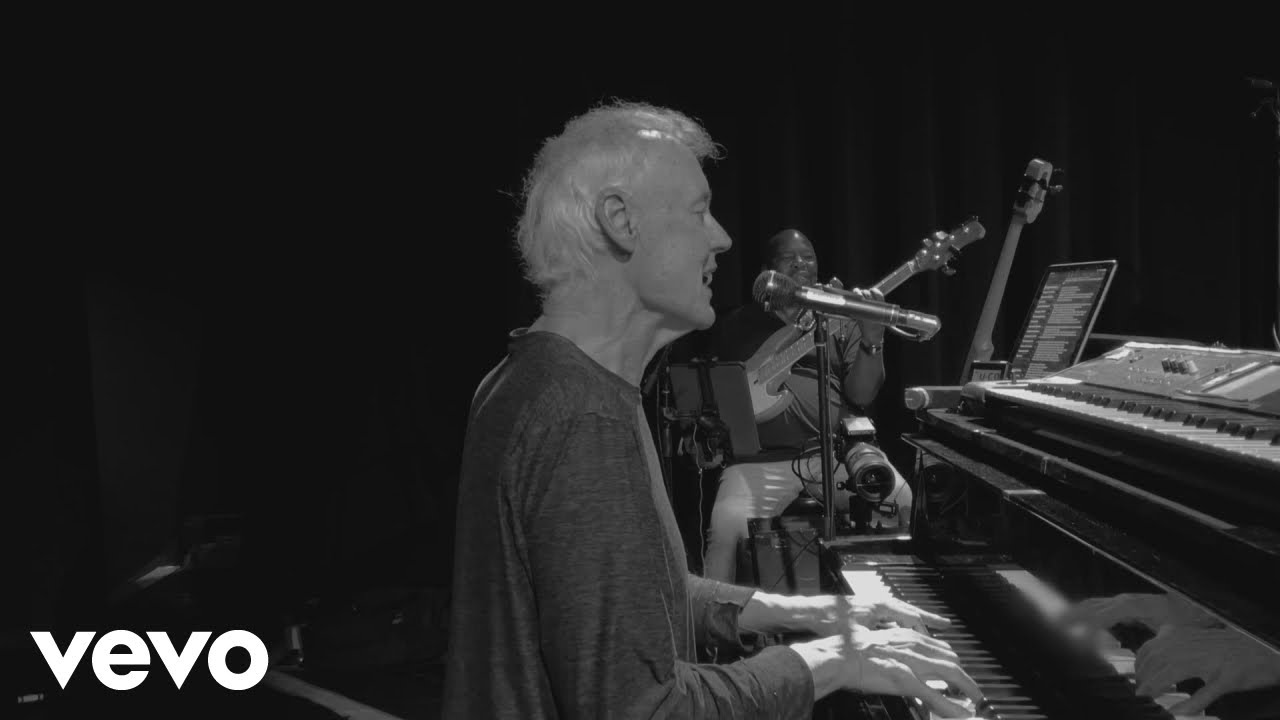
There’s a continuation of Hornsby’s creative connection to the Dead on his new album Indigo Park, with two songs – Alabama and Might As Well Be Me, Florinda – co-written by Robert Hunter, who passed away in 2019. Hornsby says the collaboration with the reclusive poet-lyricist was a virtual one.
“I never saw him. Not once,” he recalls. “I’d tell him: ‘Hey, I’m coming to town to play in the San Francisco area.’ He’d write me something that said: ‘I only go out for doctors’ visits now. I hardly ever leave the house.’ Anyway, we wrote five songs together, and I cherish them.” Florinda also features the recently passed Dead guitarist Bob Weir on guest vocals.
Another enduring musical link is with Bonnie Raitt. In 1989, Hornsby played on her mid-career comeback album Nick Of Time, playing piano on the Grammy-winning ballad I Can’t Make You Love Me. “They had the songwriter’s demo, by Mike Reid. It was very simple. So I learned the song, and I changed a bit of it to suit my style, I guess you could say. The way I move through the chords, the left hand moves in harmony with the right hand melody. And like so many records that end up being iconic and timeless, it was done very quickly.”
In a piece that this writer did about that song, Mike Reid told me: “Hornsby really played the piano part through his signature filter, and that kicked it up to another level”.
Raitt and Hornsby did two takes and that was it.
As a tribute to Raitt, Hornsby regularly performs the song in his own concerts now. Raitt returned the favour on Indigo Park, adding vocals to Ecstatic.
Hornsby considers Raitt to be one of his few contemporaries who are continuing to evolve.
“When you see her live,” he says, “she will give you what you came for – the old favourites – but she’ll play her modern music too. For instance, Just Like That, the one she won a Song Of The Year Grammy for a couple years ago. That’s a different sound. It’s kind of a folky song, which is not something she’s done a lot. But it’s beautiful. I think, in her own way, she’s pushing her form.”
After a decade in Los Angeles, Hornsby moved back east to his native Williamsburg, Virginia, where he and his wife Kathy still live today.
“It’s hardly a musical Mecca,” he says, “but I love where I live. It’s funny, I can go to LA now and enjoy it more than ever, because it’s populated by all these younger musicians that I hang with – Blake Mills, Ezra Koenig, Chris Dave, Ariel Rechtshaid. I could easily move back and be completely consumed with music, hanging out in hipsterville – Los Feliz, Echo Park – with all these guys.”
But recording Indigo Park with them provided just the musical jolt Hornsby needed: “I’ve found a path to grow old gracefully, with help from some newborn friends.”
Indigo Park continues a particularly productive period for him. Looking back at the past six years, he says he realised he’s “been writing and recording music at a near-constant clip”. And the albums that came out of that were all furthering his mission to find new collaborators and “learn new things”. Among those are Absolute Zero (collaborations with Justin Vernon of Bon Iver, and veteran jazz drummer Jack DeJohnette); Non-Secure Connection (James Mercer of The Shins, Jamila Woods, Leon Russell); ’Flicted (Ezra Koenig, Danielle Haim); the water-themed concept album Deep Sea Vents, which paired his songwriting with the avant-garde chamber group yMusic.
“I know that these records may not be for everyone,” he says. “But it’s always been the prison that an old-time nostalgic fan wants to hold you in – the prison of making the same record over and over. I’m trying to push the form and find new ways of writing a popular song.”
And what does he hope his fans will take from Indigo Park?
“I hope I’m not pissing off too many of my old fans, but I probably am,” he says with a smile. “But really, I hope that they’ll discern an attempt at deep musicianship that also has a bit of a lighter element, along with something of some depth – a bit of folk music-meets-some of the more dissonant modern classical areas out there. Mostly, I just hope that something moves them. There are several songs on this record that gave me chills while I was writing them. And that’s what I would wish for any record I’ve ever made. That it moves me, and, in turn, that people are moved by it.”
Indigo Park is out now via Zappo Productions/Thirty Tigers.

