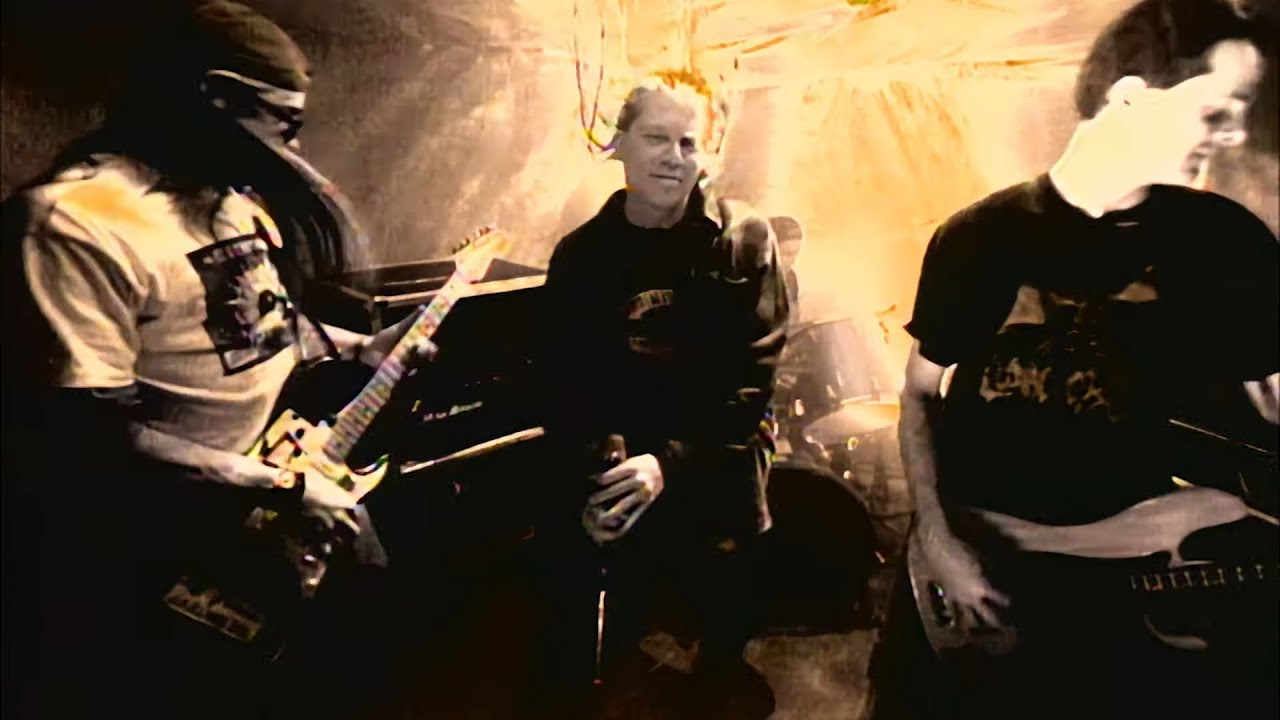
In the early 1990s, Brian 'Dexter' Holland was living a double life. During daylight hours, Holland was pursuing a Ph.D. in molecular biology at University of Southern California in Los Angeles, while in the evenings, he'd rehearse and play shows with his punk rock band, The Offspring. His bandmates had jobs - guitarist Kevin 'Noodles' Wasserman was the Head Custodian (aka janitor) at Earl Warren Elementary School while bassist Gregory 'Greg K.' Kriesel worked in a print shop - and although the band were signed to Bad Religion guitarist Brett Gurewitz's Epitaph Records label, The Offspring's status as a part-time band meant that they didn't employ a manager.
While commuting to college on the city's south side in his "shitty car", Holland would drive through Watts and South Central, two neighbourhoods blighted by poverty, racial tensions, and gang violence between street gangs the Crips, and the Bloods. His observations on the spiralling death toll on the streets of "gangland central" were poured into lyrics for a new Offspring song, Come Out And Play.
"The lyrics for Come Out and Play... were just about whatever was happening in front of me," Holland recalled to Rolling Stone. "I was there the day of the L.A. riots. So I was very aware of that part of the world."
While one of the song's key lyrics "gotta keep 'em separated" might seem like a worried suburban white boy's naive plea for the warring factions in Los Angeles' most troubled neighbourhoods to be kept apart, it was actually inspired by Holland's studies.
One day at university, he took two flasks of chemicals out of an autoclave and was waiting impatiently for the liquids to cool down.
"I thought, These things are never going to cool off. I’ve got to keep ’em separated'," he recalled while speaking with ASBMBTODAY, the magazine of the American society for biochemistry and molecular biology in 2014. "It was literally a biology inspiration."
"The riff... we both loved the surf guitar thing, especially Dick Dale, and that harks back to Orange County surfing in the 60s," Holland told Total Guitar. "We also got a kick out of the Middle Eastern melodies, which was similar in a way. We’d messed around with parts like that for years, such as on Blackball [on debut album The Offspring], but this just worked."
Come Out And Play was one of 14 new Offspring songs recorded for the band's third album during January and February 1994 at Track Records in North Hollywood. The collection, titled Smash, was instantly recognised by its creators, and those closest to them, as a major step up from 1992's Ignition album.
"During Ignition, the band really came into our own and defined what our sound was going to be," Dexter Holland told the LA Times. “But Smash was a better batch of songs."
After listening to the final mixes of the record, recorded for $20,000, Brett Gurewitz, the owner of Epitaph Records, came home to his wife and stated, “Everything’s changed. We’re going to be rich.”
Smash emerged via Epitaph on April 8, 1994, its release hugely overshadowed by the discovery, that same day, of Nirvana frontman Kurt Cobain's lifeless body in Seattle, Washington. But with the August release of Come Out And Play the album began to gain some traction, particularly when MTV picked up on the video that the quartet filmed for $5,000 in a friend's garage.
"So then it was like, 'Okay, you’re on MTV, you’re on the radio, go hit the road'," Dexter Holland told Rolling Stone. "So we played all the 500-seaters across the country. And by the time we got back home from doing that, Come Out and Play was over and [Smash's second single] Self Esteem was hitting and it was, 'Now you’ve gotta go out and do the small theaters.' So we did the whole country again, this time the 1,500-seaters. By the end we were playing 5,000-seaters. I think we did over 200 shows for that record."
My parents said, You have this great opportunity of getting a grad degree, and you’re throwing it away to go play in a punk rock band?
Dexter Holland
Naturally, playing 200 shows in a year would not have been possible if Holland stayed in 'school' so he made the decision to take a time out from his Ph.D, much to the horror of his both his college advisers and his parents.
"You have this great opportunity of getting a grad degree, and you’re throwing it away to go play in a punk rock band?" Holland recalled his incredulous parents saying. "I think they secretly hoped it was a phase."
Guitarist Noodles also decided to focus full-time on the band in the summer of 1994.
"I promised my boss that I'd finish the school year, and that I wouldn't leave to go on tour if the band was taking off," the guitarist told Ian Winwood for his Californian punk history Smash! "And so we had our video on heavy rotation on MTV, and there I'd be, sweeping up leaves each morning... There'd be high school kids walking through the school grounds watching me work, and pointing at me. They'd say, 'Man, what the hell are you doing? I just saw you on MTV right before I left the house!'"
Optimistically, Epitaph hoped to sell 100,000 copies of Smash, twice as many copies as Ignition had racked up in two years on sale. By the end of 1994, it had sold just south of four million copies in the US alone, peaking at number four on the Billboard 200 chart. Currently it has sold over eleven million copies worldwide, making it the biggest rock album ever released by an independent label.
"If there’s any real legacy to Smash it’s the independent spirit of that record," Noodles told Rolling Stone in 2014. "Because we took on Goliath with Epitaph. Hopefully that has resonated. But who knows?"