


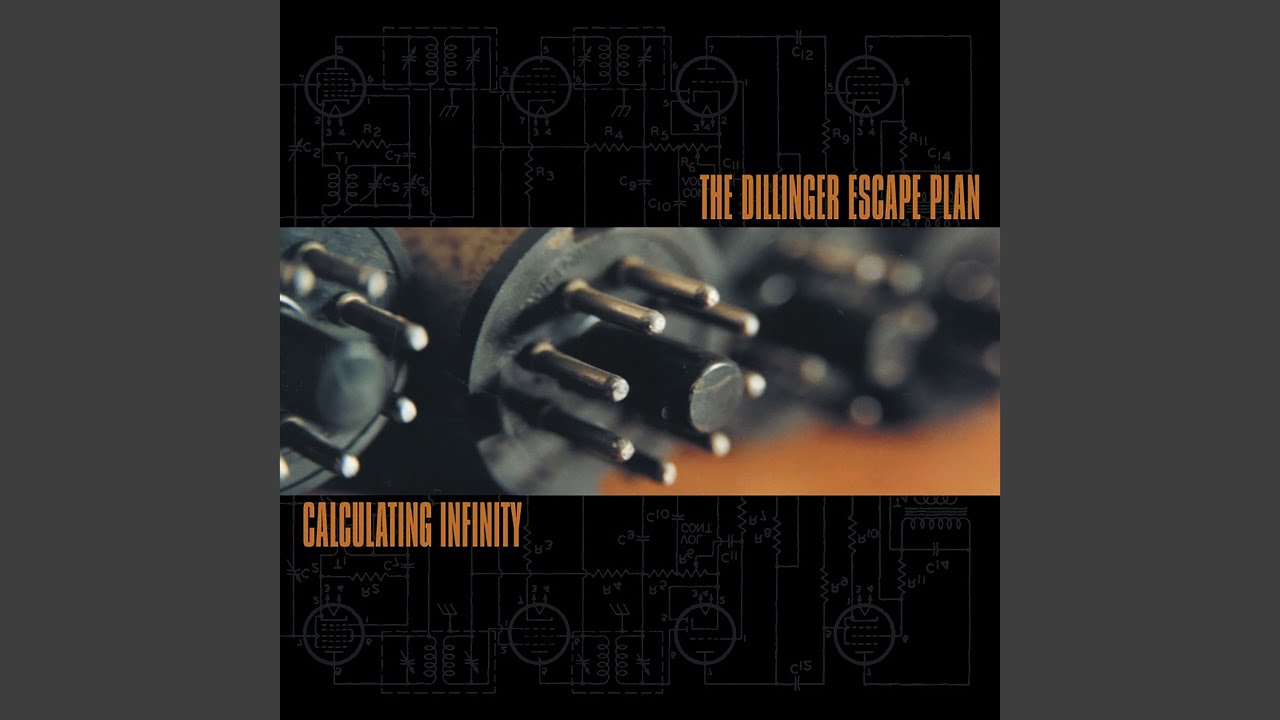
The debut album from The Dillinger Escape Plan, 1999’s Calculating Infinity, was a mathcore masterclass in aggression and technical experimentation that changed the face of heavy music. Brutal, breakneck and unique, its progressive fury spewed out equal measures of brains and bile with animalistic fervour.
Forming in 1997, the Morris Plains, New Jersey quintet had already released two EPs, their self-titled debut and its follow-up Under The Running Board – their first for Relapse. Towards the end of 1999, the band recorded Calculating Infinity with producer Steve Evetts at Trax East in South River, some 40 miles away.
While much of the album was written by Weinman and vocalist Dimitri Minakakis, but Jim Fear is credited solely to the guitarist.
A typically uncompromising, bloodied nose of a song that howled into the void, this song – all two minutes and 22 seconds of it – gave the hardcore scene reason to stop whatever it was doing and make this band their new figureheads. But its inception goes all the way back to Weinman’s childhood, when a chance encounter with a troubled soul set him on the path to artistic independence.
The title of the song is taken from Jim Fear Drive, a road which he’d use to get to his local elementary school.
“That was a place that was really pivotal in me becoming who I am,” says Weinman. "It was that place where I first started socialising with kids and realised that I was different; I really didn’t fall in line, not only with the curriculum that was being forced on us in school, but also the way that people thought.
“What the teachers called daydreaming was me just being creative and thinking about all kinds of deep things that weren’t necessarily typical math problems or things that people equated to intelligence,” he continues. “It didn’t help my self-esteem very much, for people to be constantly telling me that the way I did things or thought was wrong.”
Weinman was around six or seven when he witnessed an escaped inpatient from the nearby Greystone Park Psychiatric Hospital. From the safety of a playground, he watched as the absconder dared motorists to mow him down.
"He was screaming about being in Vietnam and running in front of cars, saying, ‘Hit me, I don’t care! I’ve seen things!'" he explains. "I was in first grade and just stared at him and he ended up coming over and talking to me. I remember realising that the world is such a bigger place than that little neighbourhood and that little street.
“I was little but I didn’t feel scared,” the guitarist adds. “I realised that there was a world out there that I wanted to experience. It definitely had a profound effect on me.”
Jim Fear isn't a simple retelling of his encounter with the Vietnam veteran in the '80s. Rather, it was this life-changing, perception-jarring experience which shaped his worldview, birthing abstract and unsettling lyrics like 'alfresco slapsticked, foam mouth sunshine... throw another crap cake on the stove, Jimmy' years later.
He was screaming about being in Vietnam and running in front of cars, saying, ‘Hit me, I don’t care! I’ve seen things!'
Ben Weinman
“In the earlier days of the band, I wrote a lot of the lyrics," he explains. "I was very hands-on with every aspect of the band, even more than I am today. So everything about this band was an opportunity for me to vent things and express myself in a way that I wouldn’t otherwise be able to.
“I don’t think the song literally talks about that day, but it is definitely inspired by some of the uglier side of things that I saw," he adds. "I think I sensed an opportunity to express myself that most people don’t have. And I really appreciate it, and I think about that and it reminds me not to take this opportunity that I’ve had to be in this band for granted.”
And that local psychiatric hospital? Weinman took the chance to explore the sprawling, abandoned building with a photographer before it was eventually torn down in 2015.
"It was one of those places where they did experiments and electric shock therapy," explains Weinman. "There was so much creepy history in that place, and I’d always wanted to go in there and see it.
"It was the scariest fucking place I have ever seen in my life – hands down," he adds. In the basement, there were still weird old wheelchairs and beds with straps on them. There were dark tunnels that you could never see to the end. There was still a full church in there with stained glass windows, and files of patients still there on the floor. There is no movie set from a horror movie that was close to this place; no-one could create a more chilling, weird setting.”

