


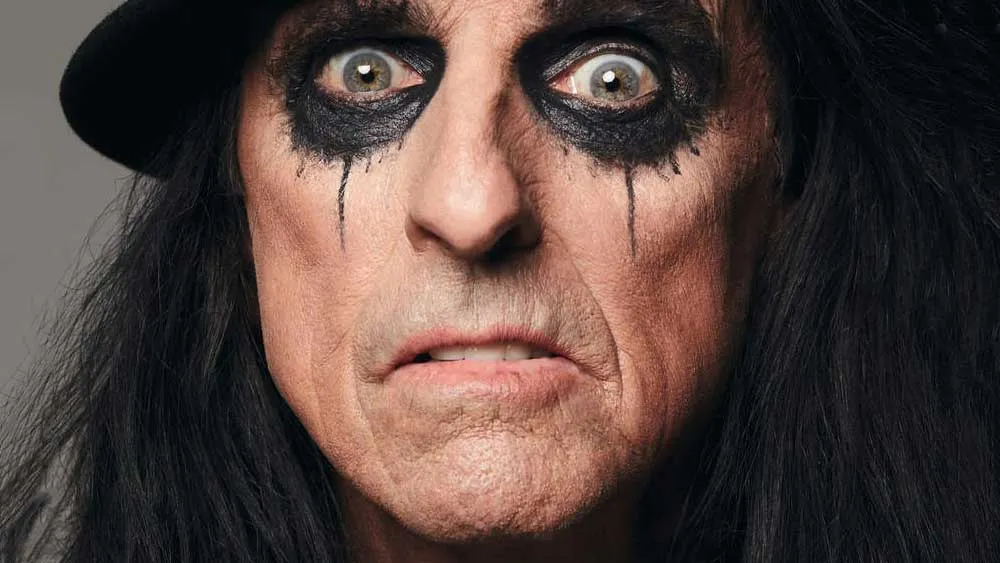
A month into a US tour, we find a newly trim Alice Cooper just minutes away from his nightly beheading in Tupelo, Mississippi.
The septuagenarian shock-rock legend spent the majority of the pandemic’s second year promoting Detroit Stories, his extraordinary return-to-form album, while enthusiastically limbering up for a return to the road that really couldn’t come soon enough.

Might Detroit Stories have been a different record were it not for lockdown?
I don’t think so. We were trying to get all of the aspects of Detroit music in there and still not lose hard rock. Even when we did songs like $1000 High Heeled Shoes, which I wrote as a Motown song, I made sure the guitars and the beat were there. I kept it in the Alice Cooper range even though we certainly did season it towards different things.
After over eighteen months off the road, how was finally hitting the stage again after such an extensive lay-off?
We were so excited about getting back together and hearing it again, getting on stage, getting the levels and all that stuff. It’s a complicated show but it came back surprisingly quickly.
Yours is a long show. Is it a a big ask physically after a year and a half of home comforts and home cooking?
Yeah [laughs]. When I left the tour I weighed a hundred and seventy pounds, which is normal, but I wanted to lose fifteen pounds. Then I got covid in December, had it for a month, and lost fifteen pounds like that. It’s the hardest way to lose it, though. I wouldn’t suggest it. I was just a wreck after about a week. Now I’ve had all three shots and we get tested every night before the show.
In this new world of infectious disease is it difficult to exercise any degree of social distancing while on the road, because, as the main cog in the Alice Cooper touring machine, you have to remain fit?
And I’m not one to sit in my hotel room. I play golf every morning with [Ryan] Roxie, our guitar player and Chuck [Garric, bass]. We know we’ve been tested and it’s just the three of us, then we go back to the hotel until the show, which is the high point of the day.
In the live arena you inhabit the character of Alice, a character that’s a long way away from your relatively mild-mannered off-stage persona, which must be a cathartic experience. Do you find that when you don’t have that release it affects your mood?
That fragments of Alice start to infect your regular personality? No, I can turn Alice on and off at will. I used to be a lot different, when I drank and took drugs I didn’t know where I began and Alice ended. So I was living in that chaos for quite a while.
When I got sober I could separate the two; I could be talking about a movie when the curtain goes up, and in the time I turn from left to right I become Alice. It’s a different posture, brain, look, everything. When the curtain comes back down and the audience isn’t there any more, I’ll go right back into talking about the movie as myself. I can turn the character on and off. That’s something I had to learn to do.
The new show is bookended by Feed My Frankenstein and Teenage Frankenstein. Do you feel something of an affinity for the doctor?
We’ve always associated ourself with being the monster. We were never part of the flow, so I made sure that we made Frankenstein our mascot.
Frankenstein could always dispose of his creature in a pit of molten sulphur or a burning mill, but you have to face yours in the shaving mirror every day.
[Laughs] The Feed My Frankenstein monster character is sewn together bits and pieces from all over the place, and introduces what the show is going to be. It’s going to encompass different pieces from different albums, all sewn together like the monster. Then at the end, when the nine-foot creature comes out for Teenage Frankenstein, it’s a nice capper.
Did teenage years running on your high school track team shape the man you became, and is running still a large part of what keeps you in shape today?
It’s funny you ask about that, because for four months before we tour I run two to three miles a night, and I go right back to my cross country and track workouts. So by the time I get on stage I’m in very good shape. I’m almost seventy-four, and have been very lucky not to have any physical problems, and during the show I feel great.
What does 2022 hold for Alice Cooper?
Well, you know us, we’re road rats, so now things are opening up again… We had to cancel a hundred and eighty shows across seventeen countries, so we’ve a lot of catching up to do.
You’re almost like Bob Dylan now, on that never-ending tour.
I read this article about Dylan recently, and when they asked him when he was going to retire he said: “Put the money aside, I write songs and Ising songs for the audience. That’s what I do and everything else is secondary to that.” And I think the same way.
I did a thing recently with Smokey Robinson, and we said if the promoters only knew we would do this for free [laughs]. There’s such a big difference between having to tour and wanting to tour. I don’t have to tour at all, I just love it.

